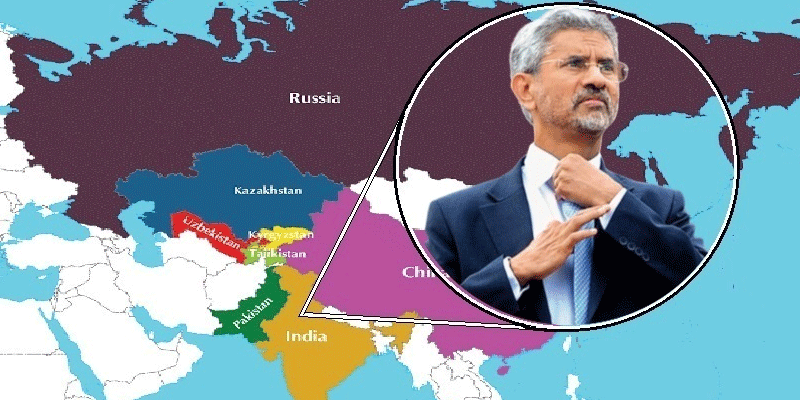
External Affairs Minister S. Jaishankar has said that “India is destined to rise in a very turbulent world”, while stressing that its growing global role will bring greater responsibilities alongside greater influence. Speaking at the Silver Jubilee celebration of the Indian Council of World Affairs (ICWA) in New Delhi, he outlined six issues that will shape Indian diplomacy in the coming decades.
India’s Rise and A Changing Global Order
Jaishankar linked India’s growing economic weight with a wider global footprint, stronger international relationships and greater relevance in global debates. He said diplomacy must remain anchored in peace and development even as the international environment becomes more uncertain. Recent conflicts, trade tensions, technological competition and shifting geopolitical alignments, he noted, are creating new demands on foreign-policy thinking.
He also highlighted the pressures created by tariff volatility and the weakening of established trading arrangements. For India, the challenge is to expand economic engagement while reducing exposure to sudden disruptions and excessive dependence on individual markets or suppliers.
Six Issues Shaping Indian Diplomacy
The first concern is India’s rapid growth and its consequences. A larger economy and expanding global presence will require diplomacy to manage more extensive relationships and a greater role in international decision-making.
The second is the global flow of talent and skills. The movement of professionals, researchers and skilled workers has become an important component of international economic relations, creating opportunities as well as policy challenges for India.
The third is communication and artificial intelligence. Jaishankar pointed to rapid technological transformation as a force capable of reshaping power, economic competitiveness and international interaction. Technology rivalry can fragment the global system, while wider technological diffusion can generate unexpected developments.
The fourth is engagement with the Global South. India’s diplomatic outreach increasingly involves countries across Asia, Africa, Latin America and other developing regions, with cooperation covering development, technology, trade and capacity-building.
The fifth is India’s civilisational identity. Jaishankar indicated that India’s historical experience and intellectual traditions can contribute to international discourse, including concepts such as Vasudhaiva Kutumbakam.
The sixth is strategic autonomy—maintaining independent decision-making while working with multiple partners in an increasingly multipolar environment. Jaishankar has also connected this approach with de-risking, diversification and trusted partnerships in areas such as technology, energy and supply chains.
Strategic Autonomy in A Fragmented World
These priorities acquire added significance amid conflicts in Ukraine and West Asia, changing energy markets, trade disruptions and competition over critical technologies and resources. For India, diversification of economic and strategic relationships can help reduce vulnerabilities while preserving room for independent policy choices.
Connectivity, technology, energy security and resilient supply chains therefore increasingly intersect with diplomacy rather than remaining purely economic concerns.
A Larger India, A More Demanding Diplomacy
Jaishankar’s message was ultimately about the responsibilities accompanying India’s expanding global role. The six issues—growth, talent, technology, the Global South, civilisational identity and strategic autonomy—cover both the material foundations and intellectual dimensions of that rise.
As global power becomes more dispersed and competition more complex, India’s diplomatic challenge will be to convert its growing capabilities into sustained partnerships and influence while retaining policy flexibility. The emphasis on peace, development and strategic autonomy provides the framework; navigating an increasingly turbulent world will determine how effectively that framework translates into international action.
(With agency inputs)