A Historic Visit with Peace at Its Core
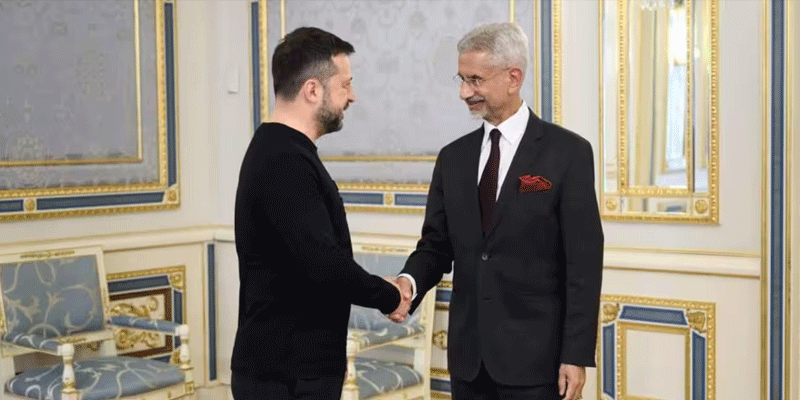
India’s External Affairs Minister S. Jaishankar’s September 3, 2026, visit to Kyiv marked a significant new chapter in India-Ukraine diplomacy. In his first standalone bilateral visit to Ukraine, Jaishankar met President Volodymyr Zelenskyy and Foreign Minister Andrii Sybiha, carrying a clear message: the Russia-Ukraine war must ultimately be resolved through dialogue and diplomacy.
From Strategic Balance to Direct Engagement
India has maintained close relations with Russia while simultaneously developing stronger engagement with Ukraine and Western countries. Prime Minister Narendra Modi’s August 2024 visit to Kyiv had signalled New Delhi’s willingness to engage directly with Ukraine. Jaishankar’s latest trip takes that approach further, coming as international efforts to revive negotiations gather renewed attention.
The timing is particularly important because India continues to face international pressure over its purchases of Russian energy. In Kyiv, Jaishankar defended New Delhi’s position, arguing that the conflict cannot be ended simply by deciding who buys or does not buy Russian oil. He maintained that diplomacy and negotiations—not economic pressure on individual countries—remain the pathway to peace.
Jaishankar’s Message: Diplomacy Must Prevail
Jaishankar reiterated India’s longstanding belief that “this is not an era of war” and said India was prepared to contribute in any manner possible to efforts aimed at ending the conflict. His approach sought to acknowledge Ukraine’s security concerns without abandoning India’s strategic autonomy or its relationship with Moscow.
The discussions also extended beyond battlefield politics. Black Sea security, attacks affecting civilian shipping, port infrastructure and global food supplies featured prominently. These concerns have implications well beyond Ukraine, particularly for international trade and maritime stability.
A Wider India-Ukraine Partnership Takes Shape
The two sides also sought to strengthen practical bilateral cooperation in education, healthcare, agriculture, digitalisation, innovation, scientific and technological collaboration, diplomatic training and university exchanges. With bilateral trade estimated at around $2.6 billion, India and Ukraine also agreed to work towards convening their intergovernmental economic commission and identifying priority areas including energy, infrastructure, transport, pharmaceuticals and machine-building.
Zelenskyy Welcomes India’s Engagement
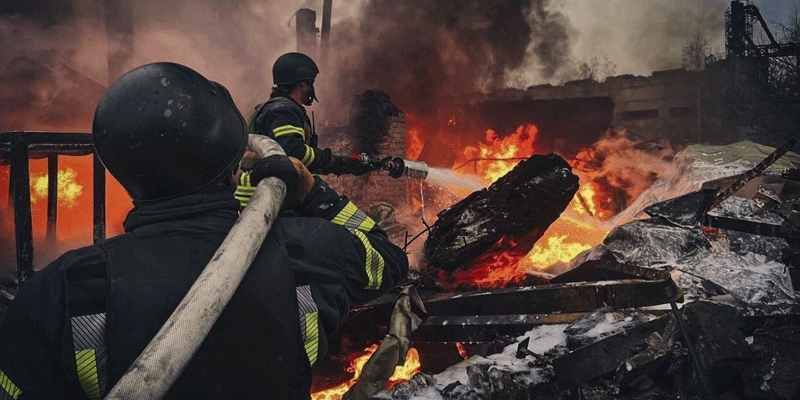
Zelenskyy welcomed Jaishankar’s visit and briefed him on Ukraine’s diplomatic efforts, including contacts involving the United States. The meeting took place against the backdrop of continuing Russian drone and missile attacks, underlining the enormous gap between diplomatic aspirations and realities on the ground. Meanwhile, Zelenskyy said U.S. representatives were expected in Kyiv and Moscow in the coming days, signalling renewed diplomatic activity.
Kyiv Visit Signals India’s Diplomatic Confidence
Jaishankar’s Kyiv mission is therefore more than a bilateral visit. It demonstrates India’s attempt to remain engaged with all major stakeholders while protecting its strategic and energy interests. New Delhi is positioning itself not as a conventional mediator, but as a credible interlocutor capable of communicating with opposing sides.
India Chooses Dialogue Over Polarisation
The Kyiv visit reinforces India’s belief that sustainable peace cannot be achieved through pressure, isolation or economic confrontation alone. Its real significance lies in keeping diplomatic channels open when the battlefield continues to dominate headlines. Whether India can translate this balanced diplomacy into a meaningful contribution to negotiations remains uncertain—but by speaking directly to Kyiv while maintaining dialogue with Moscow, New Delhi is making one message unmistakable: peace will ultimately require diplomacy, and India wants to be part of that conversation.
(With agency inputs)