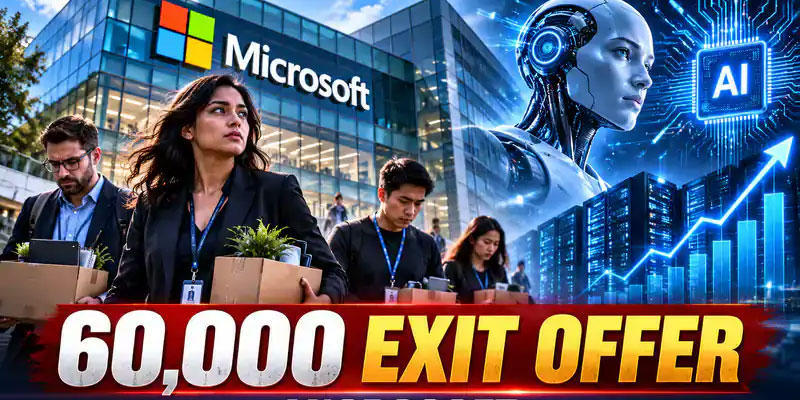
Microsoft’s voluntary exit offer signals a major workforce realignment as the technology giant increases investment in artificial intelligence, cloud computing and data-centre infrastructure. The programme covers eligible employees in India, the United States, the United Kingdom and Canada, offering a negotiated departure option instead of immediate compulsory layoffs. While the initiative gives employees greater choice, it also highlights how the AI boom is reshaping workforce planning across the technology industry.
What Microsoft’s Voluntary Exit Offer Includes
Microsoft Chief People Officer Amy Coleman announced the Voluntary Exit Offer (VEO) in an internal memo on October 26, 2026. The time-limited programme is reportedly open until December 1, with eligible employees receiving individual terms by email.
The package broadly follows Microsoft’s established severance structure, potentially including:
· One month of base salary for every completed year of service.
· Health-insurance support, subject to applicable terms.
· Career-transition assistance.
· Potential extended healthcare and stock-related benefits, depending on eligibility and local rules.
The precise financial value will vary according to tenure, employment terms and country-specific provisions.
Who Is Eligible for the Programme?
The offer reportedly covers employees at internal job level 70 or below in participating business units across the four countries. This includes some senior managers and employees with vice-president titles, but excludes corporate vice-presidents.
Unlike Microsoft’s April 2026 voluntary retirement programme, the new offer reportedly has no minimum age or service requirement, and performance is not an eligibility criterion. However, it does not extend to every employee or business unit, with certain data-centre, sales and marketing roles excluded.
What It Means for Microsoft Employees in India
Indian employees are included, but Microsoft has not publicly disclosed how many of the approximately 60,000 eligible employees are based in India. The programme therefore represents an option for qualifying staff rather than a compulsory exit or a confirmed reduction in India’s workforce.
Employees considering the offer will need to evaluate several factors:
· The total severance payout and applicable tax treatment.
· Health coverage and benefits after departure.
· Treatment of unvested stock awards and other compensation.
· Notice-period requirements and future employment prospects.
The consequences will depend on which teams participate and how many employees accept the offer.
Why Microsoft Is Reshaping Its Workforce
The initiative comes as Microsoft commits substantial resources to AI computing capacity, cloud services and data centres. These investments require significant capital, while AI-assisted workflows are changing how technology companies organise certain operations.
Voluntary departures can help a company adjust staffing levels and reduce costs without immediately resorting to compulsory redundancies. However, the offer alone does not establish which roles will subsequently be reduced or whether further layoffs will follow.
How This Differs from April’s Programme
Microsoft’s earlier voluntary retirement initiative was restricted to eligible US employees. The new offer has a broader international reach and different eligibility criteria, making it a more extensive workforce-adjustment mechanism.
Its eventual impact will depend on acceptance rates, departmental exclusions and the terms offered in each country.
AI Investment Is Reshaping the Technology Workforce
Microsoft’s VEO illustrates the growing connection between investment in AI infrastructure and workforce planning. For India, the immediate question is how many employees qualify and how attractive the local package proves to be.
Ultimately, the programme offers employees a choice while giving Microsoft greater flexibility to redirect resources towards AI. Whether it reduces the need for compulsory layoffs or signals further restructuring will become clearer only after the offer closes and its outcomes emerge.
(With agency inputs)