Haley’s Voice of Influence
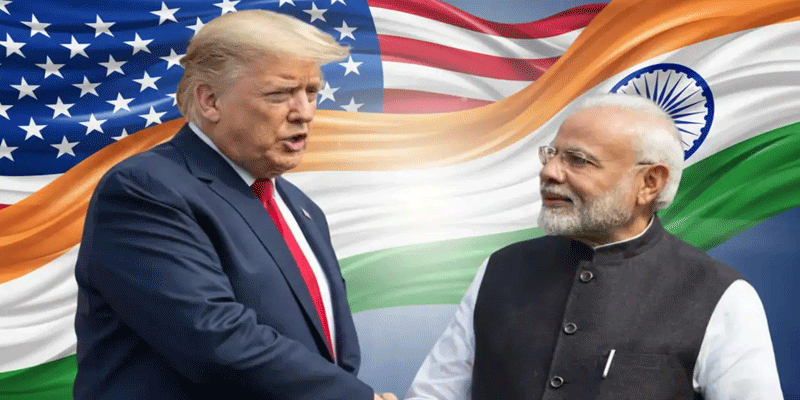
Nikki Haley, former U.S. Ambassador to the United Nations and a prominent Indian American leader, has long been an influential voice in American foreign policy. Though she endorsed Donald Trump’s 2024 presidential run, she has not shied away from critiquing his decisions. Her latest caution is directed at Washington’s escalating tariff war with India, which she believes risks fracturing a vital partnership just when America needs New Delhi most — to counter China’s growing global influence.
Tariffs and Tensions on the Rise
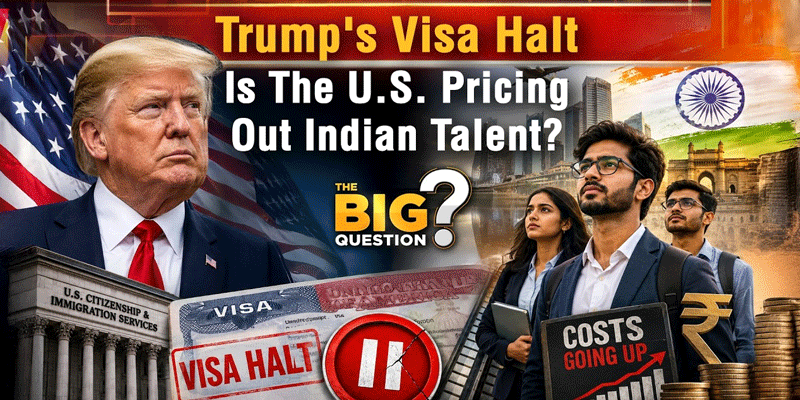
The Trump administration has imposed a 25% tariff on Indian goods and threatened similar duties on crude imports from Russia that flow into India. Together, these penalties could affect nearly $50 billion worth of Indian exports, according to India’s Commerce Ministry. The measures were partly justified by Washington as a response to New Delhi’s purchase of discounted Russian oil. Yet, Haley argues this approach is counterproductive, especially when China, one of Russia’s largest oil buyers, has avoided comparable sanctions.
In a sharply worded op-ed for Newsweek, Haley declared that treating India as if it were an adversary, rather than a democratic partner, undermines 25 years of progress in bilateral relations.
India’s Role in Supply Chain Diversification
Haley underscored that India is central to U.S. efforts to restructure global supply chains away from China. As Washington pushes to bring manufacturing back home, India remains uniquely positioned to produce at scale — particularly in industries where the U.S. struggles with competitiveness, such as textiles, low-cost electronics, and solar panels.
“India alone can replicate the scale that China offers,” Haley observed, noting that losing Indian cooperation would not only slow diversification but also leave the U.S. more dependent on Chinese supply chains — the very opposite of America’s stated strategic goals.
Strategic and Defense Dimensions
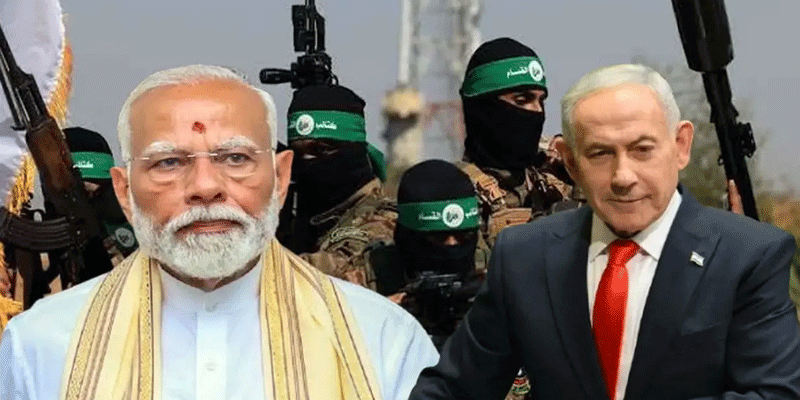
The former ambassador also pointed to India’s expanding defense partnerships with U.S. allies like Israel as evidence of New Delhi’s growing role in global security. India is not just a promising defense market for U.S. equipment but also an indispensable partner in efforts to stabilize the Indo-Pacific.
Haley emphasized that India’s geographic location places it at the center of China’s trade and energy routes. In any major conflict scenario, India’s position could complicate Beijing’s strategic options. She further highlighted India’s increasing engagement in the Middle East, where its presence can support U.S. interests as Washington reduces its own military footprint.
Demographics and Economic Potential
Beyond immediate supply chain and security concerns, Haley stressed India’s long-term demographic and economic advantages. In 2023, India surpassed China as the world’s most populous country. Unlike China’s ageing population, India’s young workforce offers a demographic dividend for decades to come.
As the world’s fastest-growing major economy, India’s rise represents the most consequential geopolitical development since China’s own emergence on the global stage. Haley argued that India’s ascent inherently limits Beijing’s ambitions to reshape the world order. “China’s goals will inevitably shrink as India’s power expands,” she wrote, adding that unlike China, India’s democratic rise does not pose a threat to the free world.
A Critical Junction in U.S.–India Relations
Haley warned that the tariff dispute, combined with disagreements over Washington’s role in India-Pakistan negotiations, has already strained ties close to a breaking point. She described the risk of “scuttling 25 years of momentum” as a self-inflicted wound at a time when both nations need each other more than ever.
Her critique is not rooted in sentimentality but in cold strategic calculation. For the U.S., India represents the only realistic counterbalance to China’s dominance in Asia. For India, U.S. technology, capital, and market access are critical in accelerating its rise. Disrupting this partnership with punitive measures, Haley suggested, would be a “preventable mistake.”
Haley’s Unique Perspective
As the first Indian American to serve in a U.S. presidential cabinet, Haley’s views carry both symbolic and strategic weight. She has lived the immigrant story while shaping policy at the highest levels. Though she ended her own presidential bid earlier this year, her interventions reflect both a personal connection to India and a pragmatic reading of U.S. interests.
Her willingness to challenge Trump, despite endorsing him politically, underscores the seriousness of her concerns: that tariffs and short-term disputes should not derail a relationship that is pivotal to the 21st century.
A Call for Pragmatic Partnership
Haley’s warning is ultimately a call for pragmatism. At a time when the U.S. seeks to outcompete China, strengthen global supply chains, and reduce costly overseas commitments, India is an irreplaceable partner. Alienating New Delhi through tariffs risks isolating Washington, slowing diversification, and weakening America’s strategic posture.
For both democracies, the task ahead is to refocus on shared objectives — from economic cooperation and defense alignment to stabilizing global hotspots. By treating India as a partner rather than a problem, Washington can secure a relationship that not only strengthens both nations but also helps sustain a balance of power in Asia and beyond.
(With agency inputs)