RBI Steps in as Rupee Faces War-Driven Pressure
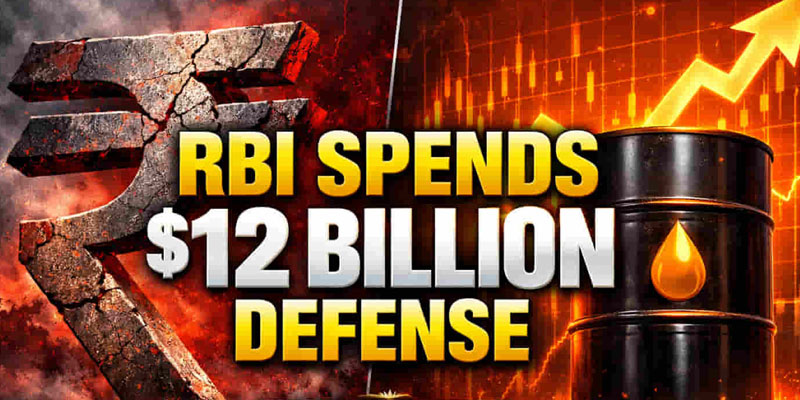
The Reserve Bank of India () has mounted an aggressive defence of the rupee this week, deploying an estimated $12 billion to contain the fallout from the escalating Middle East conflict that has rattled global markets. According to seven bankers familiar with the interventions, the central bank stepped in forcefully after the Indian currency plunged to a historic low, reflecting the shockwaves from disruptions in global oil supply and heightened investor risk aversion.
Rupee Slides to Record Levels
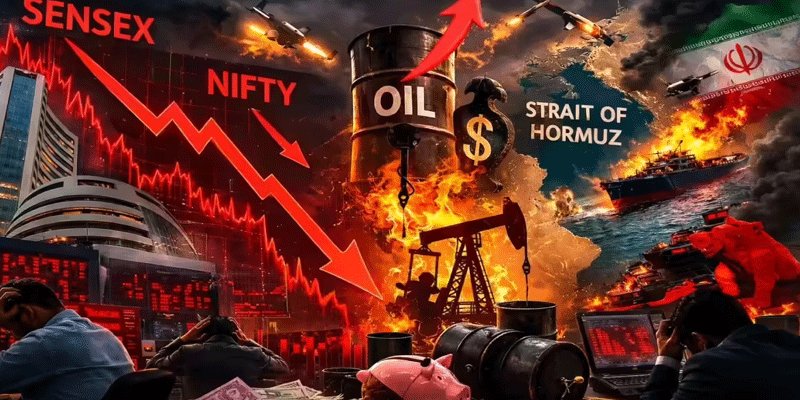
The pressure intensified on March 4 when the rupee breached 92.30 against the US dollar, its weakest level on record. The decline followed a dramatic spike in global oil prices after hostilities in the Gulf threatened shipping routes near the Strait of Hormuz. Brent crude surged more than 16% to above $83 per barrel, raising concerns for India, which imports about 85% of its crude oil needs.
Financial markets reacted swiftly. The benchmark Nifty index saw nearly ₹9.7 lakh crore in market value erased, while foreign institutional investors pulled roughly $2 billion from equities. Importers rushed to hedge their exposure to a weaker currency, amplifying the demand for dollars.
RBI’s Multi-Layered Intervention Strategy
To stabilise the currency, the RBI deployed a broad set of tools across multiple markets—spot transactions, forward contracts, futures, and the offshore non-deliverable forward (NDF) market. The most dramatic intervention occurred on Thursday morning before domestic markets opened. Heavy dollar sales routed through state-run banks briefly pushed the rupee up by 0.64% within minutes, from around 92.10 to 91.57 per dollar.
Thin liquidity in pre-market trading magnified the effect of the intervention, helping shift market sentiment. By Friday, the rupee had stabilised around 91.68, marking a modest but significant rebound after the sharp fall.
India’s large foreign exchange reserves—about $723 billion as of late January—have provided the central bank with considerable firepower. The stockpile covers roughly 11 months of imports, giving policymakers room to counter short-term volatility.
Inflation and Growth Concerns
The currency turmoil has broader economic implications. Rising oil prices could push India’s inflation higher by 200–300 basis points, according to some economists, while economic growth could slow by 0.5 to 1 percentage point if the conflict persists.
Government bond yields have already begun reacting, with the benchmark 10-year G-Sec yield rising to around 6.73%. Policymakers may consider liquidity adjustments or interest-rate guidance to contain inflation expectations if oil prices remain elevated.
Historical Parallels to RBI Interventions
The scale of the current intervention recalls several earlier episodes when the RBI acted decisively to defend the rupee. During the 2022 Russia-Ukraine war, the central bank reportedly sold over $100 billion across several months as oil prices soared and the rupee weakened toward 81 per dollar.
Earlier crises show similar patterns. The 2013 “taper tantrum”, triggered by the US Federal Reserve’s withdrawal of stimulus, forced the RBI to deploy around $20 billion to stabilise the rupee after it slid from 55 to nearly 68.5 per dollar. During the 2008 global financial crisis, about $50 billion in interventions helped steady the currency amid worldwide financial turmoil.
Compared with those episodes, the current defence is concentrated over a shorter period but backed by a much larger reserve base.
A Delicate Balancing Act
The RBI’s swift response underscores its priority: maintaining orderly market conditions rather than defending a specific exchange rate. While the central bank’s actions have temporarily steadied the rupee, the durability of this stability will depend largely on how long geopolitical tensions keep oil prices elevated.
For now, India’s sizeable reserves and proactive intervention strategy have bought valuable time. Yet if the conflict deepens and crude prices climb toward the $100 mark, the rupee could face renewed pressure—testing both the resilience of markets and the resolve of policymakers.
(With agency inputs)