SpaceX has officially entered the public-equity market, filing for what could become the largest initial public offering (IPO) in history. The company’s long-awaited regulatory filing not only reveals billions of dollars in recent losses but also exposes a governance structure designed to keep founder Elon Musk firmly in control. Through a super-voting share arrangement, Musk is set to retain overwhelming influence over the rocket, satellite, and artificial intelligence giant, effectively insulating himself from shareholder attempts to remove him from power or alter the company’s strategic direction.
A Historic Entry into Public Markets
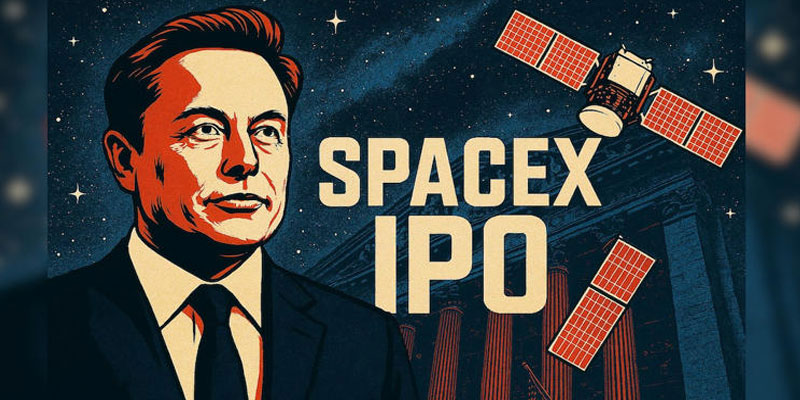
The IPO marks a watershed moment for both SpaceX and global capital markets. Formally known as Space Exploration Technologies Corp., the company has filed its S-1 registration statement with the U.S. Securities and Exchange Commission and plans to list on Nasdaq under the ticker “SPCX.”
The offering is expected to raise between $75 billion and $80 billion, potentially valuing the company at more than $1.7 trillion to $2 trillion. Such a valuation would place SpaceX among the world’s most valuable companies and comfortably surpass the scale of previous record-breaking public listings, including Saudi Aramco’s landmark debut in 2019.
For investors, the IPO represents a rare opportunity to gain direct exposure to a company that has reshaped commercial spaceflight, built a global satellite-internet network, and expanded aggressively into defense and artificial intelligence applications.
Growth at the Cost of Profitability
The prospectus, however, underscores the financial risks accompanying SpaceX’s ambitious growth strategy.
According to the filing, the company reported a net loss of approximately $4.27 billion to $4.28 billion on revenue of $4.69 billion during the first quarter of 2026. This compares with a net loss of about $528 million on roughly $4 billion in revenue during the same period a year earlier.
The widening losses reflect enormous investments in strategic projects such as Starship, the continued expansion of the Starlink satellite constellation, and emerging AI- and defense-related initiatives. The company has also disclosed an accumulated deficit exceeding $40 billion, highlighting the extent to which it has prioritized technological expansion and infrastructure development over short-term profitability.
The Governance Structure Behind Musk’s Power
Perhaps the most consequential aspect of the filing is its corporate-governance framework.
SpaceX will operate under a dual-class share structure, dividing equity into Class A and Class B shares. While public investors will largely receive Class A stock, Class B shares carry substantially greater voting rights. Elon Musk is expected to control roughly 85 per cent of the company’s total voting power through this arrangement.
This effectively gives Musk the ability to block major corporate decisions, resist efforts to replace leadership, and maintain strategic control regardless of shifts in shareholder sentiment. The structure also enables SpaceX to qualify as a controlled company, allowing it to bypass certain Nasdaq governance requirements related to board independence and committee oversight.
A New Era of Founder-Led Capitalism
The SpaceX IPO is far more than a capital-raising exercise; it is a defining test of how public markets value visionary leadership, technological ambition, and concentrated corporate control. While investors may be attracted by the company’s transformative role in space, communications, and AI, they must also recognize that ownership will not necessarily translate into influence. The offering embodies a modern corporate paradox: unprecedented growth opportunities paired with limited shareholder power, ensuring that SpaceX’s future remains closely tied to Elon Musk’s vision for years to come.
(With agency inputs)