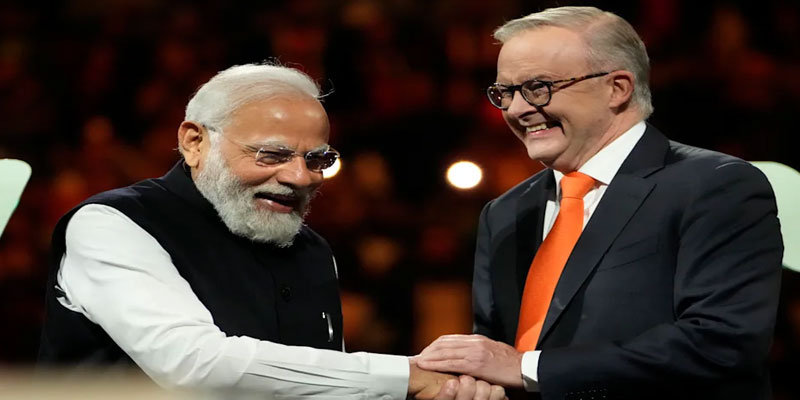
Prime Minister Narendra Modi dominated the front pages of leading Australian newspapers following his landmark visit, reflecting not only the high-profile nature of the trip but also the growing strategic importance of India in Australia's foreign policy. Described prominently by sections of the Australian media as "Mr India", Modi's visit went well beyond diplomatic symbolism. It resulted in a series of substantive agreements spanning civil nuclear cooperation, defence, critical minerals, clean energy, education and cybersecurity, underscoring the emergence of a broader, institutional partnership between two key Indo-Pacific democracies.
A Partnership Entering a New Strategic Phase
India and Australia have steadily strengthened bilateral ties over the past decade through growing economic engagement, defence cooperation and shared strategic interests in maintaining a free, open and rules-based Indo-Pacific. The relationship has evolved from one centred primarily on trade and education into a comprehensive strategic partnership driven by geopolitical realities, supply-chain resilience and energy security.
Against this backdrop, Prime Minister Modi's visit came at a crucial time as Australia seeks to diversify its international partnerships amid changing regional dynamics. India, with its rapidly expanding economy, growing defence capabilities and ambitious clean energy agenda, has emerged as one of Canberra's most important long-term strategic partners.
A Visit That Delivered Tangible Strategic Outcomes
One of the defining features of the visit was the breadth of agreements concluded between the two countries. India and Australia announced or advanced cooperation across civil nuclear energy, maritime security, defence innovation, cybersecurity, education, research collaboration and critical minerals, with a total of 18 key outcomes highlighting the comprehensive nature of the engagement.
The civil nuclear cooperation framework represents one of the most significant achievements. Australia's commitment to facilitate uranium exports under established safeguards strengthens India's long-term energy security by supporting the expansion of low-carbon baseload electricity generation while reducing dependence on fossil fuels.
Equally important is the enhanced partnership on critical minerals. Australia possesses some of the world's largest reserves of lithium, cobalt and rare earth elements essential for batteries, electric vehicles, renewable energy infrastructure and advanced manufacturing. Greater collaboration provides India with reliable access to these strategic resources while offering Australia a rapidly expanding industrial market.
Energy Security and Indo-Pacific Cooperation Gain Momentum
The partnership extends well beyond uranium supplies. Both governments reaffirmed cooperation in renewable energy, green hydrogen, clean technologies and broader energy security, reflecting a shared commitment to accelerating the global energy transition.
For India, these collaborations complement domestic initiatives aimed at expanding solar manufacturing, battery production, electric mobility and green hydrogen development. Access to Australia's mineral resources and technological expertise could significantly strengthen India's industrial competitiveness while enhancing supply-chain resilience.
The visit also reinforced defence and maritime cooperation. As Indo-Pacific security challenges become increasingly complex, closer naval collaboration, defence innovation, cyber resilience and intelligence sharing deepen the operational dimension of the bilateral relationship. Both nations continue to support a stable regional order based on international law, freedom of navigation and secure maritime trade routes.
The extensive media attention surrounding Modi's visit further reflects Australia's recognition of India's growing geopolitical influence. Prominent newspaper coverage symbolised a relationship that has moved beyond conventional diplomacy towards long-term strategic engagement.
A Partnership Built for the Future
Prime Minister Modi's Australia visit marks an important milestone in the evolution of India-Australia relations. By translating political goodwill into concrete cooperation across energy, critical minerals, defence, technology and education, both countries have strengthened the institutional foundations of their partnership. As geopolitical competition, energy transition and supply-chain diversification continue to reshape the Indo-Pacific, this deeper strategic relationship positions India and Australia to jointly address emerging regional and global challenges while creating long-term opportunities for sustainable economic and security cooperation.
(With agency inputs)