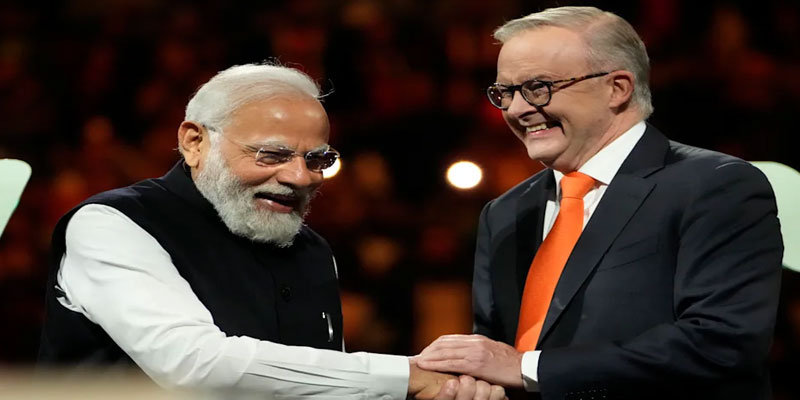
Ahead of Prime Minister Narendra Modi’s landmark visit to New Zealand, Prime Minister Christopher Luxon made a significant announcement that 57 per cent of New Zealand’s exports to India will become tariff-free from day one under the proposed Free Trade Agreement (FTA). The declaration marks a major step in bilateral economic relations and reflects a shared commitment to deepen trade, investment and strategic cooperation. Beyond tariff reductions, the proposed pact signals a broader effort by both countries to strengthen economic resilience and expand partnerships in an increasingly fragmented global trading landscape.
Importance of India–New Zealand Trade Relations
Although India and New Zealand have maintained cordial diplomatic ties for decades, bilateral trade has remained well below its potential. The two countries possess highly complementary economies—New Zealand is a leading exporter of agricultural products, forestry goods, seafood, horticulture and premium food products, while India offers strengths in pharmaceuticals, textiles, machinery, information technology and professional services.
For India, closer economic engagement with New Zealand supports its broader objective of expanding trade partnerships with developed economies across the Indo-Pacific. For Wellington, India represents one of the world's fastest-growing major markets, offering opportunities to diversify exports beyond traditional destinations and reduce dependence on a limited number of trading partners.
Trade Deal Offers Mutual Economic Gains
The proposed agreement extends well beyond a conventional tariff-cutting exercise. According to New Zealand’s trade framework, 57 per cent of its exports to India would receive tariff-free access immediately, while nearly 95 per cent of current exports are expected to become tariff-free or benefit from substantially lower duties over time.
The agreement would particularly benefit New Zealand's exporters in sectors such as forestry, wool, seafood, horticulture and wine, many of which currently face high Indian tariffs. At the same time, Indian exports—including pharmaceuticals, engineering products, machinery, textiles and manufactured goods—would receive duty-free access to the New Zealand market from the outset, creating new opportunities for Indian businesses.
The arrangement therefore reflects a balanced economic partnership in which both countries seek greater market access while strengthening long-term commercial engagement.
Strategic Importance Beyond Commerce
Prime Minister Modi’s visit carries significance well beyond trade. It is the first official visit by an Indian Prime Minister to New Zealand in nearly four decades, highlighting the growing strategic importance both countries attach to the relationship.
Discussions during the visit are expected to cover investment, maritime security, education, technology, tourism, defence cooperation and regional issues. Strengthening ties with New Zealand also enables India to broaden its strategic engagement across the Indo-Pacific, while New Zealand sees India as an increasingly influential economic and geopolitical partner.
The proposed FTA further includes provisions relating to temporary movement of skilled professionals, working holidays, student mobility and addressing skills shortages. These measures could deepen people-to-people ties while strengthening business networks and educational collaboration.
Challenges and Future Prospects
Despite the optimism, implementation will require careful management of sensitive sectors such as dairy, agriculture and labour mobility. Domestic ratification processes and industry concerns on both sides will also influence the pace of execution.
However, if successfully implemented, the agreement could become a model for India's evolving trade strategy—one that selectively combines economic liberalisation with broader strategic objectives. It also reinforces New Zealand's efforts to diversify its export markets in an increasingly uncertain global economy.
Strengthening Bilateral Cooperation
The proposed India-New Zealand trade agreement represents far more than expanded market access. It reflects a shared vision of building resilient supply chains, strengthening strategic partnerships and promoting sustainable economic growth in the Indo-Pacific. If translated into effective implementation, the pact could redefine bilateral ties, boost investment and mobility, and demonstrate how economic diplomacy can reinforce long-term geopolitical cooperation in an increasingly interconnected yet uncertain global order.
(With agency inputs)