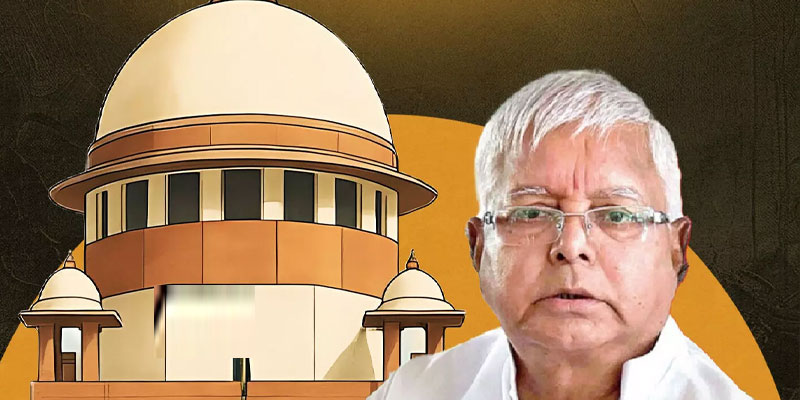
Top Court Declines to Cancel Bail in Fodder Scam
Big relief for Rashtriya Janata Dal (RJD) chief Lalu Prasad Yadav as the Supreme Court has refused to cancel his bail in the Deoghar fodder scam case, allowing him to remain out of prison while his appeal against conviction is heard. However, the ruling does not amount to an acquittal or exoneration. Instead, the apex court has shifted the focus to the substantive criminal appeal by directing the Jharkhand High Court to dispose of the matter within six months, signalling the need for a speedy conclusion to a long-pending legal battle.
The Deoghar Fodder Scam Case
The Deoghar fodder scam is one of several cases arising from the infamous fodder scam, a major corruption scandal that rocked Bihar during the 1990s. The scam involved fraudulent withdrawals of public funds from the state treasury through fake bills generated in the name of animal husbandry departments, resulting in massive financial losses to the exchequer.
Lalu Prasad Yadav, who served as Bihar's Chief Minister during the period, was convicted in the Deoghar case. In 2019, the Jharkhand High Court suspended his sentence and granted him bail while his appeal against the conviction remained pending. The Central Bureau of Investigation (CBI) challenged this relief before the Supreme Court, arguing that the suspension of sentence should be revoked. However, the appeal against the bail order remained unresolved for several years, making the prolonged delay a central issue in the latest proceedings.
Supreme Court's Ruling and Its Significance
The Supreme Court dismissed the CBI's plea seeking cancellation of Lalu Yadav's bail, observing that it was not appropriate to interfere with a relief that had been in operation for nearly seven years. Rather than reopening the question of interim liberty, the Court directed the Jharkhand High Court to decide the pending criminal appeal within six months.
The ruling preserves Lalu Yadav's existing bail but leaves the conviction intact. His legal position, therefore, remains unchanged in substance. He continues to enjoy protection from imprisonment while awaiting the High Court's final determination on whether his conviction should be upheld, modified or set aside.
The judgment also reflects the Court's concern over prolonged delays in criminal appeals. By setting a specific timeline, the apex court has emphasised that interim relief should not substitute for a final judicial determination.
Political and Legal Implications
For Lalu Prasad Yadav and the RJD, the decision provides immediate political breathing space. It removes the uncertainty of possible re-incarceration at a time when Bihar's political landscape remains intensely competitive. The party is likely to portray the order as a favourable judicial outcome, although the Court stopped well short of questioning the underlying conviction.
For the CBI and the wider anti-corruption framework, the case highlights a recurring challenge within India's criminal justice system. Delays in hearing appeals often result in interim relief continuing for extended periods, weakening the perception of timely accountability. The Supreme Court's insistence on a six-month deadline sends a broader message about judicial efficiency and the need to avoid prolonged legal limbo in significant corruption cases.
Procedural Relief, Not Final Vindication
The Supreme Court's decision represents an important procedural victory for Lalu Prasad Yadav but not the end of his legal troubles. By refusing to disturb the existing bail while simultaneously directing the Jharkhand High Court to decide the appeal within a fixed timeframe, the Court has balanced individual liberty with judicial accountability. The ultimate legal and political consequences will now depend on the High Court's verdict, which is expected to bring greater clarity to one of India's most consequential corruption cases.
(With agency inputs)