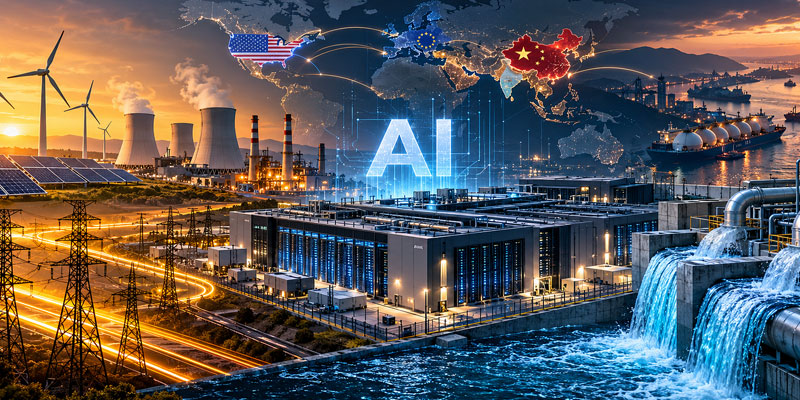
The explosive growth of generative and agentic AI is creating a new infrastructure challenge. AI data centers require enormous amounts of electricity, cooling, water, land and grid capacity. India’s data-center capacity has already expanded from about 375 MW in 2020 to approximately 1,500 MW in 2025, while AI infrastructure investment is accelerating further.
The debate has intensified after the Indian government clarified that AI data centers do not automatically require a standalone environmental clearance. They remain subject to existing environmental rules, and prior clearance can become applicable depending on the nature and scale of the project under the existing EIA framework. This distinction is important: the issue is not that data centers are completely outside environmental regulation, but whether today's framework adequately captures the unique resource intensity of hyperscale AI infrastructure.
Why AI Changes the Equation
Traditional data centers already consume significant resources, but high-density GPU clusters dramatically increase power and cooling requirements. Training frontier models requires enormous compute, while the rise of inference and autonomous AI agents means these machines can operate continuously at very high utilization.
The environmental footprint therefore extends beyond electricity consumption. Regulators need to consider water usage, grid stress, carbon intensity, diesel backup generation, electronic waste, land use and the cumulative impact of multiple data centers concentrated in one region.
This becomes particularly important in water-stressed areas. Cooling technologies can compete with communities and agriculture for freshwater, while electricity demand can force utilities to add fossil-fuel generation if renewable capacity and transmission infrastructure fail to expand quickly enough.
Environmental clearance should therefore not be viewed as an obstacle to India's AI ambitions. Properly designed, it can become a mechanism for ensuring that AI infrastructure grows without creating unsustainable pressure on local resources.
Europe: Measure Before You Expand
The European Union offers an important model. Under its Energy Efficiency Directive, qualifying data centers must report information covering their energy performance and water footprint into a European database. The European Commission is also working toward rating schemes and minimum performance standards for data centers.
This reflects an important principle: governments cannot manage the environmental impact of AI infrastructure if they cannot measure it.
Operators should therefore disclose metrics such as Power Usage Effectiveness (PUE), Water Usage Effectiveness (WUE), renewable-energy sourcing and waste-heat utilization.
Singapore: Growth Within Resource Limits
Singapore provides another useful example. Rather than allowing unlimited data-center expansion, the government says it takes a calibrated approach based on resource constraints and long-term environmental commitments.
Applicants for new capacity are assessed using internationally recognized measures such as power and water usage effectiveness, with the government expecting new facilities to demonstrate best-in-class resource efficiency.
For India, this approach is particularly relevant. Mumbai, Chennai, Hyderabad, Bengaluru, Delhi-NCR and emerging AI hubs cannot treat electricity and water availability as unlimited resources.
From Environmental Clearance to AI Infrastructure Clearance
India does not necessarily need to copy another country's regulatory model. It can create a framework suited to its own ambition of becoming a global AI and cloud infrastructure hub.
Large AI data-center projects could undergo a specialized sustainability assessment covering:
- Total electricity demand and grid impact
- Renewable-energy commitments
- Freshwater and recycled-water consumption
- Cooling technology and WUE
- Carbon emissions and backup generation
- Land, biodiversity and community impact
- Electronic-waste management
- Waste-heat recovery opportunities
- Climate resilience and disaster preparedness
- Annual environmental performance disclosure
Such assessment should be proportionate. A small edge data center should not face the same process as a multi-hundred-megawatt AI campus.
Turn Sustainability Into Competitive Advantage
Environmental regulation can actually strengthen India's competitiveness. Global enterprises increasingly have sustainability commitments covering their supply chains and technology infrastructure. AI capacity powered by renewable energy, using low-water cooling and transparent environmental reporting could command a strategic advantage.
There are also opportunities to rethink the data center itself. Research highlighted by the European Commission suggests waste heat from AI facilities could potentially support applications such as water purification and carbon capture, demonstrating how infrastructure can be designed around circular-economy principles.
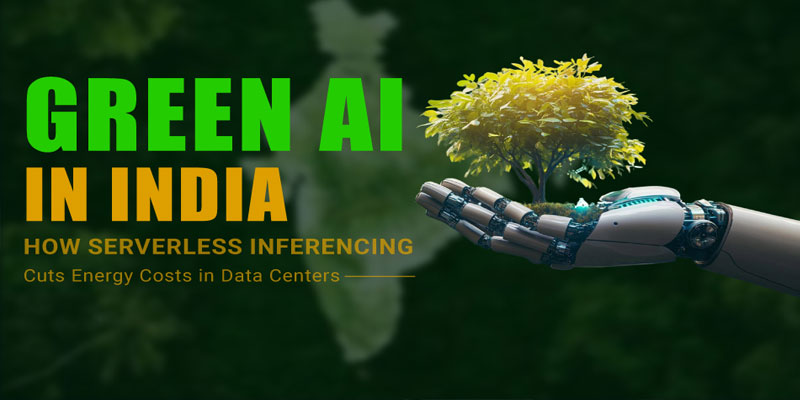
India should therefore pursue Green AI Factories—facilities designed around renewable power, advanced cooling, recycled water, energy-efficient computing and transparent sustainability metrics.
AI Growth Must Be Sustainable Growth
India has a tremendous opportunity to become one of the world's major AI infrastructure destinations. Government policy is actively encouraging cloud and AI infrastructure investment, including measures announced in Budget 2026–27.
But leadership cannot be measured only by GPUs installed, megawatts commissioned or investment attracted.
The best global practices increasingly point toward measuring energy and water consumption, demanding higher efficiency and aligning data-center expansion with resource availability and environmental objectives.
India therefore needs to find the right balance: accelerate AI infrastructure without compromising water security, energy resilience or environmental sustainability.
The future should not be a choice between AI and the environment.
The real opportunity is to make India a global hub for AI infrastructure—and a global benchmark for sustainable AI infrastructure.