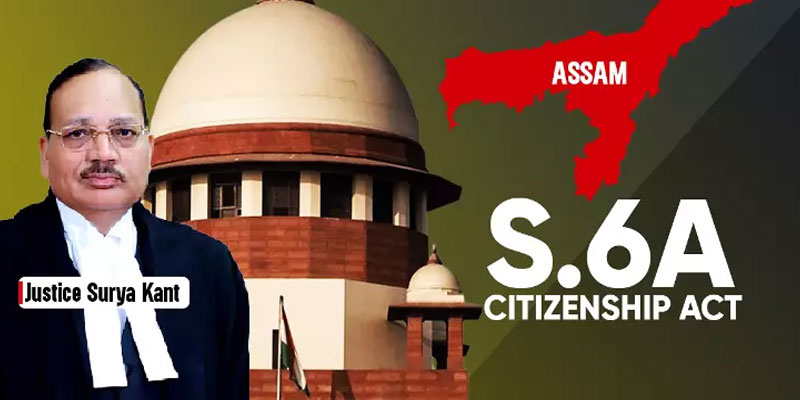
Top Court Sets Aside Foreigner Declarations Against 27 Individuals
The Supreme Court has reaffirmed that fairness, due process, and substantive evidence must remain the cornerstone of citizenship adjudication by setting aside orders that had declared 27 individuals as "foreigners" in Assam. The Court ruled that minor spelling mistakes, typographical errors, or inconsistencies in decades-old official records cannot, by themselves, justify stripping individuals of their citizenship rights. While it did not pronounce on the citizenship status of the petitioners, the Court ordered fresh hearings and directed that no coercive action be taken against them until the cases are reconsidered.
Assam's Complex Citizenship Framework
The dispute stems from Assam's unique citizenship verification system, which has evolved from concerns over illegal migration from Bangladesh. The framework draws its legal foundation from the Assam Accord and Section 6A of the Citizenship Act, a provision that the Supreme Court upheld in 2024.
Under this regime, Foreigners Tribunals determine whether a person is an Indian citizen or an illegal foreigner. An adverse finding can have severe consequences, including detention, loss of legal rights, exclusion from electoral rolls, and the possibility of deportation.
The petitioners argued that they had been declared foreigners primarily because of technical discrepancies in official documents. These included spelling variations in names, typographical errors, and inconsistencies across old voter lists and land records, despite producing legacy documents such as pre-1971 electoral rolls and ancestral land records to establish their Indian lineage.
What the Supreme Court Held
The Supreme Court set aside the decisions of both the Foreigners Tribunals and the Gauhati High Court in the 27 connected cases, directing that the matters be heard afresh. Importantly, the Court clarified that its order should not be interpreted as a declaration of Indian citizenship for the petitioners.
Instead, the judgment focused on correcting procedural deficiencies. The Court stressed that citizenship determinations must be based on a comprehensive evaluation of evidence rather than on isolated clerical mistakes. It emphasized that the burden of ensuring procedural fairness lies with the authorities conducting such inquiries.
This distinction is significant because it preserves the legal framework for identifying illegal migrants while ensuring that genuine citizens are not wrongfully excluded due to administrative imperfections.
Why the Judgment Matters
By recognizing this reality, the Supreme Court has strengthened the principle of procedural justice. The judgment encourages adjudicating authorities to assess the totality of documentary evidence, witness testimony, and family lineage instead of relying excessively on isolated spelling errors or clerical discrepancies.
The decision is also likely to influence future proceedings before Foreigners Tribunals and the Gauhati High Court. If applied consistently, it could establish a more balanced evidentiary standard that minimizes arbitrary exclusions while preserving the state's authority to identify genuine foreign nationals through lawful procedures.
Fairness Must Remain the Foundation of Citizenship
The Supreme Court's ruling represents an important reaffirmation that citizenship cannot be determined through rigid technicalities alone. In a state where questions of identity, migration, and belonging remain deeply sensitive, procedural fairness is essential to maintaining public confidence in the legal system. By insisting that evidence be evaluated holistically and humanely, the Court has reinforced a fundamental constitutional principle: the pursuit of accuracy must never come at the cost of justice, dignity, and due process.
(With agency inputs)