A Defining Moment for an Evolving Partnership
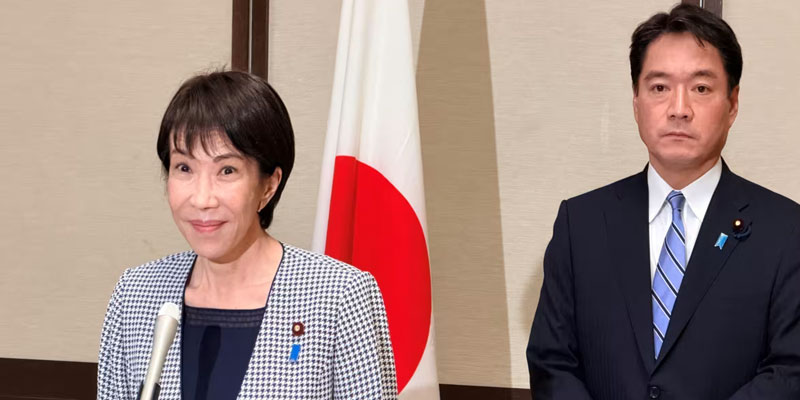
In a high-stakes visit to Tokyo, U.S. President Donald Trump lavished praise on Japan’s first female Prime Minister, Sanae Takaichi, calling her a “leader of wisdom and courage.” Their meeting—rich in symbolism, ceremony, and strategic messaging—underscored the deepening alignment between Washington and Tokyo at a time of shifting power dynamics in the Indo-Pacific. Against the backdrop of China’s expanding influence, the summit reaffirmed that the U.S.–Japan partnership remains central to regional security and economic stability.
A Diplomatic First: Leadership, Legacy, and Gender Milestone
The optics were historic. Trump, long associated with Japan’s previous male leadership, described Takaichi’s rise as “a remarkable milestone in Japanese democracy.” Takaichi, a protege of the late Shinzo Abe, reciprocated the warmth by nominating Trump for the Nobel Peace Prize and presenting him with Abe’s favorite golf putter—a symbolic gesture linking continuity, respect, and shared purpose.
While the event celebrated gender progress in Japan’s political history, it also served a geopolitical purpose: to project the alliance as united, enduring, and forward-looking, capable of adapting to modern challenges without losing its strategic core.
Economic Core: Trade and Investment Reaffirmed
Central to the discussions was the $550 billion trade and investment agreement the two countries signed earlier this year—covering automobiles, agricultural goods, energy, and advanced manufacturing. Though no dramatic new tariff announcements were made, both leaders pledged to deepen commercial engagement and settle long-pending disputes in technology, supply chains, and market access.
Japan reiterated its commitment to invest heavily in U.S. manufacturing, infrastructure, and innovation, reflecting Tokyo’s broader goal of strengthening industrial and energy cooperation. The tone of the talks suggested a shift from transactional negotiations toward structured, mutual growth and long-term strategic alignment.
Critical Minerals Pact: Countering China’s Dominance
Perhaps the most significant outcome of the summit was a new bilateral framework for critical minerals cooperation—a move explicitly designed to reduce dependency on China’s near-monopoly over rare earth elements.
The agreement envisions joint exploration, processing, and stockpiling of key minerals vital for EV batteries, semiconductors, defense systems, and green technologies. Analysts see this as a major step in constructing a trusted G7 supply chain, insulating both economies from geopolitical shocks and export restrictions. While operational details remain under negotiation, the pact sends a clear message: the U.S. and Japan are determined to lead the global “de-risking” effort in high-tech materials.
Defense and Regional Security: Reinforcing Strategic Trust
Security cooperation was another strong pillar of the summit. Trump praised Japan’s decision to raise defense spending to 2% of GDP, framing it as “proof of Japan’s leadership in defending freedom in the Indo-Pacific.”
At a U.S. naval base near Tokyo, both leaders reviewed joint defense operations and discussed enhanced missile defense integration and joint exercises. They reaffirmed the U.S.–Japan Security Treaty and reiterated support for South Korea and Taiwan, signaling unity in the face of regional tensions.
Takaichi also highlighted U.S. mediation efforts in Southeast Asian and Middle Eastern peace talks, reinforcing Washington’s continued relevance as a stabilizing global actor. Their joint meeting with the families of Japanese citizens abducted by North Korea underscored a shared human rights agenda alongside strategic goals.
Analysis: Symbolism Meets Strategic Pragmatism
Though the summit brimmed with personal warmth and historic symbolism, its outcomes were largely incremental but meaningful. The critical minerals framework represents a pragmatic move toward economic security, while the reaffirmation of defense commitments strengthens deterrence in a volatile region.
Trump’s emphasis on reciprocity in trade and defense costs reflects a shift toward partnership based on shared responsibility rather than dependence. The chemistry between Trump and Takaichi has added momentum to a relationship that already stood as a cornerstone of the Indo-Pacific order.
Renewal of an Enduring Alliance
The Trump–Takaichi summit marks more than a ceremonial exchange—it signals a strategic renewal of America’s oldest Pacific alliance. Rooted in history but shaped by present realities, the partnership now combines economic resilience, defense readiness, and diplomatic continuity.
Whether this heralds a “new golden age” or simply a pragmatic evolution, the message is unmistakable: as global power realigns, the U.S. and Japan stand together—modernizing an alliance built on trust, shared interests, and mutual resolve.
(With agency inputs)