Relations between Washington and Tehran have entered a perilous phase, marked by accelerated military preparations, sharpened rhetoric, and shrinking diplomatic space. As memories of past confrontations linger, both sides are signaling readiness rather than restraint. The late-January 2026 surge in threats, deployments, and arms transfers suggests that deterrence—not dialogue—is currently shaping the strategic mindset on both ends of the conflict.
Escalation Without a Safety Net
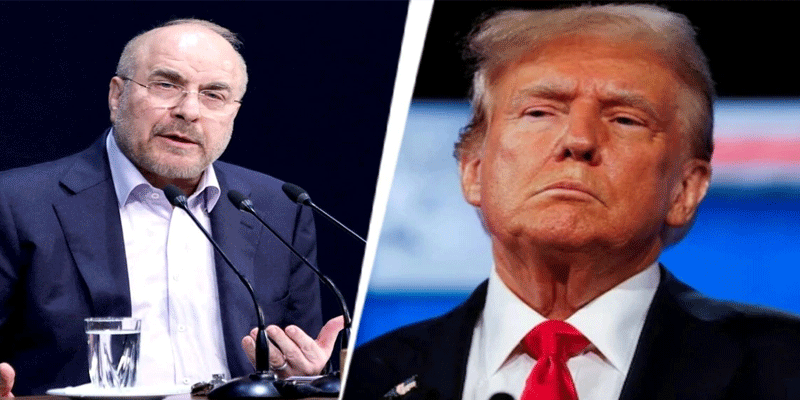
The latest spike in US–Iran tensions reflects a familiar yet increasingly dangerous pattern: military signaling layered over unresolved nuclear disputes and regional proxy wars. President Donald Trump’s renewed threats of overwhelming force, coupled with Iran’s visible investments in asymmetric warfare, have raised fears of a confrontation that could rapidly expand beyond bilateral limits. What distinguishes this moment is the scale of preparedness and the bluntness of official warnings, particularly from Iran’s top leadership circle.
Iran’s Drone Strategy and the US Show of Force
Iran has reportedly integrated approximately 1,000 advanced drones into its military structure, enhancing its strike, surveillance, and electronic warfare capabilities. State-linked media framed the move as defensive, but the scope suggests a clear intent to deter or retaliate against superior conventional forces. The absence of released imagery underscores Tehran’s emphasis on operational secrecy.
Opposite Iran’s build-up, the United States has deployed a formidable naval presence toward the Persian Gulf, including a carrier strike group led by the USS Abraham Lincoln. President Trump publicly framed the deployment as a warning, invoking speed and overwhelming power. He also referenced the 2025 “Operation Midnight Hammer” airstrikes on Iranian nuclear facilities, signaling that any future action would exceed that benchmark unless Tehran accepts stringent nuclear restrictions.
Reinforcing Allies: Arms Sales as Strategic Messaging
Washington has simultaneously moved to reinforce regional partners. The approval of nearly $16 billion in arms sales—advanced helicopters and tactical vehicles for Israel, and Patriot missile systems for Saudi Arabia—serves both practical and symbolic purposes. Militarily, these transfers strengthen air defense and rapid-response capabilities. Politically, they reaffirm US alignment with allies facing Iranian influence, from Israel’s borders to Gulf airspace. Critics, however, argue that such measures may further entrench confrontation rather than deter it.
Supreme Leader Adviser Warnings: Shamkhani’s Red Lines
Central to Tehran’s response has been the rhetoric of Ali Shamkhani, a senior adviser to Supreme Leader Ayatollah Ali Khamenei. In unusually direct language, Shamkhani warned that any US strike—regardless of scale—would be treated as an act of war. He rejected the notion of “limited” military action, insisting that retaliation would be immediate, wide-ranging, and unprecedented, explicitly naming Tel Aviv and the supporters of any aggressor as targets. His message was clear: escalation would not remain contained.
Broader Iranian Messaging and Proxy Dynamics
Shamkhani’s statements align with a wider chorus from Iran’s political and military establishment. Officials linked to the Islamic Revolutionary Guard Corps have issued sweeping threats, while lawmakers have cautioned US partners that miscalculations would dramatically expand Iran’s list of legitimate targets. Foreign Minister Abbas Araghchi reinforced the sense of readiness by stating that Iranian forces remain on constant alert. Meanwhile, allied militias across the region have hinted at missile, drone, and maritime attacks, raising the specter of a multi-front conflict.
Deterrence or Disaster
The current trajectory of US–Iran relations points toward heightened deterrence built on fear rather than trust. While military preparedness may prevent rash action in the short term, the accumulation of forces, weapons, and uncompromising rhetoric increases the risk of miscalculation. With nuclear demands unresolved, regional conflicts unresolved, and communication channels strained, stability now hinges less on strategic superiority and more on whether restraint can re-enter the equation before escalation becomes irreversible.
(With agency inputs)