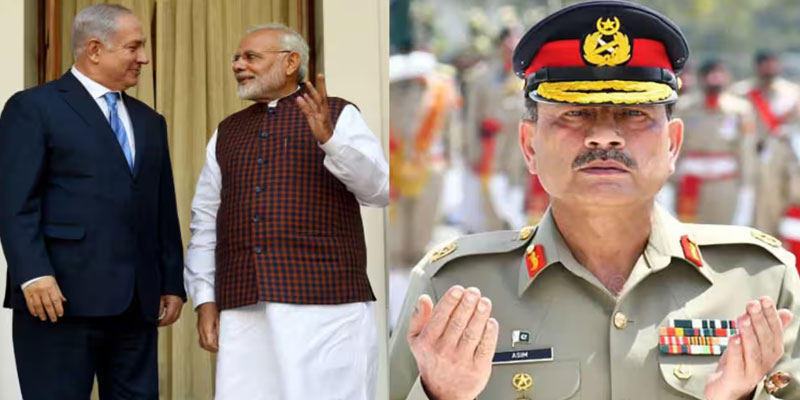
Israeli Prime Minister Benjamin Netanyahu’s proposal for a sweeping “hexagon of alliances” has sent ripples across the Muslim world, with Pakistan reacting most forcefully. Announced on February 23, 2026—just ahead of Indian Prime Minister Narendra Modi’s visit to Tel Aviv—the plan envisions a coalition linking Israel with India, Greece, Cyprus, and select Arab, African, and Asian nations. Netanyahu framed it as a strategic axis against what he termed “radical Shia” and “radical Sunni” forces.
For Islamabad, however, the proposal reads less as strategic architecture and more as a direct geopolitical challenge—one that risks redrawing alignments in ways that unsettle long-standing Islamic solidarities.
Pakistan’s Swift Parliamentary Rebuke
Within 24 hours of Netanyahu’s remarks, Pakistan’s Senate unanimously passed a resolution condemning the proposal. The motion, introduced by PPP Senator Palwasha Mohammad Zai Khan, described the rhetoric as provocative and detrimental to the unity of the Muslim Ummah. The rare unanimity—cutting across government and opposition benches—underscored how deeply the issue resonated domestically.
Pakistan’s leadership framed the Hexagon proposal as part of a broader Israeli pattern, citing moves such as Israel’s recognition of Somaliland as further evidence of attempts to fragment Muslim political cohesion. By elevating the response to parliament and invoking religious solidarity, Islamabad signaled that the matter transcends routine diplomatic disagreement.
India’s Inclusion: A Strategic Red Line
The most sensitive element for Pakistan is India’s explicit inclusion in the proposed alliance. Pakistan does not recognize Israel and has historically positioned itself as a vocal advocate of Palestinian statehood. A formalized India–Israel alignment within a broader regional bloc could symbolically merge two adversarial equations into one.
For Islamabad, the optics are powerful: Modi addressing the Knesset while Israel courts a multilateral alliance that includes India reinforces perceptions of encirclement. Given ongoing India-Pakistan tensions, any strategic deepening between New Delhi and Tel Aviv is closely scrutinized through a security lens. The Hexagon framework, even if aspirational, intensifies those anxieties.
Broader Muslim World Mobilization
Pakistan did not act alone. Alongside 13 other countries and multilateral bodies such as the OIC, the Arab League, and the Gulf Cooperation Council, Islamabad issued a joint statement expressing concern over Netanyahu’s remarks. Foreign Minister Ishaq Dar’s participation in an emergency OIC meeting in Jeddah further demonstrated Pakistan’s strategy of channeling opposition through collective Islamic platforms rather than bilateral confrontation.
This coordinated response highlights how Netanyahu’s framing—explicitly referencing sectarian blocs—struck a nerve beyond South Asia. It also illustrates the enduring sensitivity surrounding alliances perceived to challenge Muslim-majority cohesion.
Strategic Calculus Behind the Hexagon
From Israel’s perspective, the Hexagon proposal aligns with efforts to institutionalize security and technological partnerships across the Eastern Mediterranean and Indo-Pacific. By bringing India into a wider coalition, Israel expands beyond its traditional Western anchor and taps into emerging multipolar alignments.
Yet the rhetoric of ideological blocs risks inflaming sectarian fault lines and hardening opposition. Whether the Hexagon evolves into a formal alliance or remains a strategic concept, it has already reshaped diplomatic discourse.
Alliance or Alarm Bell?
Netanyahu’s Hexagon gambit may have been designed to consolidate partnerships, but it has also galvanized swift pushback from Pakistan and segments of the Muslim world. For Islamabad, the episode reinforces its self-appointed role as defender of Ummah unity. For India and Israel, it underscores the geopolitical sensitivities of deepening ties in a polarized region.
In a world of shifting coalitions, perception can matter as much as policy. The Hexagon proposal—realized or rhetorical—has already altered the conversation.
(With agency inputs)