When the River Reclaims the City
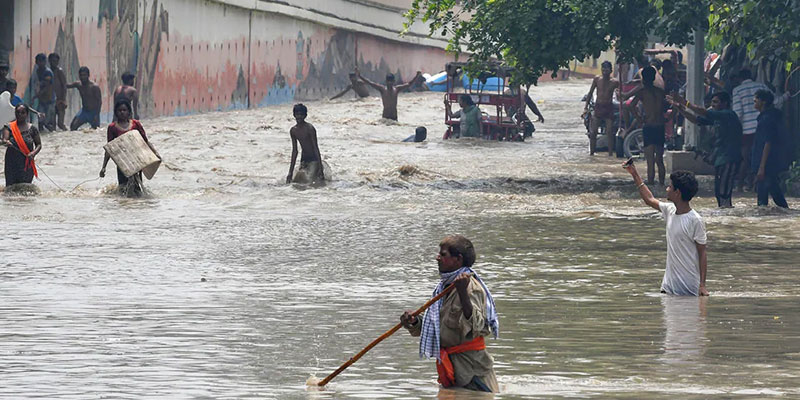
Delhi, a city accustomed to battling traffic and pollution, now finds itself submerged under a different crisis—floodwaters. With relentless monsoon rains lashing North India, the Yamuna River has swelled beyond critical thresholds, forcing large-scale evacuations and sparking memories of the catastrophic floods of 2023. The water level touched 207.39 meters, surpassing the 2013 benchmark and recording the third-highest level in the capital’s history. More than 10,000 residents have been displaced, while waterlogging and transport chaos continue to paralyze daily life.
A City on Alert: Monsoon Rains and IMD Warnings
The India Meteorological Department (IMD) has issued repeated alerts of heavy rainfall with thunderstorms across Delhi, Noida, Gurugram, Ghaziabad, and Faridabad. The capital has been inundated with incessant showers, stretching its fragile infrastructure. Waterlogged streets, gridlocked roads, and stranded commuters have become the norm over recent days.
For the city’s administration, the situation is more than just a downpour problem—it’s a crisis exacerbated by upstream releases from dams and barrages. Officials warn that while the river may stabilize temporarily, the forecast suggests more rain, and the threat of renewed flooding lingers.
Breaching History: The Yamuna Crosses 207 Metres Again
Floods along the Yamuna are not unfamiliar, but their intensity remains alarming. Historical records from Delhi’s Irrigation and Flood Control (I&FC) department reveal that the Yamuna has crossed the 207-metre mark only four times in the last six decades. The most recent—and most devastating—was in July 2023, when the river swelled to an unprecedented 208.66 metres, inundating wide swathes of the capital.
This year’s surge, fueled by both relentless rain and upstream discharges, has already displaced thousands. According to government figures, 8,018 people have been shifted to temporary tents, while another 2,030 have been relocated to permanent shelters. Though the National Disaster Response Force (NDRF) has been deployed, experts caution that any sustained release from upstream could prolong the crisis.
The Hathnikund Factor: Where the Flood Begins
At the heart of Delhi’s swelling waters lies the Hathnikund barrage, situated on the Haryana-Uttar Pradesh border. Heavy rainfall in the upper Himalayan catchments has triggered massive discharges from the barrage, overwhelming the Yamuna downstream.
On Monday, the barrage recorded a staggering release of over 329,000 cusecs—more than double the mid-August peak. The Central Water Commission (CWC) notes that flows above 100,000 cusecs have been continuous since early this week. Given that it takes between 36 to 48 hours for water to travel from Hathnikund to Delhi, Tuesday’s crisis is directly linked to Monday’s surge.
Memories of 2023 remain fresh, when sustained discharges above 100,000 cusecs for five straight days devastated large parts of the capital. While this year’s release is marginally less severe, the risk remains high, particularly with forecasts predicting further rainfall upstream.
Transport and Public Life Disrupted
The flood has not only displaced families but also disrupted public movement. The approach road to Yamuna Bank Metro Station has been closed, even though the station itself remains functional. Authorities have also suspended traffic across the Old Railway Bridge (Loha Pul), a key connection between Shastri Park and Salim Garh Fort.
To prevent river backflow into the drainage system, the I&FC department has sealed multiple regulators, including those at Vijay Ghat and Qudsia. Yet, waterlogging across arterial roads continues to cause severe congestion, further compounding the misery of residents.
Encroached Floodplains Under Threat
Experts warn that the Yamuna’s rise is reclaiming floodplain zones that have been altered or developed in recent years. Beautification projects such as Vasudev Ghat, Asita East and West, Yamuna Vanasthali, Kalindi, and Mayur Vihar parks face the risk of submergence.
According to Bhim Singh Rawat of the South Asia Network on Dams, Rivers and People, while this flood may be less intense than last year’s peak, the reclaiming of encroached floodplains is a reminder that urban development along riverbanks remains highly vulnerable.
Government’s Emergency Response: War Footing Measures
Delhi’s government has launched a comprehensive flood preparedness plan. Irrigation and Flood Control Minister Parvesh Sahib Singh Verma emphasized that officers, engineers, and ground staff are working round the clock, with special attention on flood-prone zones like the Najafgarh Basin.
Resources have been strategically positioned across 82 vulnerable locations:
· Over 550,000 sandbags and 3,400 stones.
· 14,370 wooden planks for reinforcement.
· 58 boats and 675 life jackets for rescues.
· 42 mobile pumps and 10 fixed pumping stations.
· Relief kits and shelters on standby.
The Delhi Jal Board (DJB) has stationed personnel at pumping stations 24/7 to regulate water discharge and prevent sewer backflow. Hourly updates from Hathnikund, Wazirabad, and Okhla are being monitored, with agencies working in close coordination to anticipate the next wave of risk.
Lessons in Preparedness and Resilience
Delhi’s struggle with Yamuna floods underscores a larger truth—urban centers built along rivers cannot afford complacency in the face of climate volatility. While the government’s swift evacuation and preparedness measures have prevented a repeat of last year’s scale of devastation, the crisis is far from over.
Encroachment of floodplains, unchecked urbanization, and dependence on reactive flood control rather than preventive planning continue to expose the city to recurring disasters. In the long run, resilience will demand more than sandbags and shelters—it will require restoring natural floodplains, rethinking city planning, and strengthening cooperation between states on water management.
For now, as families take refuge in shelters and officials race against the rising waters, Delhi is once again reminded that the Yamuna is not just a river to be controlled, but a force of nature that commands respect.
(With agency inputs)