Centre Moves to Strengthen Public Examination Integrity
The Centre is introducing the Public Examinations (Prevention of Unfair Means) Amendment Bill, 2026 in the Lok Sabha today, proposing stringent penalties of up to 10 years' imprisonment and fines of up to ₹50 lakh for paper leaks and the use of unfair means in public examinations. The legislation also seeks to establish fast-track courts and time-bound investigations, signalling the government's determination to restore public confidence in India's examination system amid widespread concerns over recurring exam irregularities.
A Law Born Out of Rising Examination Fraud
India enacted the Public Examinations (Prevention of Unfair Means) Act, 2024 to combat paper leaks, impersonation, tampering of examination processes, and organised cheating syndicates. The law covers several high-stakes recruitment and entrance examinations conducted by agencies such as the Union Public Service Commission (UPSC), Staff Selection Commission (SSC), Railway Recruitment Boards, banking recruitment bodies, and the National Testing Agency (NTA).
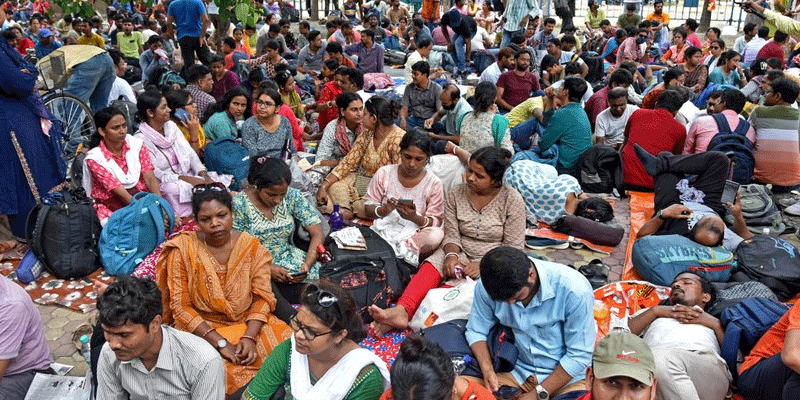
However, continued allegations of question paper leaks and large-scale malpractice, coupled with mounting public dissatisfaction and student protests, have prompted the government to further tighten the legal framework through the proposed amendment.
Key Provisions of the Amendment Bill
The proposed legislation significantly enhances both the severity of punishment and the speed of judicial proceedings.
Under the new provisions, individuals involved in paper leaks or the use of unfair means could face a minimum prison term of five years, extendable to 10 years, along with fines reaching ₹50 lakh. For organised examination fraud involving criminal networks or institutional collusion, the punishment becomes even more stringent, prescribing at least seven years of imprisonment and fines of up to ₹10 crore.
Why the Amendment Holds Significance
The proposed amendments go beyond imposing tougher punishments. Their primary objective is to restore the credibility of India's competitive examination system, which serves as the gateway to government employment and higher education for millions of aspirants.
The government has positioned the legislation as a powerful deterrent against organised cheating syndicates, technology-enabled fraud, insider collusion, and commercial networks that profit from examination leaks. Importantly, the focus remains on dismantling criminal ecosystems rather than criminalising genuine candidates.
Politically, the move also reflects the government's response to sustained public outrage and widespread demands for accountability following recent controversies surrounding examination integrity.
Strong Law, Stronger Implementation Needed
The amendment's greatest strength lies in its emphasis on certainty and speed. Time-bound investigations and dedicated fast-track courts could reduce prolonged litigation and increase the likelihood of timely convictions, thereby strengthening deterrence.
Yet punishment alone cannot eliminate examination fraud. Paper leaks are rarely isolated incidents; they often expose vulnerabilities across the entire examination ecosystem, including printing facilities, logistics chains, digital platforms, cybersecurity systems, insiders, and intermediaries. Unless these structural weaknesses are simultaneously addressed through technological safeguards, institutional accountability, and continuous monitoring, even the toughest legal provisions may have limited impact.
From Deterrence to Lasting Reform
The Public Examinations Amendment Bill represents one of India's strongest legislative attempts to protect the integrity of competitive examinations. By combining harsher penalties with faster investigations and expedited trials, the government seeks to reassure millions of students that merit—not manipulation—will determine success. However, the amendment's true effectiveness will ultimately depend not on the severity of its provisions, but on consistent enforcement, institutional transparency, and comprehensive reforms that close the loopholes enabling examination fraud in the first place.
(With agency inputs)