Ladakh’s Long Standing Demands
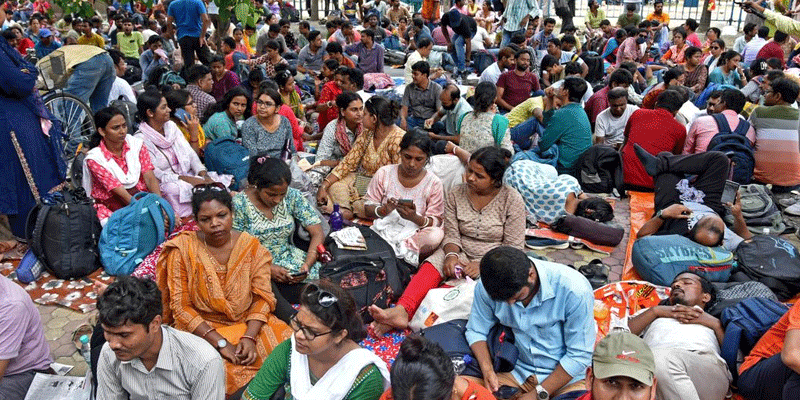
For years, Ladakh has witnessed peaceful agitations demanding full statehood and constitutional safeguards under the Sixth Schedule to protect its fragile ecosystem, land, and culture. What began as a people-led campaign saw a sharp turn this September, when prominent engineer and activist Sonam Wangchuk intensified the movement through a hunger strike that lasted nearly two weeks. His fast was aimed at pressing the Centre to act decisively on Ladakh’s aspirations.
On Friday, Wangchuk was detained in Leh just hours before he was scheduled to virtually address a press conference organized by the Leh Apex Body. His arrest came two days after the Ministry of Home Affairs (MHA) accused him of delivering “provocative speeches” that allegedly incited violent clashes on 24 September. The ministry further claimed that Wangchuk’s references to movements in Nepal and Sri Lanka, as well as his earlier visits abroad, suggested a pattern of agitation-building.
The Director General of Police (Ladakh), S.D. Singh Jamwal, echoed this view, stating that Wangchuk and some Congress members had “incited” the crowd. An FIR under multiple sections of the Bharatiya Nyaya Sanhita (BNS) has been filed, naming Wangchuk and others in connection with rioting and arson cases. Around 40 individuals, including several ex-servicemen, have also been detained.
From Unrest to Curfew, Now Stability
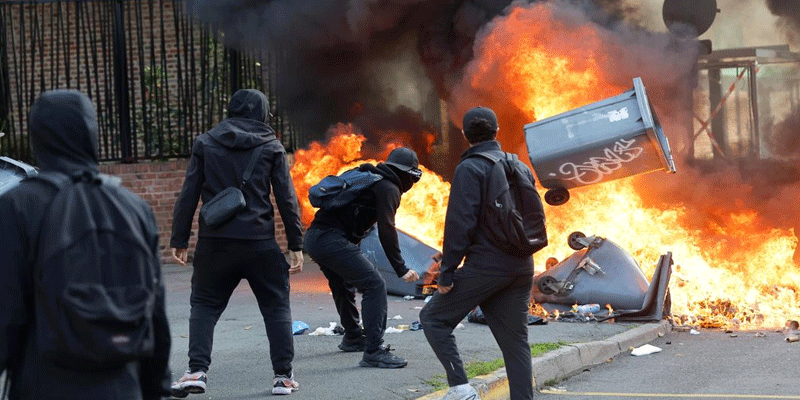
Ladakh briefly descended into turmoil on 24 September when protests demanding statehood and special protections spiraled out of control in Leh. Demonstrators clashed with police, leading to arson at government buildings and the local BJP office. Security forces resorted to tear gas and even live rounds, resulting in at least four deaths and over 70 injuries.
The unrest prompted the administration to impose a curfew in Leh and call for calm. Importantly, since the imposition of restrictions, the region has returned to order. No fresh incidents of violence have been reported, and authorities say the situation is “under control.”
The Ministry’s Position
The MHA maintains that while Ladakh’s concerns are being addressed through dialogue with local leaders, violence cannot be tolerated. It stressed that a high-powered committee with representatives from the region has already secured concessions, and further discussions are underway. The ministry has urged people to remain patient and avoid actions that undermine negotiations.
In parallel, the government has moved against Wangchuk’s NGO, the Students’ Educational and Cultural Movement of Ladakh (SECMOL), by cancelling its licence under the Foreign Contribution (Regulation) Act, citing repeated violations.
Wangchuk’s Defence
Wangchuk, who has long championed non-violence, distanced himself from the clashes, arguing that the violence undermined a peaceful movement built over five years. He appealed to the youth to refrain from aggression and reiterated that Ladakh’s demands could only be achieved through dialogue and peaceful means.
The Road Ahead
The arrest of Sonam Wangchuk has cast a spotlight on Ladakh’s simmering demands, but for now, the streets are calm. With curfew in place and talks between the Centre and Ladakhi leadership continuing, the immediate focus is on preventing a repeat of the recent violence.
The larger question remains: will Ladakh’s demand for statehood and Sixth Schedule status be met through negotiation, or will continued delays only deepen disillusionment? For now, the region is in a fragile but steady calm, waiting for both Delhi and its local leaders to find common ground.
(With agency inputs)