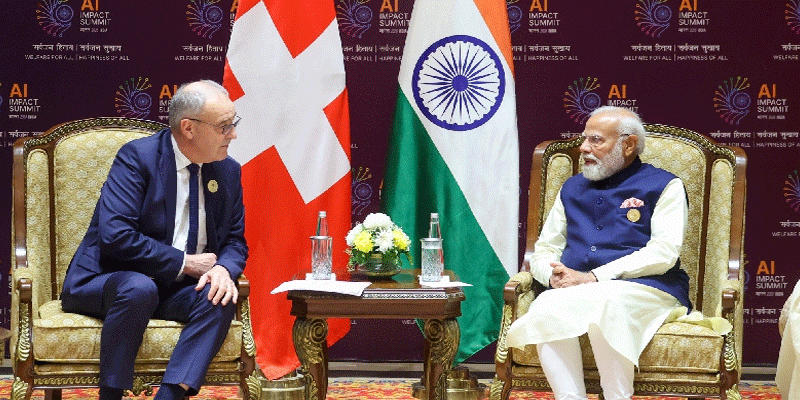
Tight security arrangements, dog squads deployed at Bharat Mandapam, as New Delhi prepares to host one of the year’s most consequential gatherings of emerging and major economies. The 18th BRICS Summit, being held on September 12–13, brings together leaders from the expanded grouping and prominent representatives of partner countries and international institutions, placing India at the centre of global discussions on trade, energy, technology, security and reform of multilateral institutions.
Delhi Fortified for a High-Stakes Summit
Security has been elevated across the capital, with around 15,000 Delhi Police personnel and nearly 200 companies of paramilitary forces deployed. More than 500 CCTV cameras are supporting surveillance, while specialised security teams and dog squads are operating around Bharat Mandapam, hotels, airports and designated movement corridors. Traffic restrictions and route diversions have also been planned to protect visiting leaders while maintaining essential public movement.
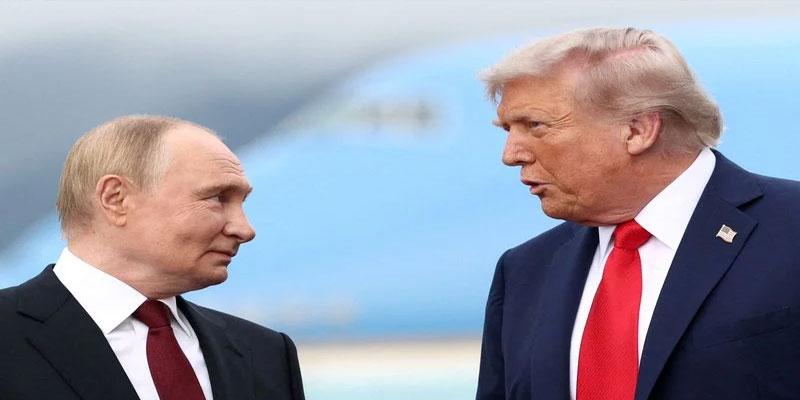
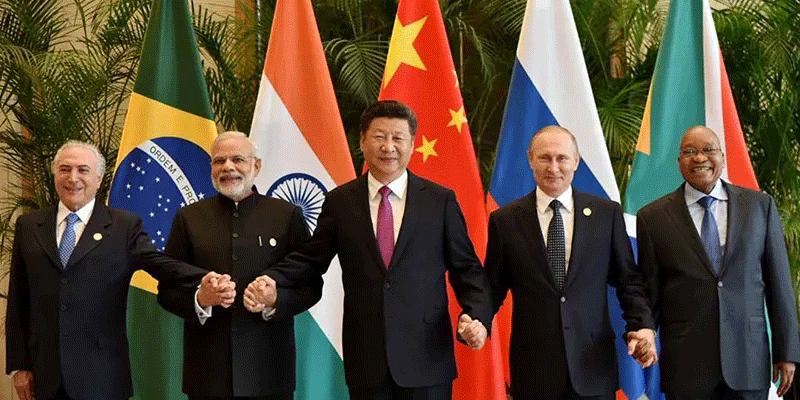
The extensive security architecture reflects the summit’s exceptional diplomatic profile, with India hosting leaders including Vladimir Putin, Xi Jinping and Masoud Pezeshkian amid conflicts in Ukraine and West Asia and growing global economic fragmentation.
From BRIC to a Major Global Platform
BRICS began as BRIC, bringing together Brazil, Russia, India and China, before South Africa joined in 2011. Its subsequent expansion has transformed it into a much broader platform representing major emerging economies across Asia, Africa, the Middle East and Latin America.
The current 11-member grouping includes Brazil, Russia, India, China, South Africa, Egypt, Ethiopia, Iran, Saudi Arabia, the UAE and Indonesia. Its growing economic and demographic weight has given BRICS greater significance in debates over global governance, development finance, trade, technology and the representation of the Global South.
India’s 2026 chairship is built around Resilience, Innovation, Cooperation and Sustainability, with hundreds of meetings and engagements conducted throughout the year.
World Leaders Converge on New Delhi
The wider gathering also includes senior representatives from partner and outreach countries, United Nations Secretary-General Antonio Guterres and New Development Bank President Dilma Rousseff. The presence of such figures expands the summit beyond BRICS members and reinforces India’s effort to connect the grouping with the wider Global South.
India’s Diplomatic Opportunity
India is seeking to make BRICS a practical economic and diplomatic forum, rather than allowing it to become defined solely by opposition to Western influence. Discussions are expected to address trade barriers, investment, cross-border payments, technology, artificial intelligence, energy and food security, critical supply chains and reform of global institutions.
This approach gives New Delhi considerable diplomatic space. India maintains strategic ties with Russia, expanding engagement with the United States and Europe, deepening relationships with Gulf countries and Israel, and important connectivity interests involving Iran.
The summit also provides an opportunity for India to demonstrate its capacity to convene countries with sharply differing geopolitical positions. Modi’s planned interactions with Putin and Xi carry particular importance amid evolving India-Russia ties and efforts to stabilise India-China relations.
From Hosting BRICS to Shaping Its Future
India’s leadership will ultimately be judged not by the scale of the summit or its elaborate security arrangements, but by whether New Delhi can translate BRICS’ growing political weight into practical cooperation. If India can build consensus on trade, technology, energy security, resilient supply chains and stronger representation for developing economies, BRICS can evolve from a powerful coalition into an effective instrument of global economic governance. For India, the summit is therefore more than diplomacy—it is an opportunity to demonstrate that strategic autonomy can also deliver global leadership.
(With agency inputs)