Kejriwal Intensifies Opposition as Gadkari Seeks Legal Relief
The debate over E20 ethanol-blended petrol has intensified, moving beyond fuel stations into the political arena and the courtroom. While Aam Aadmi Party (AAP) National Convener Arvind Kejriwal has launched a nationwide campaign against the Centre's E20 policy, Union Road Transport and Highways Minister Nitin Gadkari has approached the Bombay High Court against allegedly defamatory social media posts and deepfake videos linking him and his family to financial gains from the ethanol blending programme. The twin developments have transformed what began as a policy discussion into a broader contest involving public trust, political accountability and digital misinformation.
Understanding the E20 Fuel Policy
E20 refers to petrol blended with 20% ethanol, a biofuel primarily produced from sugarcane, maize and other agricultural feedstock. The Centre has promoted ethanol blending as a key component of India's clean-energy transition, aiming to reduce dependence on imported crude oil, lower carbon emissions and provide better returns to farmers through increased ethanol production.
However, the policy has also generated concerns among motorists regarding reduced fuel efficiency, compatibility with older vehicles and the limited availability of conventional petrol. Critics have argued that consumers deserve greater flexibility during the transition to higher ethanol blends.
Kejriwal Launches Campaign Against E20 Rollout
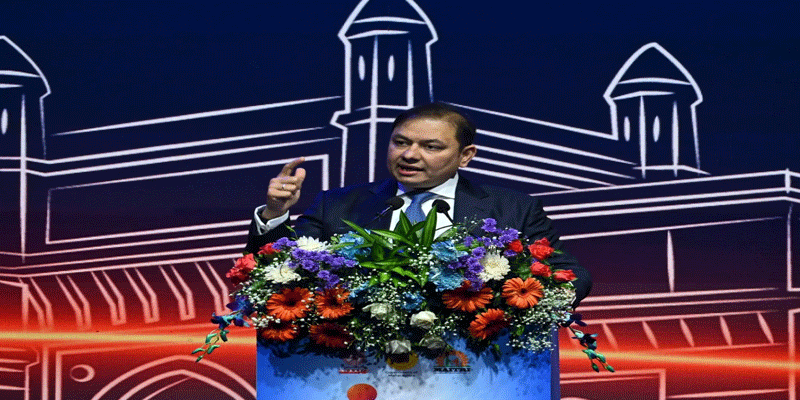
Stepping up the opposition's attack, Arvind Kejriwal has announced a "National Town Hall Against E20" to be held in New Delhi on August 1, presenting it as a citizen-led movement against what he describes as the forced implementation of ethanol-blended fuel.
The campaign follows extensive signature drives and public outreach programmes organised by the AAP. Kejriwal has previously stated that nearly two lakh petitions would be submitted to Prime Minister Narendra Modi, demanding either the rollback of the E20 policy or the continued availability of pure petrol alongside blended fuel, allowing consumers to make an informed choice.
Opposition leaders argue that the Centre accelerated the transition without adequately addressing the concerns of owners of older vehicles. They point to the 2021 NITI Aayog roadmap, which had recommended a phased rollout, gradual expansion of E20 and continued availability of E10 as a protective fuel during the transition period.
Government Defends Policy as Scientifically Valid
The Centre has firmly rejected allegations that E20 causes widespread engine failures or insurance complications. According to the government, ethanol blending has undergone scientific evaluation and forms a critical part of India's strategy for energy security, reduced fossil fuel dependence and lower emissions.
The Petroleum Ministry has also dismissed several viral social media videos and claims alleging engine damage, fuel adulteration and insurance disputes, describing many of them as misleading, inaccurate or lacking credible evidence.
Gadkari’s Legal Action Adds New Dimension
The controversy has now entered the judicial arena. Nitin Gadkari has moved the Bombay High Court against social media posts and deepfake content alleging that he and his family financially benefited from the E20 programme.
Although ethanol blending falls under the jurisdiction of the Ministry of Petroleum and Natural Gas, Gadkari has been one of the government's most prominent public advocates of alternative fuels, including ethanol, biofuels and green mobility. The High Court has permitted him to pursue a civil suit against Meta, other digital platforms and unidentified individuals responsible for the allegedly defamatory content.
The case highlights the growing challenge of deepfakes and misinformation in shaping public opinion around government policies. It also signals that authorities are increasingly prepared to pursue legal remedies against digitally manipulated or defamatory content rather than relying solely on public clarifications.
Balancing Clean Energy with Consumer Confidence
The E20 controversy illustrates the complexities of implementing large-scale energy reforms in a diverse automobile market. While the government's long-term objectives of reducing crude imports, enhancing energy security and promoting cleaner fuels remain strategically important, public acceptance depends on transparent communication, consumer confidence and practical safeguards for existing vehicle owners.
At the same time, the emergence of deepfake campaigns has expanded the debate beyond fuel policy into questions of digital accountability, platform responsibility and reputational protection. As political opposition intensifies and legal proceedings unfold simultaneously, the controversy is becoming a test of both policy execution and information governance.
A Debate Beyond Fuel, Towards Trust and Transparency
The E20 dispute has evolved into more than a disagreement over ethanol-blended petrol. It now represents the intersection of energy policy, political contestation, consumer rights and the growing influence of digital misinformation. While Kejriwal seeks to mobilise public opinion through a nationwide campaign, Gadkari's legal action underscores the government's determination to counter defamatory narratives through the courts. Ultimately, the success of India's ethanol transition will depend not only on scientific and economic merit but also on transparent policymaking, informed public engagement and credible safeguards that inspire confidence among consumers.