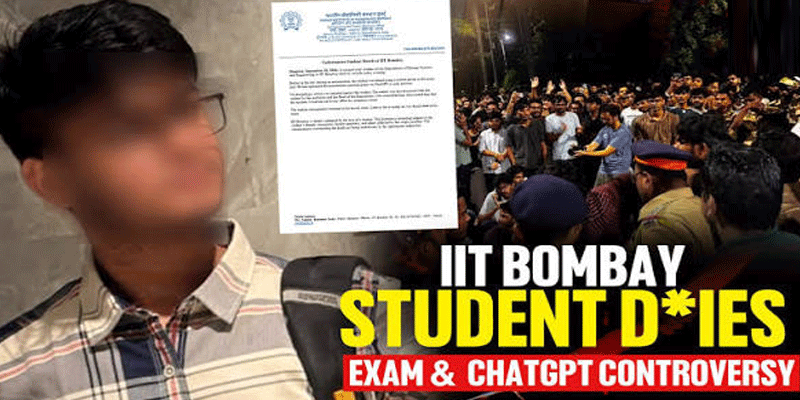
Cheating from ChatGPT, a student’s death, then protests: the sequence at IIT Bombay has triggered a wider debate over academic pressure, disciplinary procedures, mental-health support and institutional accountability. A second-year student, Sahil Wakode, died by suicide on Friday evening after being found using a mobile phone during an examination, according to the institute. His death was followed by protests involving hundreds of students and demands for greater transparency.
Exam Incident and The Student’s Death
According to IIT Bombay’s statement, Wakode, from the Department of Energy Science and Engineering, was found using a phone during a mid-semester examination and had uploaded the question paper to ChatGPT to seek answers. The institute said no disciplinary action was initiated. Instead, the instructor and Head of Department counselled him and assured him that the incident would not adversely affect his academic career.
Wakode subsequently returned to his hostel room and was later found dead. Police have begun investigating the circumstances, with an Accidental Death Report initially filed. The incident has been reported as the third student suicide at the Powai campus within roughly six months.
Why Students Took to The Streets
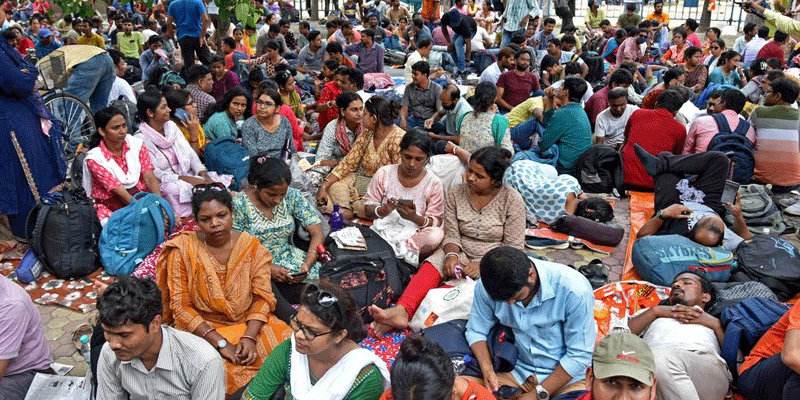
The death quickly developed into a campus-wide protest. More than 400 students gathered, demanding accountability and answers from the administration. The ongoing mid-semester examinations were also postponed amid the unrest.
At the centre of the dispute is a sharp difference between the institute’s account and allegations made by students:
· Institute’s position: No disciplinary proceedings were initiated; Wakode was counselled and assured that his academic career would not be affected.
· Students’ allegation: Wakode was threatened with a possible one-year suspension, which they say could have required him to leave the hostel and potentially delay his degree.
· Unresolved issue: Students argue that the circumstances and communication surrounding the incident require an independent examination. The alleged link between disciplinary pressure and the death has not been independently established.
Protests Expand Beyond One Incident
The demonstrations soon moved beyond the examination episode. Students raised concerns about mental-health services, student representation in decision-making and restrictions on campus spaces.
They called for:
· An independent inquiry into recent student deaths.
· Greater accessibility and effectiveness of mental-health services.
· Mental-health sensitisation for faculty members.
· Stronger student representation in institutional committees.
· A review of campus restrictions affecting common spaces.
· Accountability from senior officials over the handling of the episode.
The institute’s Director, Prof Shireesh Kedare, subsequently told students that a committee would examine both the circumstances surrounding Wakode’s death and the broader concerns raised during the protests.
Parents Raise Serious Allegations
Wakode’s parents have also alleged institutional mistreatment and caste-based discrimination and have demanded a higher-level investigation. These are allegations made by the family and remain subject to investigation; they should not be treated as established findings. Police are recording statements as the inquiry continues.
Beyond Blame, A Test of Institutional Responsibility
The IIT Bombay episode raises difficult questions about how premier institutions respond when academic misconduct intersects with student vulnerability. Establishing what happened requires a transparent investigation rather than assumptions about causation. At the same time, the protests underline a broader concern: disciplinary systems must uphold academic integrity while ensuring that students facing intense pressure have accessible, non-judgmental avenues for support. The outcome of the inquiry will therefore matter not only to Wakode’s family and IIT Bombay, but also to how elite educational institutions approach academic discipline, mental health and student welfare.
(With agency inputs)