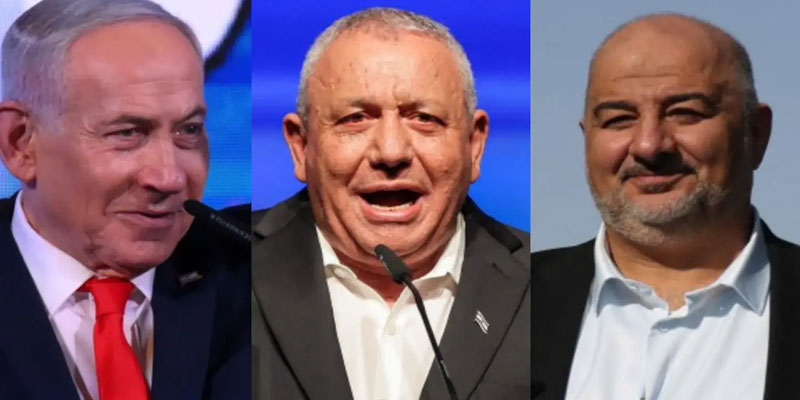
Netanyahu's bloc finishes ahead in Israel, but still short of majority. The election has produced a hung Knesset, leaving Benjamin Netanyahu's political future uncertain despite his Likud party emerging as the largest single party. His right-wing coalition has secured 53 seats in the 120-member parliament, falling eight short of the 61 required to form a government. Meanwhile, opposition leader Gadi Eisenkot's bloc has won 48 seats. With Arab-led parties holding the remaining 19 seats, Israel faces weeks of political negotiations, with several possible outcomes, including a coalition government, power-sharing arrangement or another election.
How Israel Reached This Political Deadlock
The election has exposed deep political divisions within Israel, with neither major political camp securing sufficient parliamentary support to govern independently.
· Netanyahu's right-wing bloc: 53 seats, comprising Likud and its far-right and ultra-Orthodox allies.
· Eisenkot's opposition bloc: 48 seats, comprising Yashar, B'Yachad, Yisrael Beytenu and The Democrats.
· Arab-led parties: 19 seats, divided between the Joint List and Raam.
The strong performance of Arab-led parties, supported by increased voter turnout, has made them potential kingmakers.
Five Possible Outcomes: Who Could Form Government?
The election has opened several possible routes to power, although each presents considerable political challenges.
1. Netanyahu Returns with Right-Wing Coalition
Netanyahu could attempt to expand his existing 53-seat alliance by securing support from at least eight additional lawmakers. However, his opposition to depending on Arab parties makes this route particularly difficult.
2. Eisenkot Forms an Opposition Government
Eisenkot has a potential pathway to 61 seats by securing support from Raam and the Joint List. However, his right-leaning partners, particularly those opposed to relying on Arab parties, could resist such an arrangement. This remains a possible but fragile option.
3. National Unity Government
President Isaac Herzog could encourage Netanyahu and Eisenkot to negotiate a broad-based unity government. A rotating premiership or power-sharing arrangement could offer a compromise. However, their ideological differences and personal political rivalry remain significant obstacles.
4. Minority Government with Outside Support
Eisenkot could attempt to govern without an outright parliamentary majority, relying on Arab-party support or abstentions during confidence votes. Such an arrangement would be vulnerable to political disagreements and could struggle to survive.
5. Another General Election
If coalition negotiations fail and no alternative government secures parliamentary backing within the constitutional timetable, Israel could return to the polls. Given the current political fragmentation, this possibility cannot be ruled out.
What Happens Next?
The newly elected 26th Knesset is scheduled to be sworn in on November 10. President Isaac Herzog will consult political factions before assigning a leader the responsibility of forming the government. Importantly, the largest party's leader does not automatically receive the mandate.
The designated candidate gets 28 days to assemble a coalition, with a possible 14-day extension. If unsuccessful, another candidate may receive the opportunity, while further parliamentary procedures could precede fresh elections.
Political Arithmetic Will Decide Israel's Future
Netanyahu retains the advantage of leading the largest parliamentary bloc and continuing as caretaker prime minister. However, Eisenkot potentially has a more direct numerical route to 61 seats, provided he can reconcile his partners with Arab-party support.
Ultimately, Israel's political future will depend less on which party finished first and more on which leader can build a workable parliamentary majority. A unity government may emerge as a compromise, but if ideological divisions prevail, another election could become unavoidable. For now, Israel faces prolonged political uncertainty at a particularly sensitive moment for its national security, regional diplomacy and domestic stability.
(With agency inputs)