London on Edge
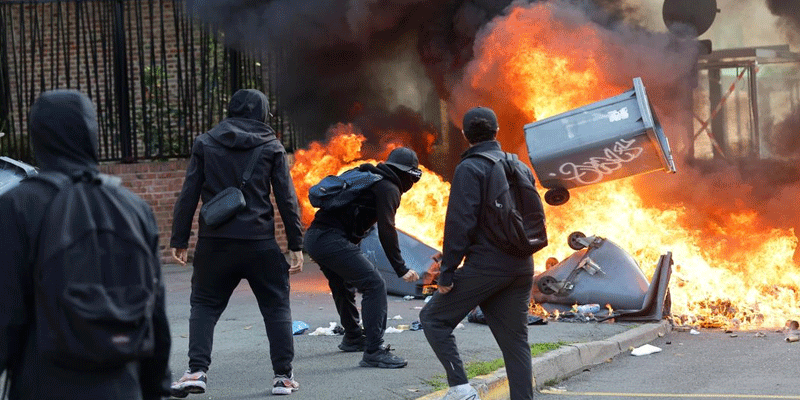
Central London witnessed extraordinary scenes as rival demonstrations turned violent during a far-right “Unite the Kingdom” rally, raising troubling questions about the state of Britain’s political climate. Organized by activist Tommy Robinson, the march drew tens of thousands of people waving national flags, chanting anti-immigration slogans, and calling for radical change. The eruption of violence — leaving more than two dozen police officers injured — was not only about immigration but also a deeper clash over national identity, free speech, and the meaning of patriotism in modern Britain. Elon Musk’s controversial video remarks during the rally added further fuel to the fire, linking Britain’s turmoil with broader global anxieties over migration and governance.
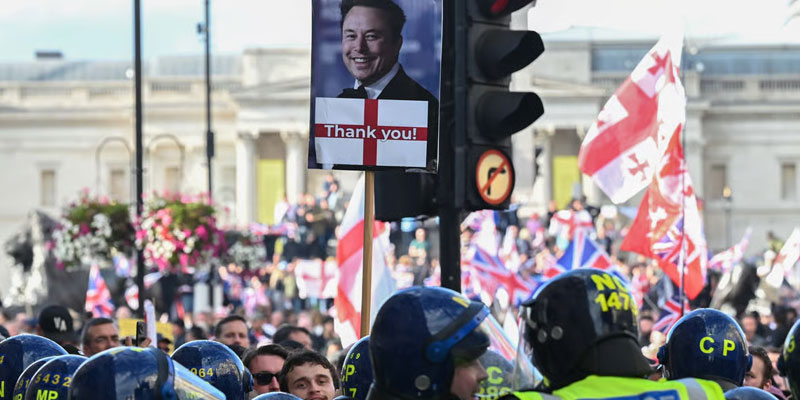
On September 13, over 100,000 demonstrators poured into London carrying the St George’s Cross and Union Jack. Billed as a defense of free speech, the event carried unmistakable anti-immigrant and anti-Muslim undertones. Chants of “Stop the boats” and “Send them home” echoed alongside hostile slurs aimed at Prime Minister Keir Starmer. Robinson, speaking to the crowd, declared the event “the spark of a cultural revolution,” portraying migrants as enjoying more rights than the “British public.”
The rally was not confined to local voices. French far-right politician Éric Zemmour addressed the march, framing immigration as part of a “great replacement” narrative. Adding global visibility, Elon Musk appeared virtually, warning that uncontrolled migration was “eroding Britain” and calling for “revolutionary government change.” His comments, including inflammatory claims about left-wing violence, shocked many in Britain’s political establishment.
Counter-Protests and Escalation
The far-right demonstration was met by thousands of counter-protesters organized by anti-racism groups and supported by progressive lawmakers like Diane Abbott and Zarah Sultana. Their message was one of solidarity with migrants: banners declared “Refugees welcome” and chants of “Smash the far right” filled the air.
Tensions rose when the massive turnout from Robinson’s supporters spilled beyond police containment lines near Whitehall. Confrontations broke out between demonstrators, counter-protesters, and police officers. Bottles, flares, and projectiles were hurled at law enforcement, leaving 26 officers injured, four critically. By the end of the day, authorities reported 25 arrests for violent disorder and other offenses.
Political Leaders Respond
Prime Minister Keir Starmer quickly condemned the violence, reaffirming Britain’s values of tolerance and diversity. “We will not surrender our flag to those who use it as a symbol of violence, fear, and division,” he declared. Stressing that peaceful protest is a democratic right, Starmer drew a firm line against assaults on officers or intimidation based on race or background.
Business Secretary Peter Kyle expressed concern over the extremism on display, insisting that perpetrators of violence must face consequences. He also dismissed Musk’s remarks as “incomprehensible” and “totally inappropriate.” Home Secretary Shabana Mahmood echoed these sentiments, promising the “full force of the law” against offenders.
Why the Anger?
The grievances fueling the rally are multi-layered. Immigration sits at the core — protesters argue that newcomers are straining resources, taking jobs, and driving crime. Over the summer, far-right groups staged demonstrations outside hotels housing asylum seekers, some of which descended into clashes.
Free speech is another flashpoint. Robinson and his allies claim Britain suppresses dissent, pointing to the recent mass arrests at pro-Palestinian rallies, including over 800 detentions linked to the banned group Palestine Action. They contend that ordinary Britons face restrictions on expression, while migrants and minorities are “protected.”
These themes of cultural threat, erosion of sovereignty, and censorship form the ideological backbone of the movement, amplified by online platforms and high-profile endorsements like Musk’s intervention.
Elon Musk’s Intervention
Musk’s participation gave the rally an unusual global dimension. In his virtual address, the Tesla and X chief painted a bleak picture of Britain’s trajectory: “This is a destruction of Britain, initially a slow erosion, but now rapidly increasing with uncontrolled migration.” He praised “British common sense” but warned that unless drastic action is taken, violence is inevitable.
He went further, calling for “revolutionary government change” and systemic reform, suggesting that bureaucrats no longer serve the people. Critics across the political spectrum viewed his comments as reckless, with some warning they emboldened extremist groups. Yet his intervention highlights how the UK’s internal debates resonate with international populist currents, where immigration and identity have become defining battlegrounds.
A Clash of Narratives
The London protests illustrate a growing rift in British society. On one side are those who frame immigration and multiculturalism as existential threats to national identity. On the other are communities and leaders emphasizing inclusivity, diversity, and the country’s long history of immigration as a strength.
This ideological divide is not limited to Britain. Zemmour’s speech and Musk’s remarks connect London’s unrest to a transnational conversation about the “future of Europe” and Western societies. The symbolism of flags, chants about borders, and invocations of “revolution” show how movements once considered fringe have moved closer to the mainstream, at least in terms of visibility.
Britain at a Crossroads
The violent scenes in London underscore a nation grappling with questions far larger than one day’s unrest. Immigration, free speech, and national identity remain flashpoints capable of mobilizing masses and straining public order. While far-right groups claim to defend patriotism, their tactics risk deepening divisions and undermining the very freedoms they say they stand for.
At the same time, counter-protesters reflect an equally determined vision of a pluralistic Britain that rejects scapegoating migrants. The government faces the delicate task of safeguarding freedom of assembly while protecting communities from intimidation and violence.
Musk’s intervention adds an unsettling international dimension, suggesting Britain’s struggles are part of a broader global contest over democracy, migration, and governance. Whether the UK emerges from this turmoil more fractured or more resilient will depend on the ability of leaders and citizens alike to reaffirm tolerance, uphold the rule of law, and resist those who thrive on division.
(With agency inputs)