Trump Revives Tariff Leverage Through New Trade Probes
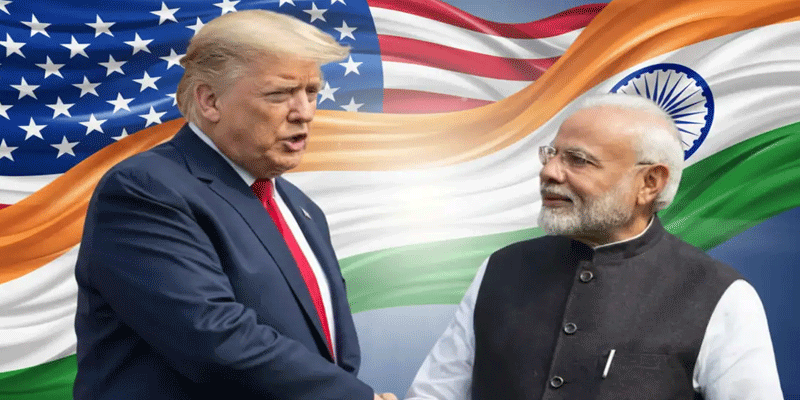
The United States has reopened a major front in global trade politics by launching fresh investigations into alleged unfair trade practices. The administration of Donald Trump has directed the Office of the United States Trade Representative to initiate aggressive Section 301 of the Trade Act of 1974 probes targeting several major economies, including India, China, the European Union, Japan, South Korea, and Mexico.
The investigations, announced by US Trade Representative Jamieson Greer, focus primarily on “excess industrial capacity”—a claim that certain countries are producing far more than their domestic demand and exporting the surplus in ways that distort global markets. Alongside this, Washington has also opened a sweeping probe into forced labor practices affecting imports from more than 60 countries, expanding the scope of the Uyghur Forced Labor Prevention Act beyond China’s Xinjiang region.
These investigations could result in new tariffs or quotas ranging from 10% to 50% by summer 2026, effectively rebuilding the tariff pressure strategy after the Supreme Court of the United States struck down broad emergency tariffs earlier imposed under the International Emergency Economic Powers Act.
Strategic Context: Rebuilding the Tariff Arsenal
The probes represent a recalibration of Washington’s protectionist trade agenda. While earlier blanket tariffs were invalidated by the court, Section 301 investigations remain a legally robust mechanism for imposing targeted trade penalties.
The US administration has already maintained existing Section 301 actions against China and Brazil, and is now expanding scrutiny to sectors such as pharmaceuticals, digital taxes, technology regulation, and fisheries subsidies. According to Greer, the goal is to protect US economic security and counter structural policies that allegedly give foreign producers an unfair advantage.
With temporary tariffs imposed in February set to expire in July, the investigations are expected to conclude quickly, giving Washington the legal basis to impose fresh duties if violations are confirmed.
Why India Is Under Scrutiny
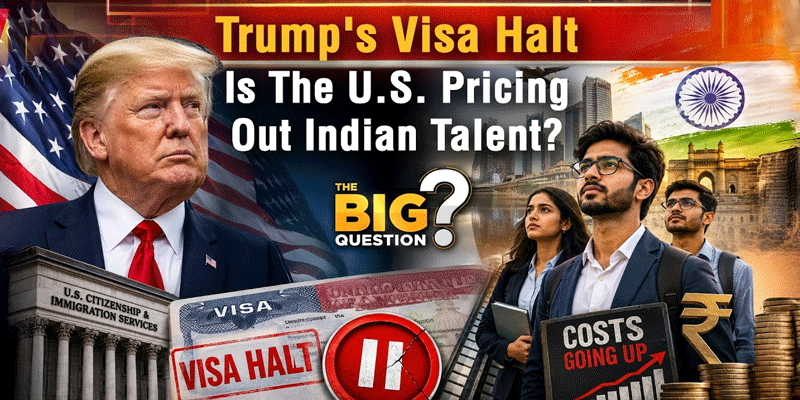
Among the targeted economies, India faces particular attention due to its growing manufacturing base and a trade surplus with the United States exceeding $30 billion. Washington has raised concerns about potential industrial overcapacity in sectors such as steel, automobiles, and electronics—industries that have benefited from incentives under the government’s “Make in India” strategy.
For India, the stakes are high. Nearly $80 billion in annual exports to the US could face disruptions if tariffs are imposed. Industries such as pharmaceuticals and information technology—key pillars of India’s export economy—could experience rising costs and supply chain complications for American companies that rely heavily on Indian services and generic medicines.
How Might India Respond?
India has several strategic pathways to respond to the US probe. The most immediate is diplomatic engagement. Commerce Minister Piyush Goyal is expected to intensify dialogue with the US Trade Representative to demonstrate compliance and highlight recent trade concessions made under a limited bilateral agreement.
Domestic reforms could also play a role. By improving transparency in subsidy programs, production data, and labor compliance audits, India could address allegations of overcapacity or labor violations before they translate into punitive tariffs.
At the same time, New Delhi may pursue export diversification through free trade agreements with the European Union, the United Kingdom, and ASEAN markets to reduce dependence on the US. If tariffs are ultimately imposed, India retains the option of challenging the measures at the World Trade Organization, though such disputes often take years to resolve.
Navigating a New Era of Trade Tensions
The renewed Section 301 investigations signal a return to aggressive economic nationalism in global trade policy. While Washington views the probes as necessary to counter unfair practices, the move risks escalating tariff disputes and fragmenting international supply chains.
For India, the challenge lies in balancing strategic partnership with the United States while safeguarding its export-driven growth. Careful diplomacy, policy adjustments, and market diversification will be essential if New Delhi hopes to avoid becoming a major casualty of the next wave of tariff wars.
(With agency inputs)