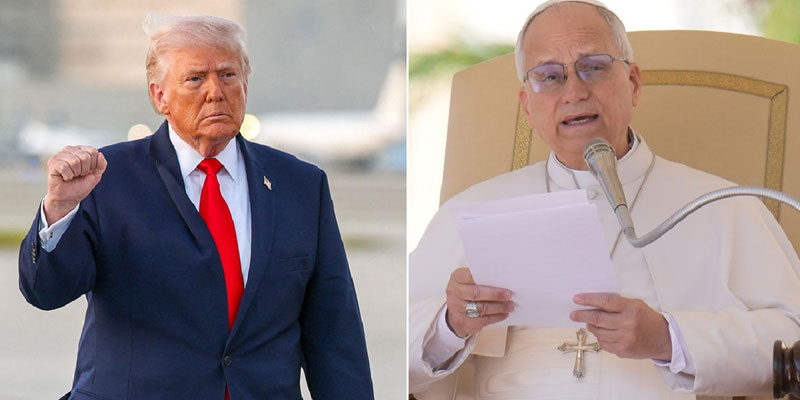
A fresh controversy has erupted after Donald Trump launched sharp criticism of Pope Leo XIV, even sharing AI-generated images depicting himself as religious figures such as Jesus Christ. The episode has quickly evolved into a wider debate over religion, politics, and the boundaries of symbolism in an age of digital amplification.
Iran War Remarks Trigger Clash
The tension began when Pope Leo XIV delivered a strong message during a peace vigil at St Peter’s Basilica. Addressing the ongoing Iran conflict, he warned against what he described as a “delusion of omnipotence”—a mindset where leaders place excessive faith in military power, wealth, and dominance.
Although he did not name Trump directly, the remarks were widely interpreted as criticism of the former president’s hardline rhetoric, including threats to “obliterate” Iran. The Pope called for restraint, diplomacy, and an end to violence, urging leaders to prioritise peace over confrontation.
Trump responded forcefully, criticising the Pope’s stance on foreign policy and accusing him of weakness. Through public statements and social media posts, Trump dismissed the Vatican’s position, framing it as naive in the face of global security threats.
AI Imagery and Religious Backlash
The controversy deepened when Trump shared AI-generated images portraying himself as Jesus Christ carrying a cross and as a pope-like figure blessing his followers. These images went viral, triggering strong reactions across religious and political circles.
Critics, including theologians and Christian groups, described the imagery as inappropriate and even blasphemous. Many argued that using sacred religious symbols for political messaging crosses ethical lines, especially during a period of geopolitical conflict.
Supporters of Trump, however, defended the posts as symbolic or humorous, reflecting the growing role of exaggerated digital content in modern political communication. The incident highlights how artificial intelligence is blurring the boundaries between satire, propaganda, and belief.
Pope Leo’s Response: A Moral, Not Personal, Critique
In response, Pope Leo XIV clarified that his remarks were not aimed at any individual but at broader systems of power. He emphasised that the “delusion of omnipotence” refers to a mindset that glorifies war and control rather than humility and peace.
Importantly, he stated that he does not “fear” Trump or his administration, reinforcing the Vatican’s independence in moral discourse. His position reflects a long-standing tradition within the Church of addressing systemic issues rather than targeting individuals directly.
By framing the issue this way, the Pope seeks to elevate the debate beyond personalities, focusing instead on the ethical implications of leadership in times of conflict.
Broader Implications: Religion, Power and Digital Politics
This episode reveals deeper fault lines in global discourse. First, it underscores a clash between two forms of influence: the moral authority of religious leadership and the populist appeal of political spectacle.
Second, it highlights the growing role of AI in shaping narratives. The use of religious imagery generated by artificial intelligence raises new questions about respect for faith and the manipulation of symbols for political gain.
Finally, the disagreement reflects broader divisions over the Iran conflict. While the Vatican advocates diplomacy and restraint, Trump’s approach emphasises strength and deterrence, illustrating contrasting visions of global leadership.
A Clash Beyond Personalities
The Trump–Pope Leo XIV controversy is more than a personal feud—it represents a deeper conflict between competing ideas of authority, morality, and communication. On one side stands a religious leader calling for humility and peace; on the other, a political figure leveraging bold rhetoric and digital imagery to mobilise support.
As technology continues to reshape how messages are delivered and perceived, such clashes are likely to intensify. Ultimately, the episode serves as a reminder that in times of global tension, the battle for influence is not just fought on the ground—but also in the realms of belief, symbolism, and perception.
(With agency inputs)