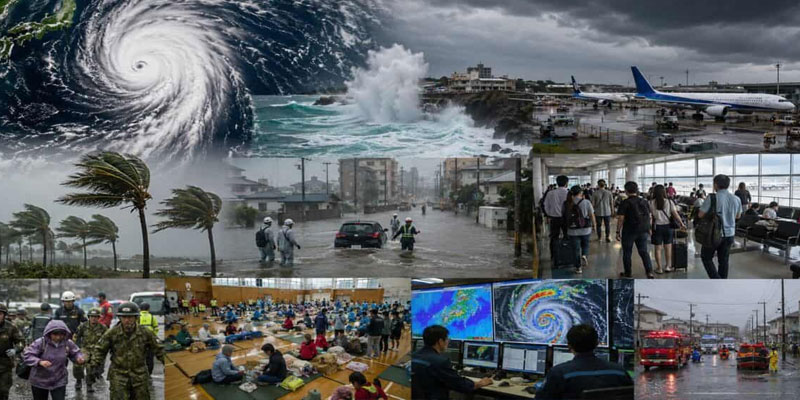
Dolphin Hits Okinawa as China Braces for Landfall
Typhoon Dolphin has struck Japan’s southern Okinawa prefecture, bringing powerful winds, injuries and widespread power outages, while China has shut ports and ferry routes ahead of the storm’s expected landfall. With sustained winds reaching 162 km/h and gusts up to 216 km/h, the slow-moving system has already disrupted flights and maritime transport across Japan, China and Taiwan.
A Rare, Long-Track Pacific Typhoon
Dolphin is notable for forming unusually far east near the International Date Line before travelling westward across the Pacific and turning towards the Ryukyu Islands and China. Its relatively slow movement has increased the duration of exposure to strong winds and heavy rainfall, raising concerns for densely populated coastal areas.
Okinawa Bears the First Major Impact
As Dolphin moved northwest from Okinawa, authorities reported multiple injuries and significant power disruption. Five elderly people in Okinawa suffered non-life-threatening injuries, with several falling because of strong winds. Power outages affected tens of thousands of buildings across Okinawa and Kagoshima, according to the latest reports.
Naha Airport was shut and domestic flights to and from Okinawa were cancelled by major carriers including ANA and Japan Airlines. Ferry services were also disrupted. Dolphin’s outer rain bands have brought additional heavy rainfall to parts of Kyushu, adding pressure to communities already dealing with recent natural disasters.
China Raises Alert as Landfall Nears
China is preparing for Dolphin to make landfall between Zhoushan in Zhejiang and Fuding in Fujian, potentially from Sunday night into Monday. Authorities have closed ports, suspended 162 passenger ferry routes and introduced wider transport restrictions. Ningbo Lishe International Airport is also expected to suspend operations temporarily.
The threat extends beyond coastal flooding. Heavy rainfall could affect Shanghai and surrounding areas, with forecasts warning of exceptionally high rainfall in some locations. China’s early shutdowns reflect an increasingly precautionary approach aimed at protecting workers, vessels and critical infrastructure.
Taiwan And Transport Networks Also Hit
Taiwan has experienced significant disruption from Dolphin’s wider circulation, with dozens of international flights cancelled and heavy rain expected across northern areas. Maritime operations have also been affected.
The storm therefore represents more than a weather emergency: it is simultaneously disrupting air travel, ferries, ports and regional logistics across a major East Asian economic corridor.
The Bigger Risk: Supply Chains and Energy
Dolphin’s projected path brings it close to the Shanghai–Hangzhou Bay economic and shipping complex, including the major Ningbo-Zhoushan port region. Temporary closures could create vessel delays, missed port calls and congestion even after operations resume.
Energy and commodity movements could also face short-term disruption if port restrictions affect coastal refineries, storage facilities or other maritime infrastructure.
The Final Test Comes at Landfall
The crucial period will be Sunday night and Monday, when Dolphin approaches China’s eastern coast. The scale of rainfall, storm surge and flooding will determine whether the disruption remains manageable or becomes a major economic and humanitarian emergency.
Dolphin’s journey across the Pacific demonstrates how a single slow-moving storm can rapidly become a regional crisis affecting communities, transport networks and global supply chains. Its ultimate impact will depend not only on wind strength, but on how effectively Japan, China and Taiwan manage the storm’s prolonged and interconnected risks.
(With agency inputs)