A Mansion Under Attachment
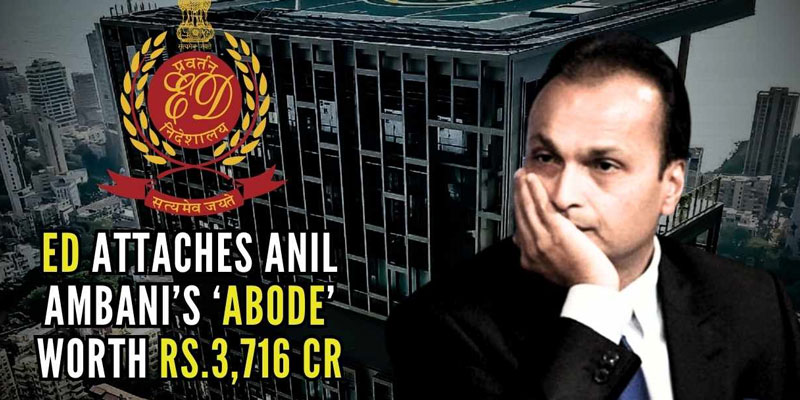
In a dramatic escalation of its money laundering investigation, the Enforcement Directorate (ED) has attached industrialist Anil Ambani’s 17-storey Mumbai residence, ‘Abode’, valued at ₹3,716 crore. Located in the upscale Pali Hill neighbourhood, the ultra-luxury property—complete with helipad, infinity pool, private elevators and spa—has long symbolised the former tycoon’s corporate zenith.
The attachment comes under the Prevention of Money Laundering Act (PMLA) as part of an alleged ₹15,700 crore bank loan fraud linked to Reliance Communications (RCOM). Ambani, 66, appeared before ED officials in Delhi for a second round of questioning, following an earlier session in August 2025. What was once a residence reflecting corporate grandeur is now central to a high-stakes financial investigation.
What Are the Allegations?
The ED’s case traces back to RCOM’s financial collapse in 2019 under a staggering debt burden of nearly ₹47,000 crore. According to the agency, several bank loans extended to RCOM were allegedly diverted through shell companies and complex financial structures rather than being used for legitimate corporate purposes.
At the core of the probe is the allegation that loan proceeds were siphoned off and layered through offshore entities and domestic trusts to obscure their origin. The ED claims that assets worth ₹15,700 crore—identified as “proceeds of crime”—have been attached so far.
A significant part of the agency’s argument concerns the ownership structure of ‘Abode’. Investigators allege that the property was transferred into a private family trust, RiseE Trust, purportedly to distance Ambani from direct ownership and shield the asset from creditor claims. The ED has suggested that the trust structure functioned as a façade to camouflage beneficial ownership, thereby frustrating recovery proceedings initiated by lenders after RCOM’s insolvency.
What the ED Has Said
According to the agency, its investigation has uncovered a “money trail” linking loan disbursements to high-value assets, including the Pali Hill residence. Officials have argued that the aggregation of properties into the trust was designed to make it appear as though Ambani had no personal involvement.
The attachment of ‘Abode’ follows earlier provisional seizures, including a ₹473.17 crore portion of the property in November. The current action significantly widens the scope of asset freezes under PMLA provisions. The ED has indicated that further attachments could follow if additional proceeds of crime are identified.
Ambani and associated entities have denied wrongdoing, calling the attachments premature and maintaining that financial stress at RCOM resulted from business failure rather than fraud. However, courts have previously upheld interim attachment orders, lending procedural backing to the ED’s actions.
What Happens Next?
Under PMLA procedures, the provisional attachment must be confirmed by the Adjudicating Authority within a stipulated timeframe. If upheld, the property could eventually be confiscated following trial proceedings. Ambani retains the right to challenge the attachment before appellate tribunals and higher courts.
The investigation may also widen to examine related entities within the broader Anil Dhirubhai Ambani Group (ADAG), especially where financial interlinkages are suspected. Criminal prosecution, if sanctioned, would hinge on establishing intentional diversion and laundering of funds beyond reasonable doubt.
For lenders, the attachment strengthens prospects of asset recovery, though liquidation or auction processes can be prolonged and legally contested.
A Defining Moment for Corporate Accountability
The attachment of ‘Abode’ represents more than the freezing of a luxury home; it underscores an intensified regulatory crackdown on alleged financial misconduct among high-profile corporate figures. As enforcement agencies pursue complex financial trails, the case raises larger questions about governance standards, banking oversight, and the use of trusts in corporate structuring.
For Anil Ambani, the outcome could shape not only personal liability but also the future of his business interests. For India’s corporate ecosystem, the episode signals that regulatory scrutiny now extends beyond boardrooms—into the very residences that once symbolised unchecked success.
(With agency inputs)