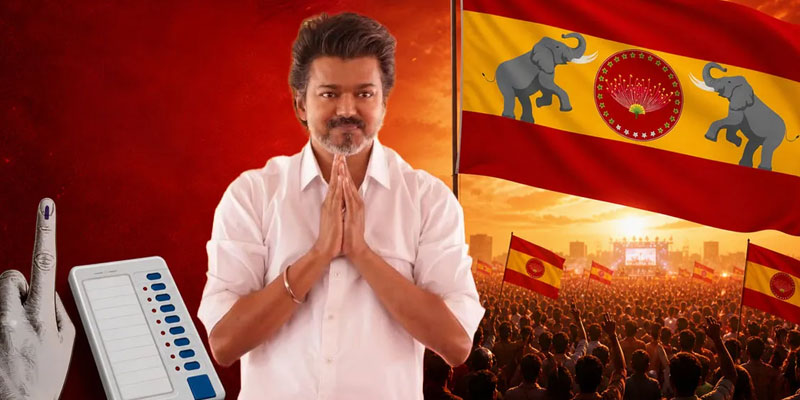
The political landscape in Tamil Nadu has been dramatically reshaped, and the aftershocks are now being felt within the All-India Anna Dravida Munnetra Kazhagam (AIADMK). Reports suggest that more than 30 MLAs may break ranks to support Vijay’s Tamilaga Vettri Kazhagam (TVK), following its emergence as the single-largest party. What began as an electoral upset is fast evolving into an internal crisis that could redefine opposition politics in the state.
TVK’s Surge and the New Power Equation
TVK’s impressive tally of 108 seats in the 234-member Assembly has placed it within striking distance of the majority mark of 118. This outcome not only disrupts the long-standing dominance of Dravidian majors but also introduces a new axis of power.
AIADMK, led by Edappadi K. Palaniswami (EPS), has been pushed to a distant third position with around 26 confirmed wins and leads in about 20 constituencies. The party’s weakened standing has intensified internal dissatisfaction, particularly over leadership strategy and alliance decisions.
C.V. Shanmugam and the Brewing Rebellion
At the centre of the unfolding rift is C. V. Shanmugam, a senior AIADMK leader and Rajya Sabha MP. He is reportedly mobilising a faction of MLAs to consider extending support to TVK, either formally or through a breakaway group.
While Shanmugam has publicly maintained that any decision must be taken collectively, reports of meetings with like-minded legislators signal a deeper churn. The suggestion that over 30 MLAs could defect acts as a strategic warning to EPS—either adapt to the new political reality or risk losing control of the party.
Electoral Arithmetic and Strategic Leverage
The numbers give Shanmugam’s faction considerable bargaining power. Even a shift of 20–30 MLAs would be enough to push TVK past the majority threshold, enabling Vijay to form a stable government without a full-scale alliance.
This creates a high-stakes scenario:
· For TVK, outside support from AIADMK legislators offers a swift route to power.
· For the dissident faction, it opens the door to influence in a new regime.
The situation effectively turns AIADMK into a kingmaker—albeit a divided one.
EPS’s Dilemma: Identity vs Relevance
EPS now faces a difficult choice. Supporting TVK could keep AIADMK within the power structure but risks reducing it to a junior partner and elevating Vijay as the primary anti-DMK figure. On the other hand, refusing support may accelerate internal fragmentation and embolden defectors.
The crisis also reflects deeper structural issues within AIADMK—its inability to reclaim power since 2016, erosion of its voter base, and the challenge of competing with a charismatic outsider like Vijay who has captured youth and neutral voters.
A Turning Point in Tamil Nadu Politics
This moment signals more than a temporary rebellion—it points to a possible realignment in Tamil Nadu’s political order. The rise of TVK has disrupted traditional binaries, and AIADMK’s internal instability highlights its struggle to remain relevant in a three-cornered contest.
Crisis or Reinvention?
The reported move by 30-plus MLAs is not merely a tactical maneuver but a reflection of AIADMK’s existential crossroads. Whether EPS can contain the rebellion or whether Shanmugam’s camp translates pressure into a formal split will shape the immediate future of the party.
For TVK, this is an opportunity to consolidate power and expand its base. For AIADMK, it is a test of survival. The outcome will determine whether this election marks the beginning of a coalition era—or the decline of one of Tamil Nadu’s most influential political forces.
(With agency inputs)