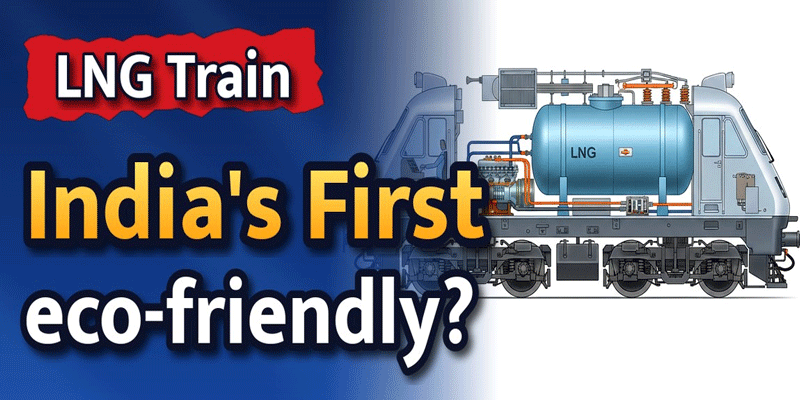
India’s first LNG-powered hybrid train was flagged off from Sabarmati Railway Station in Gujarat on September 27, marking a new step in Indian Railways’ effort to reduce diesel dependence and adopt alternative fuels. Union Home Minister Amit Shah launched the eight-coach train alongside railway projects worth ₹1,472 crore in the Sabarmati division.
Why LNG for Indian Railways
Indian Railways has been steadily reducing diesel consumption through extensive electrification and improved operational efficiency. Diesel use has fallen sharply over the past decade, while the national transporter is working towards its stated 2030 net-zero diesel objective. Yet diesel-powered services remain relevant on routes where electrification is incomplete or where alternative traction technologies are still being evaluated.
LNG, or liquefied natural gas, offers an intermediate option. Unlike a completely new propulsion system, it can be integrated with existing internal-combustion technology through a dual-fuel configuration, allowing engines to use LNG and diesel depending on operational requirements and fuel availability. LNG combustion also produces lower levels of several pollutants, including carbon dioxide, nitrogen oxides and particulate matter, compared with conventional diesel operation.
How India’s First LNG Train Works
The new train is an eight-coach, non-AC DEMU operated by Western Railway. Two 1,400-horsepower Driving Power Cars at the Sabarmati Integrated Coaching Depot have been converted to run on LNG and diesel. More than 2,000 kilometres of field trials were completed before its launch.
Under the system, LNG can replace nearly 40% of diesel consumption, while diesel remains available as a complementary fuel. The inaugural service operated on the approximately 62-km Sabarmati–Mahesana Junction section, although Indian Railways has yet to finalise the train's permanent route.
Fuel Savings and Environmental Benefits
The project is significant not simply because LNG is being introduced, but because it tests whether existing diesel-based railway assets can be made more fuel-efficient without waiting for complete network electrification.
Indian Railways estimates:
· Around ₹11.9 lakh annual fuel savings per Driving Power Car.
· Approximately ₹23.9 lakh annual savings for the eight-coach rake.
· Reduced consumption of diesel through LNG substitution.
· Lower emissions of CO₂, NOx and particulate matter.
· Continued operational flexibility because the train can use diesel when LNG is unavailable.
The technology therefore provides a potential bridge between conventional diesel traction and longer-term zero-emission alternatives.
LNG Complements India’s Emerging Rail Technologies
The LNG initiative follows India’s introduction of hydrogen-powered railway technology earlier in 2026. The two approaches serve different technological purposes. Hydrogen fuel-cell trains are designed around zero tailpipe emissions, whereas LNG remains a fossil fuel but can reduce diesel consumption and emissions while using modified conventional engines.
This makes the Gujarat project particularly relevant for testing how alternative fuels can be deployed pragmatically across railway operations.
A Pilot That Could Shape the Next Transition
The LNG train should ultimately be assessed through sustained data on fuel savings, maintenance, reliability, emissions and operating costs. If the Gujarat experience validates these advantages, similar dual-fuel systems could be considered for other diesel-dependent corridors where electrification is pending or technically less immediate.
The broader significance lies in Indian Railways pursuing multiple pathways simultaneously. Electrification remains the principal route to reducing diesel dependence, while LNG can serve as an intermediate technology for sections that continue to require internal-combustion traction. The Sabarmati experiment will therefore be important in determining how effectively alternative fuels can support the railway’s transition towards cleaner, more efficient and increasingly low-carbon operations.
(With agency inputs)