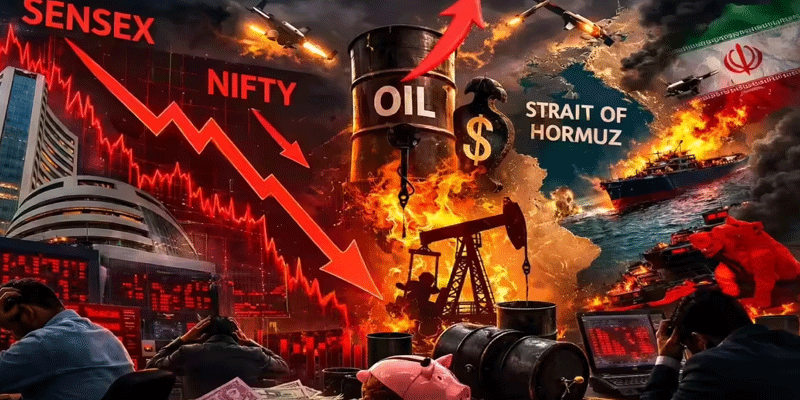
Sensex and Nifty opened sharply lower on Monday as rising crude oil prices, renewed geopolitical uncertainty and weak Asian market cues triggered broad-based selling. The Sensex initially fell around 730 points to 73,170.12, while the Nifty dropped 231.50 points to 22,908.95. The sell-off subsequently deepened, with the Sensex touching 72,855.76 and the Nifty 22,819.65, bringing both benchmarks close to six-month lows.
Oil Surge Becomes the Immediate Trigger
Brent crude rose about 2.27% to $106.70 a barrel, making energy prices the central concern for investors. The latest increase followed renewed uncertainty surrounding US-Iran tensions and the possibility of prolonged disruption around the strategically important Strait of Hormuz.
For India, higher crude prices carry wider economic implications because the country is heavily dependent on imported oil. An extended rise can increase the import bill, put pressure on the rupee, raise transportation and production costs and complicate inflation management.
Seven-Week Losing Streak Deepens
The latest decline comes after both benchmark indices had already recorded losses for seven consecutive weeks. Friday's modest recovery therefore failed to reverse the broader weakness. The Sensex had closed at 73,895.74 and the Nifty at 23,140.50 on Friday before Monday's sharp reversal.
Weakness was broad rather than confined to a few companies. All 30 Sensex constituents were trading lower during the early session.
Among the prominent laggards were:
· Bajaj Finance
· Kotak Mahindra Bank
· HDFC Bank
· Bajaj Finserv
· Hindustan Unilever
· Mahindra & Mahindra
· Larsen & Toubro
· Bharat Electronics
Later market updates indicated losses across all major sectors, with mid-cap and small-cap stocks also under pressure.
Who Is Under Pressure and Why?
Oil-sensitive businesses face the most direct risk because higher fuel and raw-material costs can compress margins. Airlines, logistics, paints, chemicals and tyre companies are particularly exposed if input costs rise faster than their ability to pass them on to customers.
Consumer-facing companies can also face indirect pressure if expensive fuel reduces household purchasing power. Banks and financial stocks, meanwhile, can be affected through slower credit demand and concerns about borrowers' financial conditions if inflationary pressures persist.
Thus, Monday's selling reflects both direct earnings concerns and broader macroeconomic anxiety.
Foreign Selling Adds to Market Pressure
Foreign investor activity has compounded the weakness. Foreign Institutional Investors sold equities worth ₹3,693.93 crore on Friday, while domestic institutional investors bought about ₹2,838.17 crore.
September has already witnessed substantial foreign outflows, reflecting concerns over crude prices, elevated US bond yields, the dollar and global geopolitical risks.
Asian Markets Reinforce the Risk-Off Mood
Weak regional cues added another layer of pressure. South Korea's KOSPI, Japan's Nikkei 225 and Shanghai's SSE Composite were trading lower, although Hong Kong's Hang Seng was higher.
This indicates that Monday's decline is part of a broader reassessment of risk rather than an isolated domestic development.
Oil, Geopolitics and Flows Hold the Key
The immediate direction of Indian equities will depend heavily on crude prices, developments around US-Iran tensions and the pace of foreign investment flows. Sustained Brent prices above $100 could keep inflation, currency and corporate-margin concerns alive, while easing geopolitical tensions could reduce the risk premium.
Monday's sharp fall therefore highlights India's exposure to external energy shocks. Domestic growth fundamentals remain important, but in the near term, oil prices and global risk sentiment are likely to remain the dominant forces shaping Dalal Street.
(With agency inputs)