Oil Prices and Weak Monsoon Cloud India’s Growth Outlook
The International Monetary Fund (IMF) has identified rising oil prices and the possibility of a weak monsoon as the two biggest risks to India's economic growth in FY27. While India is expected to remain one of the world's fastest-growing major economies, the IMF has warned that escalating tensions in West Asia, volatile energy markets and climate-related uncertainties could weigh on growth and fuel inflation. The Fund has also announced that it will reassess the quality of India's GDP data later this year after the release of revised national accounts.
IMF's Latest Growth Outlook
In its July 2026 World Economic Outlook (WEO), the IMF marginally lowered India's FY27 GDP growth forecast from 6.5% to 6.4%, citing higher global energy prices. However, it raised the FY28 projection to 6.7%, reflecting confidence in India's resilient domestic demand.
India continues to be among the fastest-growing large economies, but the IMF has cautioned that external shocks and statistical limitations complicate accurate assessment of its growth trajectory.
In November 2025, the IMF's Data Adequacy Assessment assigned India's GDP statistics a "C" grade, pointing to concerns over the outdated 2011-12 base year, reliance on wholesale price indices and methodological shortcomings in measuring economic activity.
Rising Oil Prices: India's Biggest External Risk
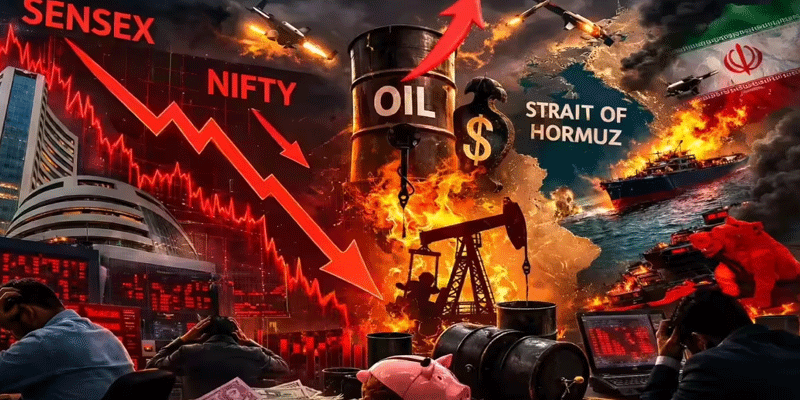
According to the IMF, the widening conflict in the Middle East remains the single biggest external threat to India's economy. Since India imports over 80% of its crude oil, prolonged price increases or supply disruptions could significantly affect growth.
Higher crude prices could impact India through several channels:
· Pressure on trade and current account deficit: Costlier imports widen the trade gap and weaken the rupee.
· Higher inflation: Rising fuel and transport costs may complicate the RBI's inflation management and monetary policy.
· Fiscal burden: Fuel tax cuts or higher subsidies to shield consumers could reduce the government's fiscal space for development spending.
Market estimates suggest that every USD 10 per barrel increase in crude prices could reduce GDP growth across Asia by 20-30 basis points, with India particularly vulnerable.
Weak Monsoon Could Further Slow Growth
The IMF has also flagged the possibility of a below-normal monsoon, partly due to El Niño conditions, as a major domestic risk. Importantly, it noted that the current growth forecast does not fully capture the potential impact of weak rainfall.
A deficient monsoon could lead to:
· Lower agricultural production: Reduced crop output may raise food inflation and affect farm incomes.
· Weaker rural consumption: Lower rural spending could impact FMCG sales, construction and consumer durables.
· Higher fiscal expenditure: Increased spending on crop insurance and relief measures may strain public finances.
A prolonged rainfall deficit could therefore weaken growth while simultaneously increasing inflationary pressures.
IMF to Reassess India's GDP Data
The IMF will reassess India's national accounts during its next Article IV Consultation, expected later this year, after the release of revised GDP estimates based on the new 2022-23 base year.
The updated series is expected to improve statistical accuracy by incorporating revised price indices, industrial production data and historical GDP estimates. A stronger methodology could help address the shortcomings that led to India's current "C" rating and enhance confidence in the country's economic data.
The Risks Behind the Growth Story
· Oil remains India's biggest external vulnerability: Continued geopolitical tensions in West Asia could increase inflation, widen trade deficits and slow economic growth.
· Monsoon uncertainty amplifies domestic risks: Agriculture, rural consumption and food prices remain closely tied to rainfall, making weather conditions a crucial determinant of FY27 growth.
· Reliable GDP data matters for policymaking: Updating India's GDP base year and improving statistical methodology will enhance economic assessment, strengthen investor confidence and support better policy decisions.
· Growth outlook remains resilient but fragile: While India's medium-term fundamentals remain strong, external shocks and domestic climate risks could significantly alter current projections.
Growth Prospects Depend on Managing Multiple Risks
The IMF's assessment highlights that India's economy remains fundamentally strong but faces increasing uncertainty from global and domestic factors. Rising oil prices, an unpredictable monsoon and the ongoing overhaul of GDP measurement all have the potential to reshape the FY27 outlook. Sustaining India's growth momentum will depend on prudent macroeconomic management, improved statistical transparency and resilience against external shocks. While the long-term outlook remains positive, policymakers will need to closely monitor these evolving risks to ensure that growth remains stable, inclusive and sustainable.
(With agency inputs)