A Landmark Accord After Two Decades of Negotiation
On January 27, 2026, India and the European Union sealed a historic Free Trade Agreement (FTA), concluding negotiations that first began in 2007 and were revived in 2022 after years of stalemate. Celebrated by leaders on both sides as a transformative deal, the agreement creates one of the world’s largest free-trade spaces, linking markets that together account for nearly a quarter of global economic output and almost two billion consumers. Legal vetting and ratification are underway, with implementation expected once EU member states and institutions complete approvals.
Why This Agreement Matters
The India–EU FTA is significant not only for the scale of trade it covers but also for its strategic timing. Global supply chains are shifting amid geopolitical tensions, rising protectionism, and disruptions in key trade routes. Against this backdrop, both India and the EU sought economic diversification and deeper partnerships with like-minded economies.
The agreement gradually eliminates tariffs on most goods, expands services trade, improves investment access, and introduces cooperation in technology, mobility, and strategic industries. For India, whose exports and industrial ambitions are growing rapidly, access to Europe’s high-value market could be transformative. For Europe, India offers one of the fastest-growing consumer and manufacturing hubs in the world.
Detailed Analysis: India’s Gains and Trade-Offs
Key Gains for India
The biggest immediate benefit lies in improved access for Indian exports. European duties will be removed or reduced on nearly all Indian shipments, giving sectors such as textiles, leather goods, chemicals, pharmaceuticals, electronics, and gems a competitive advantage. Analysts project a 20–30 percent rise in exports in several of these industries over the next few years.
India also secured concessions in services trade, particularly through easier movement of skilled professionals under temporary visa arrangements. This directly benefits India’s strengths in IT services, engineering, finance, and consulting.
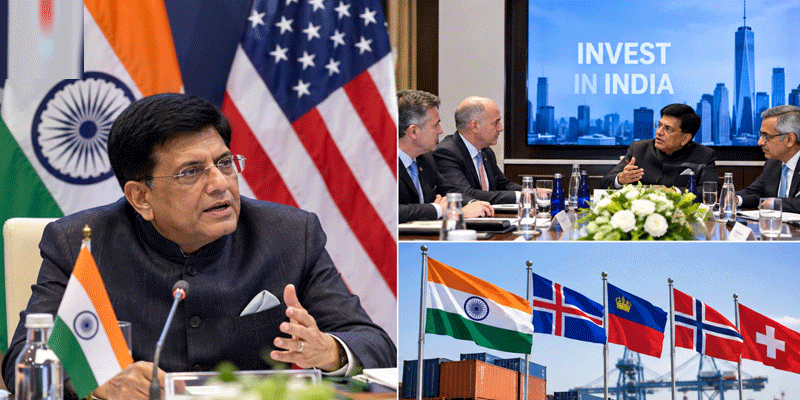
Another important gain is investment inflow. European firms are expected to expand manufacturing and technology partnerships in India, helping diversify supply chains away from China while boosting India’s industrial capabilities and employment.
Geopolitically, the agreement strengthens India’s multi-alignment strategy, positioning it as a central trade partner for advanced economies while reinforcing its role in Indo-Pacific economic networks.
Challenges and Potential Losses
However, the agreement also presents adjustment pressures. India has committed to lowering tariffs on a vast majority of EU goods, opening domestic markets to highly competitive European automobiles, machinery, pharmaceuticals, and luxury consumer products. Indian manufacturers, especially small and medium enterprises, may face tougher competition unless productivity improves.
Agriculture remains sensitive. Although safeguards exist, farmers fear future exposure to subsidized European products could squeeze local producers. Adjustment support and careful policy calibration will be essential.
Compliance with EU environmental and quality standards could also raise costs for Indian exporters, particularly smaller firms unfamiliar with stringent certification norms.
Opportunity with Responsibility
The India–EU FTA marks a decisive step in India’s economic integration with global markets. While the deal promises higher exports, greater investment, and stronger strategic partnerships, its success will depend on domestic reforms that help Indian industries compete internationally. If accompanied by support for vulnerable sectors and proactive industrial policy, the agreement could significantly accelerate India’s path toward becoming a major global economic power. Otherwise, the benefits may remain uneven. The pact, therefore, represents both opportunity and responsibility for India’s next phase of growth.
(With agency inputs)