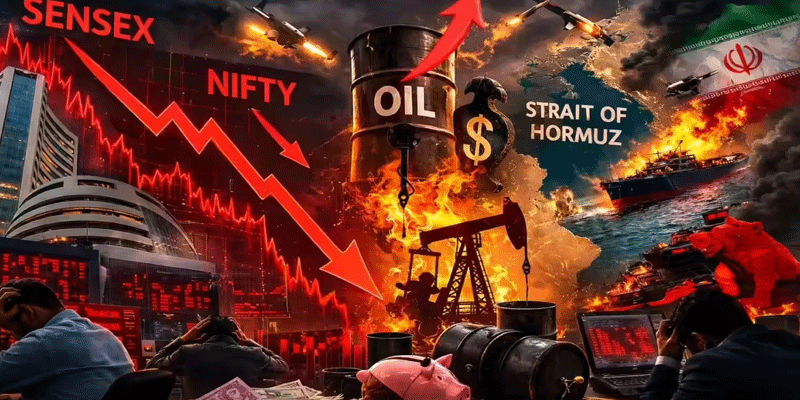
Indian equities endured their third consecutive session of losses on Wednesday, with the Sensex plunging more than 800 points and the Nifty slipping below 23,450. The sell-off came as Brent crude crossed the psychologically important $100-a-barrel mark amid escalating US-Iran tensions. The Sensex closed at 74,764.23, down 813.35 points, while the Nifty settled at 23,431.50, lower by 203.60 points.
A Fresh Shock for Already-Weak Markets
The decline extended a broader weakening trend. Indian benchmarks had already fallen sharply in recent sessions as geopolitical uncertainty, expensive crude, foreign selling and liquidity pressures weighed on sentiment. Tuesday's close had already taken the Sensex to 75,577.58 and the Nifty to 23,635.10.
The latest fall wiped out roughly ₹2 lakh crore in investors' wealth, highlighting how quickly an external geopolitical shock can translate into domestic market losses. With India heavily dependent on imported crude, sustained oil prices near $100 can raise the import bill, inflation risks and pressure on corporate profitability.
What Are the Six Factors Behind Today’s Market Crash?
1. Crude Oil Crosses the $100 Barrier
The biggest trigger was the renewed surge in oil prices. Brent crossed $100 for the first time since July as fears of supply disruption intensified. Higher crude threatens India's inflation outlook, trade balance and corporate margins, particularly for oil-sensitive industries.
2. US-Iran Conflict Raises Geopolitical Risk
Military escalation involving the US, Iran and Iran-backed forces has increased fears of a prolonged regional conflict. Any disruption around the Strait of Hormuz could further tighten global energy supplies and keep the geopolitical risk premium elevated.
3. Global Risk-Off Sentiment
Rising oil prices are simultaneously reviving inflation and interest-rate concerns. US equities weakened, while higher bond yields made riskier assets less attractive, creating a negative global backdrop for emerging markets.
4. Heavy IT Selling Deepened the Fall
IT stocks were among the biggest losers, with the Nifty IT index falling sharply. Concerns over higher US rates, global growth and technology-sector earnings added another layer of pressure to the benchmarks.
5. IPOs Are Absorbing Market Liquidity
India's busy primary market is diverting money from established listed shares into new issues. Analysts have pointed to the IPO pipeline as an additional liquidity constraint for the secondary market.
6. Weak Technical Structure and Foreign Selling
The indices were already in a short-term downtrend, with key support levels under pressure. Continued foreign investor caution and selling amplified the decline, while the rupee's slide beyond ₹95 to the dollar added another concern for investors.
The Larger Warning Behind Wednesday’s Fall
Wednesday's crash is more than a one-day correction. It reflects the convergence of oil, war, currency pressure, global rates, liquidity constraints and fragile technical sentiment. Unless geopolitical tensions ease and crude retreats from the $100 zone, Indian equities could remain volatile. For investors, the immediate lesson is clear: when external shocks collide with stretched valuations and weak market breadth, even a fundamentally resilient market can lose substantial value in a matter of hours.
(With agency inputs)