Islamabad Steps into a Fragile New Role
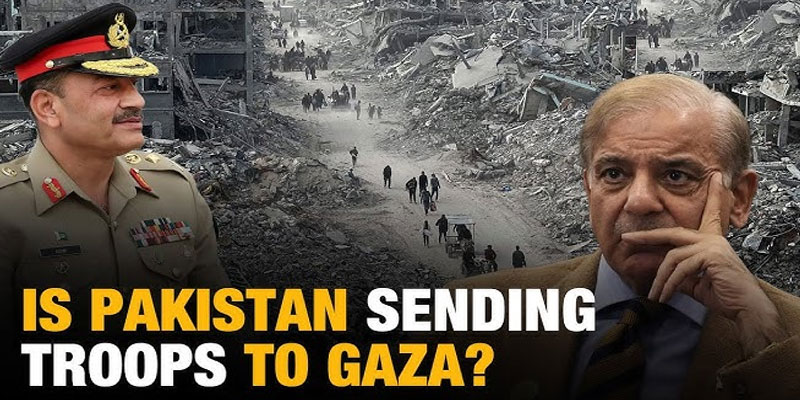
In a striking turn of global diplomacy, Pakistan is reportedly preparing to deploy around 20,000 troops to the Gaza Strip as part of a newly envisioned international stabilization force. The initiative—shaped through discreet negotiations between Pakistan’s Field Marshal Asim Munir, the CIA, and Israel’s Mossad—marks a historic shift in Pakistan’s foreign and military policy. For a nation that has long aligned itself with the Palestinian cause, this step signals not just strategic recalibration but a deep entry into the post-war restructuring of Gaza after two years of devastating conflict.
The Secret Negotiations and Emerging Agreement
According to intelligence leaks, closed-door meetings among Pakistani, Israeli, and American officials culminated in an understanding to include Pakistan’s military in a multinational coalition overseeing Gaza’s reconstruction and security. The arrangement forms a key part of US President Donald Trump’ ambitious 20-point “Gaza Peace Framework,” designed to broker a ceasefire, dismantle militant infrastructure, secure hostage releases, and gradually restore Palestinian self-governance under international oversight.
Under this plan, Pakistan—one of the world’s largest Muslim militaries—will anchor the International Stabilization Force (ISF) alongside troops from Indonesia, Azerbaijan, and other partner nations. The force’s declared mission is humanitarian: restoring order, facilitating aid delivery, and supporting rebuilding efforts. Yet analysts emphasize that its underlying function is far more strategic—to contain residual Hamas influence, act as a buffer between Israel and Palestinian factions, and ensure the political transition proceeds under controlled conditions.
A Diplomatic and Strategic Realignment
This potential deployment would represent a remarkable diplomatic pivot. Pakistan has never recognized Israel and has historically been one of its strongest Muslim critics. The quiet removal of the long-standing “passport not valid for Israel” clause from new Pakistani travel documents hints at a gradual softening of this stance.
For Islamabad, the calculus is pragmatic. Years of economic strain, mounting debt, and political turbulence have forced a search for renewed international relevance and financial relief. By aligning with a US-backed initiative, Pakistan seeks both economic aid and political legitimacy, potentially easing Western scrutiny and opening the door to Gulf investment support.
For Washington and Tel Aviv, Pakistan’s participation offers significant advantages. Its forces possess the operational expertise and cultural credibility needed in Gaza’s volatile environment—qualities Western troops cannot easily replicate. In effect, Islamabad becomes a capable intermediary: acceptable to Muslim audiences but aligned with Western stabilization goals.
Regional Resistance and Domestic Risks
Despite its diplomatic allure, the plan faces intense headwinds. Regional powers like Iran, Turkey, and Qatar—staunch defenders of Hamas—are likely to view Pakistan’s involvement as a betrayal of the Palestinian cause and an endorsement of Israeli interests.
Domestically, too, the deployment could ignite political turmoil. Conservative religious groups and opposition parties may denounce the move as capitulation to the West, especially if Pakistani forces are perceived to be suppressing Palestinian resistance. Casualties or missteps on the ground could swiftly erode public support and destabilize the government at home.
The risk extends beyond public opinion. By embedding itself in Gaza’s complex sectarian and political landscape, Pakistan risks being drawn deeper into Middle Eastern rivalries—between Sunni and Shia blocs, pro-US and anti-US factions, and competing visions of regional order.
Global Implications: A Proxy Model for Peace or Control?
The initiative also reflects a larger strategic transformation: Washington’s shift toward outsourcing regional stability to trusted Muslim-majority partners. This model reduces American and Israeli exposure while advancing their objectives indirectly.
For the US and Israel, Pakistan’s entry is a diplomatic win. For Pakistan, it’s a high-risk attempt to convert military strength into economic and political capital. For the Middle East at large, it may either herald a new era of pragmatic cooperation—or deepen polarization if seen as foreign manipulation disguised as peacekeeping.
Between Necessity and Nationhood
Pakistan’s planned troop deployment to Gaza underscores a defining moment in its global positioning. It blends humanitarian rhetoric with strategic necessity—a bid for stability, credibility, and economic relief. Yet the gamble is immense. Success will hinge on Islamabad’s ability to balance its role as a peacekeeper without appearing as an enforcer of foreign agendas.
In the end, Pakistan’s “Gaza gamble” is more than a military mission—it is a test of whether a nation under economic duress can redefine its place in a turbulent world without losing sight of principle, sovereignty, or public trust.
(With agency inputs)