A ₹6.5-Crore Settlement Raises Bigger Questions
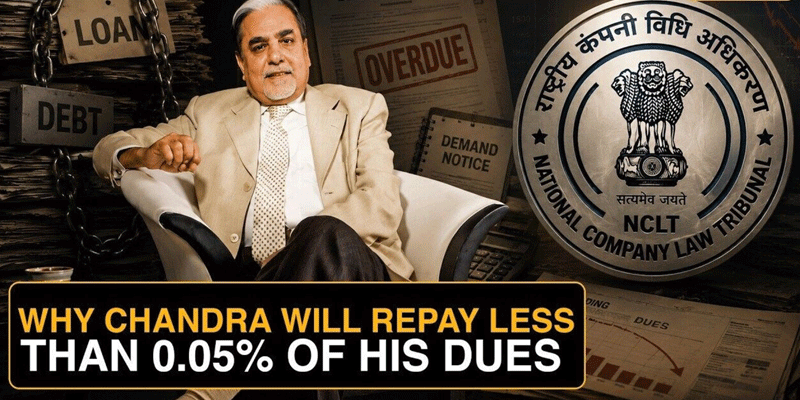
The National Company Law Tribunal’s approval of Subhash Chandra’s personal-insolvency repayment plan has triggered a larger debate over whether the Insolvency and Bankruptcy Code adequately protects creditor voting from conflicts of interest. The plan offers creditors just ₹6.25 crore against admitted claims of ₹22,006.57 crore, with another ₹25 lakh allocated for insolvency costs. That amounts to a recovery of roughly 0.03%, or a 99.97% haircut.
The case is significant not simply because of the extraordinarily low recovery, but because creditors representing a substantial voting share were allowed to participate despite allegations of family and commercial links with Chandra.
What the NCLT Approved
On August 25, NCLT member Nilesh Sharma approved the plan after 80.814% of creditors by voting share supported it. The proceedings began in 2022 after Indiabulls Housing Finance initiated insolvency proceedings against Chandra as a personal guarantor for Essel Group borrowers.
The resolution professional reported that Chandra’s estate contained limited assets of negligible value and could potentially fail even to cover bankruptcy costs. The tribunal therefore accepted the argument that the repayment plan was preferable to liquidation, allowing Chandra to deploy his tangible and intangible resources towards settlement.
The Voting Controversy
The central dispute concerns five creditors—Veena Investments, Direct Media Distribution Ventures, World Crest Advisors, Lemonade Capital Advisors and Corpcall Capital Advisors—which together held 61.78% of the voting power.
Objecting lenders argued that these entities were connected to Chandra through family relationships, Essel Group associations, overlapping directorships or broader commercial links and therefore should have been disqualified from voting.
Veena Investments is controlled by Sushila Devi Goel, wife of Chandra’s younger brother Jawahar Goel, while Direct Media and World Crest are its subsidiaries. Lemonade and Corpcall have also been linked to Essel-related entities through directors and partners. Their votes were ultimately decisive in securing the statutory majority.
The IBC’s Narrow ‘Associate’ Test
The tribunal’s reasoning rests on the wording of the IBC. Section 109(4)(b) prevents an “associate” of a personal guarantor from voting, while Section 79(2)(g) defines an associate largely through ownership and formal control—such as holding more than 50% of share capital or controlling board appointments.
The NCLT found that family connections, commercial proximity or indirect influence could not replace evidence meeting that statutory threshold.
Legally, this approach protects due process. But it raises a policy concern: formal ownership may not always reflect real economic influence.
After HDFC Bank, Union Bank Moves to Challenge
The controversy is now moving towards appellate scrutiny. Union Bank of India’s UK arm is set to challenge the NCLT order before the National Company Law Appellate Tribunal, while HDFC Bank is also considering an appeal. Canara Bank and LIC Housing Finance had opposed the plan.
Chandra, meanwhile, disputes the portrayal of the case as a ₹22,000-crore personal debt write-off, arguing that actual bank exposures and settlements are different and that claims include accumulated interest.
The Bigger IBC Question
The NCLAT will now have an opportunity to clarify whether the existing statutory definition adequately captures indirect influence in personal-guarantor insolvency. If the law recognises only formal control while overlooking material influence, the Chandra case could expose a structural weakness in creditor governance.
The ultimate question is therefore larger than one repayment plan: can the IBC remain credible if technical compliance allows connected interests to determine outcomes that leave ordinary creditors with almost nothing?
(With agency inputs)