Why Trump Is Mulling Fresh Tariffs
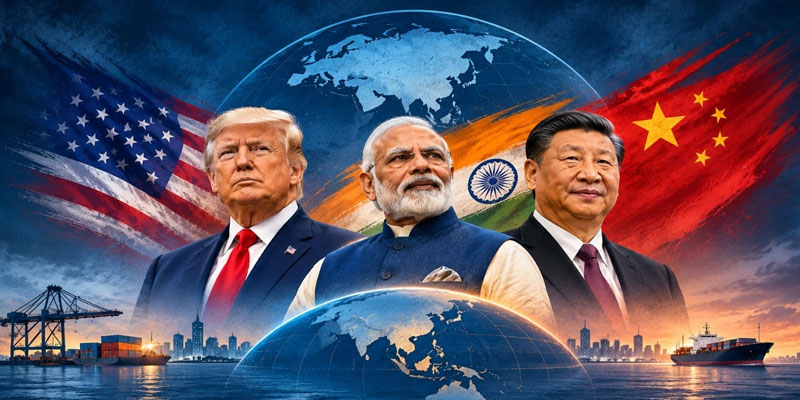
The Trump administration’s renewed tariff push against India, China and the European Union signals Washington’s determination to protect American manufacturing and regain trade leverage. By invoking alleged “structural excess capacity” in foreign economies, the US is preparing to challenge industrial policies it believes enable excessive production and cheaper exports. The move could reshape trade relations, unsettle supply chains and complicate negotiations with key partners.
Section 301 Returns to the Centre
The investigation was launched by the Office of the US Trade Representative (USTR) on March 11, 2026, under Section 301 of the Trade Act of 1974. The provision empowers Washington to respond to foreign practices considered unreasonable, discriminatory, and harmful to American commerce.
The probe covers 16 economies, including India, China, the EU, Japan, South Korea, Vietnam, Mexico and Bangladesh. The US alleges that subsidies, state-backed industrial expansion and production beyond domestic demand create persistent trade surpluses and weaken American manufacturers.
Fresh Tariffs: Rebuilding Washington’s Trade Leverage
According to Reuters, the administration is preparing to release its findings and propose duties on a wide range of imports. The new tariffs could be additional to existing duties, while partly replacing the broad global tariffs invalidated by the US Supreme Court in February.
Possible rates remain uncertain. Reports suggest proposals could range from 15% to 25%, although negotiated tariff ceilings may be respected. The measures are also expected to reinforce Trump’s strategy of using tariffs to secure manufacturing commitments and favourable trade terms.
India’s Rebuttal: Capacity Is Not Unfair Competition
India has firmly rejected the allegations, arguing that manufacturing expansion reflects domestic demand and long-term economic development rather than deliberate export dumping. In its submission, New Delhi asked Washington to close the investigation.
The timing is particularly sensitive as India and the US pursue a bilateral trade agreement. India has already faced additional duties under a separate Section 301 investigation concerning forced-labour import restrictions. Fresh excess-capacity tariffs could further affect machinery, electronics, chemicals, textiles and other export sectors, potentially complicating preferential market access.
China and Europe: Resistance and Uncertainty
China has described the excess-capacity argument as protectionism and warned that it would take necessary measures if its interests were harmed. Beijing argues that industrial capacity must be assessed objectively, not weaponised to restrict trade. The proposed duties could strain the fragile US-China trade truce and invite retaliation.
The EU faces a delicate dilemma. While Brussels shares concerns about Chinese industrial overproduction, it could itself become a target of American tariffs, reviving transatlantic trade tensions.
Tariffs May Protect, but Also Divide
For Washington, the objective is industrial revival and bargaining power. Yet higher duties may increase consumer prices, disrupt supply chains and provoke countermeasures. The decisive question is whether negotiated partners, particularly India, receive exemptions or face uniform treatment. Until final findings and tariff schedules emerge, uncertainty—not merely the tariff rate—remains the greatest concern for global trade.
(With agency inputs)