As the Russia-Ukraine war continues and the broader global security environment becomes more unstable due to the ongoing US-Iran conflict, Ukraine is increasingly positioning itself not just as a recipient of military aid, but also as an emerging exporter of advanced battlefield expertise—particularly in drone warfare.
Ukraine’s Rise as a Drone Power
Over the past two years, drones have become central to Ukraine’s military strategy against Russia. Ukrainian forces have relied extensively on unmanned aerial systems for surveillance, precision strikes, logistics, and counteroffensives, rapidly developing expertise under real combat conditions.
By 2026, Ukraine’s annual drone production reportedly crossed seven million units, ranging from small tactical drones to advanced long-range strike systems. This large-scale battlefield experience has attracted global attention, especially from countries seeking affordable and effective defence technologies amid rising geopolitical tensions.
Zelenskiy’s latest statement reflects how Ukraine is now leveraging this expertise diplomatically, turning military innovation into international partnerships and economic opportunity.
Expanding Global Defence Partnerships
Ukraine has recently signed multiple defence and technology agreements across Europe and the Middle East. In April 2026, Kyiv reached major deals with Germany, Norway, and Netherlands focused on joint drone production, missile cooperation, software integration, and air defence systems.
At the same time, Zelenskiy expanded outreach in the Gulf region. Security and technology partnerships were discussed with Saudi Arabia, Qatar, United Arab Emirates, Bahrain, and Azerbaijan, where concerns over missile threats and asymmetric warfare have increased due to regional instability involving Iran and its proxies.
Ukraine has reportedly deployed specialists abroad to train partner nations in counter-drone systems and battlefield adaptation strategies.
Drone Diplomacy and Energy Security
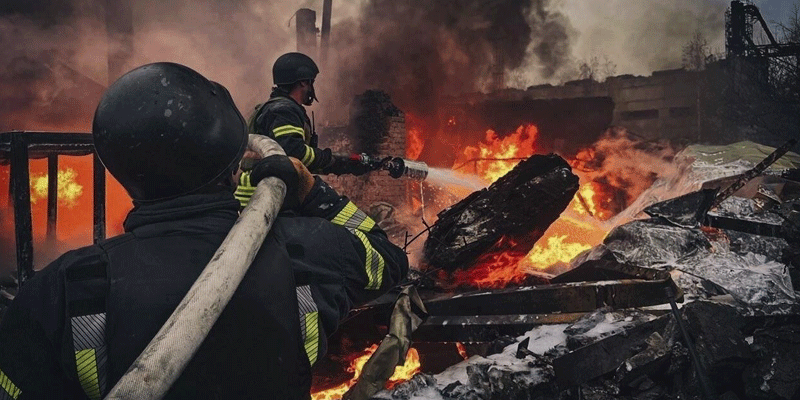
Beyond military cooperation, these agreements also carry major economic and energy implications for Ukraine. Zelenskiy stated that Kyiv is already receiving essential fuel supplies through these strategic partnerships, helping offset damage caused by Russian attacks on energy infrastructure and Black Sea disruptions.
As global oil prices surge due to tensions around the Strait of Hormuz, Ukraine is also seeking alternative energy arrangements with Middle Eastern countries while simultaneously reopening export channels for its agricultural products, especially grain.
This diversification strategy reduces Ukraine’s dependence on Western military assistance at a time when US and European resources are increasingly stretched by multiple global conflicts.
A New Model of Wartime Diplomacy
Ukraine’s “drone diplomacy” represents a significant evolution in modern geopolitics. Instead of relying solely on traditional military alliances, Kyiv is exporting battlefield innovation, defence knowledge, and technological adaptability as strategic assets.
Challenges remain, including concerns about weapons proliferation, production capacity, and long-term sustainability. Yet Ukraine’s success demonstrates how wartime necessity can accelerate technological leadership and reshape diplomatic influence.
Ultimately, Zelenskiy’s strategy reflects a broader transformation: Ukraine is no longer only fighting for survival but also redefining its role in the global defence and security landscape through technology-driven diplomacy.
(With agency inputs)