A Bold Target for a Maturing Partnership
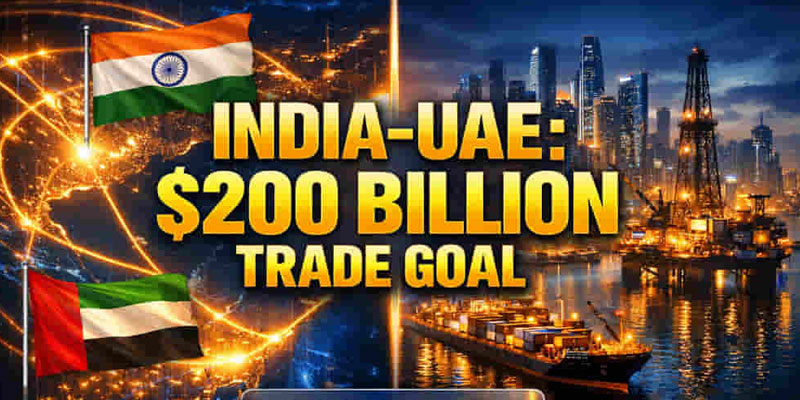
India and the United Arab Emirates have set an ambitious goal of reaching $200 billion in bilateral trade by 2032, signaling a decisive deepening of one of Asia–Middle East’s most dynamic economic relationships. Announced during UAE President Sheikh Mohamed bin Zayed Al Nahyan’s January 2026 visit to New Delhi, the target reflects confidence built on rapid trade growth since the 2022 Comprehensive Economic Partnership Agreement (CEPA) and a shared vision of long-term economic integration.
From Momentum to Scale
Bilateral trade between India and the UAE crossed the $100 billion mark in FY 2024–25, driven largely by non-oil commerce that has expanded at double-digit rates since CEPA came into force. With this momentum as a foundation, Prime Minister Narendra Modi and Sheikh Mohamed agreed that incremental growth would not suffice. Instead, they outlined a structural transformation—anchored in logistics, digital trade, and MSME integration—to double trade volumes within a decade.
Strategic Context: Why the Target Is Achievable
The India–UAE relationship has evolved into a comprehensive strategic partnership, underpinned by investment flows, energy cooperation, and people-to-people ties. The UAE is among India’s top investors and hosts a large Indian diaspora that fuels remittances and business networks. Meanwhile, both countries are diversifying away from traditional dependencies—India from oil-heavy trade baskets and the UAE from hydrocarbons—creating strong alignment for expanding non-oil, services, and technology-driven trade.
Bharat Mart: A Physical Gateway for Indian MSMEs
Bharat Mart, located in Dubai’s Jebel Ali Free Zone, is designed as a permanent commercial bridge for Indian small and medium enterprises. Rather than relying solely on intermediaries, Indian exporters will gain access to dedicated showrooms, warehousing, and light manufacturing facilities in one of the world’s most efficient logistics hubs.
The concept allows global buyers—particularly from West Asia, Africa, and Eurasia—to physically examine Indian products ranging from textiles and gems to engineering goods and agri-exports. Proximity to Jebel Ali Port, Al Maktoum International Airport, and regional rail networks ensures fast onward movement, reducing both costs and delivery times. In effect, Bharat Mart transforms Dubai into an offshore extension of India’s export ecosystem.
Virtual Trade Corridor: Digitising Cross-Border Commerce
Complementing this physical infrastructure is the Virtual Trade Corridor (VTC), a digital platform that integrates customs, payments, and logistics systems of both countries. Built under the CEPA framework, the VTC enables paperless trade by automating documentation, compliance checks, and settlement processes.
For Indian exporters—especially MSMEs—the corridor simplifies cross-border transactions that traditionally involved multiple agencies and delays. Digital payments in local currencies, real-time cargo tracking, and faster customs clearances are expected to cut logistics and transaction costs significantly. By linking Indian trade portals with UAE systems, the VTC creates a seamless digital pathway from factory gate to overseas buyer.
A Template for Next-Generation Trade
The $200 billion trade target is more than a numerical ambition; it represents a shift in how India and the UAE conduct commerce. By pairing Bharat Mart’s physical presence with the Virtual Trade Corridor’s digital efficiency, both countries are building an integrated trade architecture suited to a fragmented global economy. If executed effectively, this model will not only redefine India–UAE economic ties but also offer a blueprint for how emerging economies can collaborate to scale trade beyond traditional limits.
(With agency inputs)