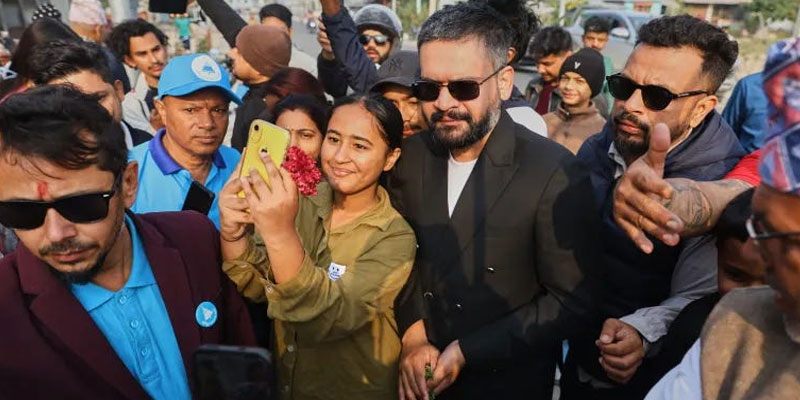
Final Results Confirm Landslide Victory for Balendra Shah
Nepal’s political landscape has undergone a dramatic shift after final results from the March 5, 2026 general elections confirmed a sweeping victory for the Rastriya Swatantra Party (RSP). Led by engineer-turned-musician-
The scale of the victory has stunned traditional parties. The once-dominant Nepali Congress was reduced to a small parliamentary presence, reflecting widespread voter frustration with entrenched political elites. Shah’s meteoric rise represents a generational shift in Nepal’s politics, fueled by a powerful youth movement demanding transparency, economic opportunity and an end to corruption.
Youth Protests and the Rise of a New Political Force
The roots of this political upheaval lie in the massive youth protests that erupted in 2025. Frustration had been building among Nepal’s young population over economic stagnation, corruption scandals and chronic political instability. In less than two decades, Nepal had witnessed more than a dozen governments, leaving many citizens disillusioned with the traditional power structure.
These frustrations erupted into nationwide protests led largely by young voters mobilized through social media platforms. Demonstrations intensified after allegations of corruption in major infrastructure and hydropower projects, eventually forcing the collapse of the coalition government led by KP Sharma Oli.
Balendra Shah, already known for his anti-corruption activism and music criticizing political elites, emerged as a symbol of this uprising. His party capitalized on the public demand for change, promising transparent governance and economic revival.
Shah’s Vision for Economic Renewal
The RSP’s campaign focused heavily on rebuilding Nepal’s economy. The country faces sluggish growth, high youth unemployment and heavy reliance on remittances from citizens working abroad. Shah has pledged to boost job creation through investments in infrastructure, tourism and digital governance.
Hydropower development remains a central pillar of his economic strategy. Nepal possesses immense hydropower potential, and Shah hopes to attract foreign investment while expanding exports to neighboring markets such as India.
At the same time, his government is expected to pursue balanced economic engagement with both India and China, two major powers that exert significant influence in the region.
Key Challenges in Stabilizing Nepal
Despite the overwhelming electoral mandate, Shah faces significant challenges in governing Nepal. One of the most immediate hurdles is the relative inexperience of many RSP lawmakers. As a young party formed only a few years ago, it lacks the administrative and legislative experience that traditional parties accumulated over decades.
Economic pressures present another major obstacle. Nepal’s growth remains modest, while unemployment—especially among youth—continues to rise. Delivering rapid economic improvements will be essential to maintain the support of the very voters who propelled Shah to power.
Political accountability is another sensitive issue. The new government will face calls to investigate the deaths and allegations of excessive force during the protests that preceded the election. Addressing these demands transparently will test Shah’s commitment to reform.
Finally, managing Nepal’s delicate geopolitical balance will be crucial. The country depends heavily on India for trade and energy connectivity, while China offers infrastructure investment through regional initiatives. Navigating these relationships without tilting too far toward either side will require careful diplomacy.
A Mandate for Change, Not Certainty
Balendra Shah’s landslide victory marks a historic turning point in Nepal’s politics. The election reflects a powerful rejection of old political structures and a strong mandate for reform driven by a younger generation.
Yet transforming electoral enthusiasm into effective governance will be the real test. Economic recovery, institutional reform and diplomatic balance will determine whether the “Balen wave” becomes a lasting political transformation or simply another chapter in Nepal’s turbulent political history.
(With agency inputs)