Historic All-Gold Performance Brings Global Recognition
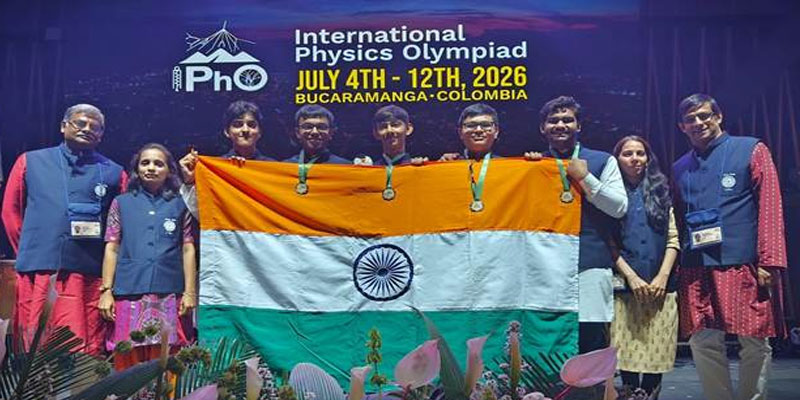
India has scripted one of its finest achievements in international school-level science, with all five members of its contingent winning gold medals at the 56th International Physics Olympiad (IPhO) 2026 in Bucaramanga, Colombia. The remarkable feat placed India jointly at the top of the global standings among 87 participating countries, marking a watershed moment for the country's scientific talent pipeline. Congratulating the team, Prime Minister Narendra Modi described the achievement as a "historic milestone," saying it reflected India's scientific excellence and brought immense pride to the nation.
What is the International Physics Olympiad?
The International Physics Olympiad is among the world's most prestigious and demanding pre-university science competitions. Established in 1967, it brings together the brightest high school students from across the globe to compete in rigorous theoretical and experimental examinations that go far beyond standard school curricula.
The 2026 edition witnessed participation from 381 students representing 87 countries. Competitors are tested on conceptual understanding, advanced mathematical modelling, experimental precision, analytical thinking, and problem-solving abilities under intense time constraints.
India has participated in the Olympiad for several decades and has consistently earned medals, establishing itself as one of the stronger-performing nations. Over the years, Indian students have secured numerous gold, silver, and bronze medals through a highly competitive national selection process. However, an all-gold performance by the entire five-member team, coupled with a joint World No. 1 ranking, ranks among the country's greatest accomplishments in the history of the competition.
A Performance That Reflects Scientific Excellence
The Indian team comprised Kanishk Jain, Riddhesh Anant Bendale, Rishit Garg, Shresth Suraiya, and Svarit Joshi, each of whom secured a gold medal.
Their success reflects the strength of India's structured Olympiad ecosystem. The Homi Bhabha Centre for Science Education (HBCSE), operating under the Tata Institute of Fundamental Research (TIFR) and the Department of Atomic Energy, oversees the country's multi-stage selection, mentoring, and training programme. Students undergo rigorous screening before receiving intensive coaching from leading scientists and educators.
The outcome demonstrates that sustained institutional support, expert mentorship, and scientific curiosity can enable Indian students to compete with—and outperform—the world's best young physicists.
PM Modi's Congratulations and the Larger Significance
Prime Minister Narendra Modi hailed the achievement as a matter of national pride, stating that the students had achieved a historic milestone that showcased India's growing scientific capabilities. His remarks underscored a broader vision of nurturing knowledge-based excellence as the country seeks leadership in advanced technologies.
The accomplishment carries significance beyond medals. India has been investing heavily in research, innovation, semiconductor manufacturing, artificial intelligence, quantum technologies, and space exploration. Outstanding performances in global Olympiads reinforce confidence in the country's future scientific workforce and inspire younger students to pursue careers in science and technology.
Equally important, the success validates India's long-established model of identifying exceptional talent early and providing systematic academic support to help students excel internationally.
Building India's Scientific Future
India's clean sweep at the International Physics Olympiad is more than an exceptional student achievement—it is a testament to the country's growing scientific ecosystem. By combining talent identification, rigorous training, and institutional excellence, India has demonstrated that it can compete at the highest global level in fundamental sciences. As these young achievers represent the next generation of researchers, innovators, and technologists, their success offers both inspiration and evidence that India's long-term investment in scientific education is beginning to yield world-class results.
(With agency inputs)