Iran on Thursday accused the United States of carrying out a "barbaric attack" after a cancer hospital in the country's southwest was evacuated following nearby strikes. Tehran alleged that the attacks endangered hundreds of vulnerable patients and warned that any future US assault on Iranian infrastructure would invite retaliation against critical infrastructure across the region. The latest developments mark another dangerous phase in the rapidly escalating US-Iran confrontation, raising concerns that the conflict could expand beyond military targets to civilian facilities, energy infrastructure and vital shipping corridors across the Gulf.
Rising US-Iran Military Confrontation
Tensions between the United States and Iran have intensified steadily over recent months, with both countries exchanging direct military strikes after years of proxy confrontations. Washington maintains that its latest operations are aimed at degrading Iranian military capabilities allegedly used to threaten international commercial shipping through the Strait of Hormuz, one of the world's most important energy transit routes.
Iran, however, has consistently condemned these strikes as violations of its sovereignty and has vowed to respond proportionately. The confrontation has gradually evolved from strategic deterrence to direct military engagement, significantly increasing the risk of a broader regional conflict involving Gulf states and critical economic infrastructure.
Hospital Evacuation Sparks Humanitarian Concerns
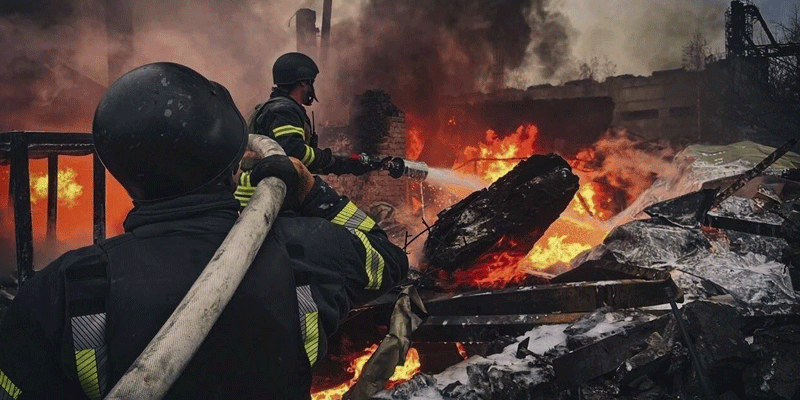
The latest controversy emerged after Iranian state media reported explosions near Ahvaz in southwestern Iran, where a cancer treatment hospital was reportedly affected by nearby strikes.
According to Iranian authorities, 211 chemotherapy patients had to be evacuated from the hospital as a precautionary measure. While the full extent of physical damage to the medical facility remains unclear, Tehran has highlighted the incident as evidence that US military operations are placing civilian lives at risk.
Iranian officials argue that the episode demonstrates how military actions can have severe humanitarian consequences, particularly when essential healthcare institutions are located close to strategic installations.
Iran Issues Strong Warning
Foreign Ministry spokesperson Esmaeil Baqaei described the strikes as "barbaric" and warned that Iran would retaliate if the United States targeted the country's critical infrastructure.
Iranian officials indicated that any future attacks on domestic infrastructure could prompt reciprocal action against regional infrastructure, potentially including energy installations, information technology networks and desalination facilities. Such warnings significantly broaden the scope of possible retaliation, extending beyond conventional military targets to assets essential for civilian life and regional economic stability.
Separate reports also indicate that more than 260 people were injured during the broader wave of attacks across multiple provinces, further intensifying public anxiety and political tensions.
Regional and Global Implications
The latest exchange represents a significant escalation because it introduces humanitarian concerns alongside military calculations. By highlighting the evacuation of cancer patients, Iran is seeking to strengthen international scrutiny of US military operations and reinforce its diplomatic narrative that civilian institutions are increasingly being affected.
At the same time, Tehran's warning regarding regional infrastructure raises concerns for Gulf countries, whose energy facilities, shipping networks and public utilities could become vulnerable if the conflict widens. Given the strategic importance of the Strait of Hormuz for global oil supplies, any disruption could have immediate repercussions for international energy markets, maritime trade and global economic stability.
Escalation Carries Heavy Regional Costs
The latest developments illustrate how the US-Iran confrontation is steadily moving beyond military deterrence into a broader contest with serious humanitarian, economic and geopolitical consequences. As civilian infrastructure and essential public services increasingly enter the conflict narrative, the danger of miscalculation grows substantially. Preventing further escalation will require sustained diplomatic engagement, restraint by all parties and renewed international efforts to prevent a regional crisis that could destabilise not only the Gulf but also global energy security and international commerce.
(With agency inputs)