LIC Hits Four-Month Low After Discounted Stake Sale
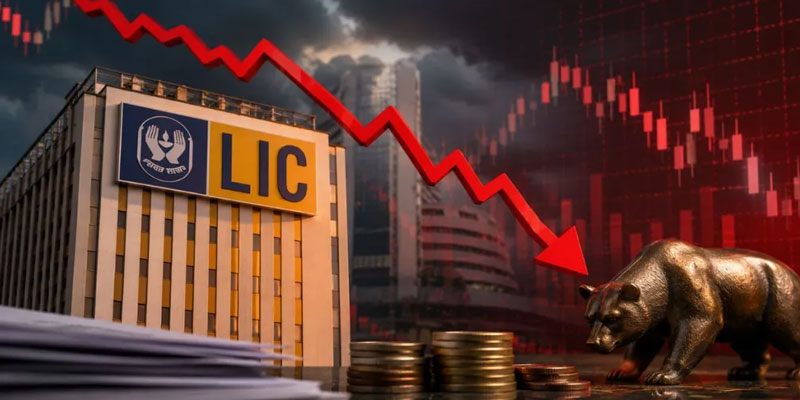
Shares of Life Insurance Corporation of India (LIC) tumbled to their lowest level in nearly four months after the Centre announced a discounted Offer for Sale (OFS) of up to 6.5% of its stake in the insurance giant. The announcement triggered heavy selling on Dalal Street as investors reacted to the lower offer price and the prospect of a large influx of shares into the market. While the immediate market response has been negative, analysts believe the move could ultimately strengthen LIC's market profile by increasing public shareholding, improving liquidity and enhancing institutional participation.
Why the Government Is Selling Its Stake
LIC, India's largest life insurer, was listed on the stock exchanges in May 2022 through one of the country's biggest initial public offerings. However, despite its listing, the government has continued to hold an overwhelming majority stake.
At present, the Centre owns around 96.5% of LIC, leaving public investors with only about 3.5% ownership. The latest stake sale is primarily aimed at helping LIC move closer to the Securities and Exchange Board of India's (SEBI) minimum public shareholding requirement of 25%.
The offer opened for institutional investors on August 4, while retail investors and eligible employees can participate on August 5, with the latter receiving a ₹15-per-share discount.
Why LIC Shares Fell Sharply
The market reacted swiftly because the OFS floor price represented an 11% discount to LIC's previous closing price of ₹428.50.
With investors able to purchase shares at a significantly lower price through the OFS, demand in the secondary market weakened considerably. As a result, LIC shares declined by as much as 9.26% during early trading, touching their lowest level in almost four months.
Market participants also viewed the large government stake sale as creating a temporary supply overhang. The prospect of millions of additional shares entering the market naturally placed downward pressure on prices, with many institutional investors preferring to wait until the final allocation price became clear.
Importantly, analysts stress that the decline does not reflect any sudden deterioration in LIC's core insurance business. Instead, it is largely a technical market reaction driven by pricing and liquidity considerations.
Wider Public Ownership Could Be a Long-Term Positive
Despite the short-term weakness, experts believe the stake sale could benefit LIC over time. If fully subscribed, public ownership would rise to nearly 10%, marking another step towards achieving SEBI's public float requirements.
A broader shareholder base is expected to improve stock liquidity, strengthen price discovery, attract greater domestic and foreign institutional investment and increase analyst coverage. It could also make LIC a more representative constituent of major market indices while reducing concerns over excessive government ownership.
Meanwhile, analysts also see a fiscal dimension to the transaction, with the proceeds expected to support the government's broader financing requirements amid higher global crude oil prices and an expanding import bill.
Short-Term Pain, Long-Term Market Maturity
The sharp fall in LIC's share price reflects immediate market dynamics rather than a deterioration in business fundamentals. As the OFS unfolds, investor response will determine the stock's near-term trajectory. Over the longer term, however, LIC's valuation will depend on sustained operational performance, stronger profitability, improved product mix and greater market-driven governance. If accompanied by these structural improvements, wider public ownership could ultimately transform today's market correction into tomorrow's growth opportunity.
(With agency inputs)