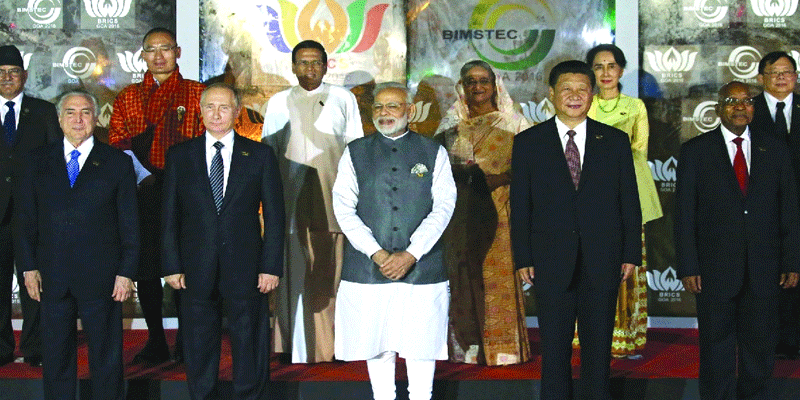
Prime Minister Narendra Modi and Chinese President Xi Jinping are scheduled to meet in New Delhi on Saturday evening on the sidelines of the 18th BRICS Summit, in what could prove to be an important moment for India-China relations. Xi’s first visit to India in seven years comes after a gradual easing of tensions following the 2020 Galwan crisis, making the meeting a closely watched test of whether renewed diplomatic engagement can translate into greater stability, stronger economic cooperation and tangible progress on unresolved security concerns.
From Galwan Crisis to Cautious Engagement
India-China ties suffered their worst setback in decades after the June 2020 Galwan Valley clash, in which 20 Indian and four Chinese soldiers were killed. The confrontation triggered tighter scrutiny of Chinese investments, restrictions on business visas, bans on several Chinese applications and suspension of direct passenger flights.
A disengagement agreement reached in October 2024 subsequently enabled troops to withdraw from several confrontation points, with the remaining positions restored by December. Since then, direct flights have resumed, some visa procedures have eased, the Kailash Mansarovar pilgrimage has restarted and border trade through designated routes has reopened.
Yet the thaw remains fragile. Significant military deployments continue along the Line of Actual Control, while disputes over Arunachal Pradesh and periodic friction underline the absence of a permanent border settlement.
The Border Will Remain Central
For Modi, the principal agenda is likely to be border stability. India has consistently maintained that peace and tranquillity along the frontier are essential for normalising broader relations.
New Delhi is expected to seek stronger mechanisms to prevent patrol confrontations, improve military communication and advance negotiations on boundary management and eventual delimitation. Recent discussions between National Security Adviser Ajit Doval and Chinese Foreign Minister Wang Yi produced an eight-point consensus, creating a framework for further engagement.
Defence concerns will also remain prominent, particularly China’s infrastructure development near the frontier and its close strategic relationship with Pakistan. Beijing, meanwhile, is likely to emphasise strategic stability while resisting what it views as efforts to constrain China’s regional influence.
Trade Offers Opportunity—and Reveals Vulnerability
Economic relations present both an incentive and a challenge. China was India’s largest import source in FY2025-26, supplying approximately $132 billion worth of goods, including crucial components for electronics, infrastructure and manufacturing.
Modi is therefore likely to raise India’s concerns over the substantial trade imbalance, market access, supply-chain reliability and restrictions affecting businesses and professionals. New Delhi has eased some investment restrictions in sectors such as electronics and solar manufacturing, while retaining caution around sensitive areas including telecommunications, finance and defence.
The two leaders could also discuss direct flights, visas, tourism, industrial investment, rare earths and critical technologies.
Why Xi’s Visit Matters Now
Xi’s presence in India carries significance beyond the bilateral meeting. It demonstrates that both sides recognise the economic and strategic costs of prolonged confrontation. For India, stabilising ties with China could allow greater focus on economic growth, manufacturing and wider strategic priorities while managing competition.
However, New Delhi is unlikely to interpret the visit as a complete reset. The border remains unresolved, military deployments continue and economic dependence remains asymmetric.
A Thaw Must Be Measured by Action
The Modi-Xi meeting should therefore be judged by concrete outcomes rather than diplomatic symbolism. A durable relationship requires verified progress along the border, stronger communication mechanisms and the gradual removal of barriers affecting trade and people-to-people ties. India’s objective is not to eliminate competition with China, but to ensure that competition does not again become confrontation.
(With agency inputs)