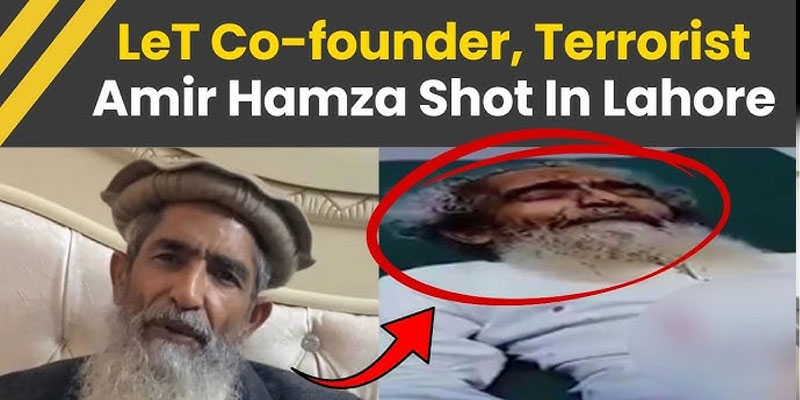
Terrorist Amir Hamza, co-founder of Lashkar-e-Taiba (LeT), was shot by unidentified gunmen outside a news channel office in Lahore on April 15, 2026, in what appears to be a targeted attack. The 67-year-old extremist leader is currently in critical condition, marking the second attempt on his life within a year and triggering intense speculation about the motives behind the assault.
Who is Amir Hamza? A Key Architect of LeT
Amir Hamza is widely regarded as one of the founding pillars of the Lashkar-e-Taiba, established in the mid-1980s alongside Hafiz Saeed. Over the decades, he evolved into one of the organization’s most influential figures, second only to Saeed in ideological and operational importance.
Designated a global terrorist by the United States in 2012, Hamza played a central role in recruitment, fundraising, and propaganda. He was also known for his writings and editorial contributions to extremist publications, helping shape LeT’s ideological narrative and outreach.
Lashkar-e-Taiba: A Persistent Threat
Lashkar-e-Taiba remains one of the most notorious militant organizations in South Asia. Originally focused on Kashmir, it has been linked to major attacks, including the 2008 Mumbai terror attacks, the 2001 Indian Parliament attack, and other incidents targeting Indian interests.
Despite international sanctions and official bans in Pakistan, the group has continued to operate through front organizations such as Jamaat-ud-Dawa and Falah-e-Insaniat Foundation. Its resilience has often been attributed to covert support networks and adaptive strategies, including the use of proxy groups and informal funding channels.
The Attack: Motives and Theories
The shooting took place in Lahore’s Pindi Stop area as Hamza exited a television studio. Gunmen on motorcycles opened fire before fleeing, leaving him critically injured. The absence of an immediate claim of responsibility has fueled multiple theories.
One possibility is internal factionalism within militant networks. Recent years have seen leadership struggles and targeted killings within extremist groups, suggesting fractures in what were once tightly controlled organizations. Another angle points to rival groups such as Tehrik-i-Taliban Pakistan (TTP) or ISIS-K, both of which have clashed with LeT-linked networks.
There is also speculation about covert intelligence operations, though no evidence has surfaced to substantiate such claims. Notably, Hamza had survived a previous attack in May 2025, indicating he may have been under sustained threat.
Broader Implications: Instability Within Militant Networks
The attack highlights growing instability within Pakistan’s militant ecosystem. Increased scrutiny by international bodies and internal crackdowns may be disrupting established networks, leading to infighting and targeted eliminations.
For India, any weakening of LeT leadership could be seen as a strategic development, given the group’s history of cross-border terrorism. However, such incidents also carry risks—leadership vacuums can trigger splintering, with smaller factions potentially becoming more unpredictable and aggressive.
At a regional level, the incident underscores the fragile security environment in South Asia, where militant groups, state responses, and geopolitical tensions remain deeply intertwined.
A Turning Point or Prelude to More Violence?
The shooting of Amir Hamza may signal a significant shift within the militant landscape, but its long-term impact remains uncertain. Whether it leads to the weakening of Lashkar-e-Taiba or sparks further instability will depend on how internal dynamics unfold. For now, the attack serves as a stark reminder that even entrenched extremist networks are not immune to disruption—yet such disruptions often come with new and unpredictable risks for regional security.
(With agency inputs)