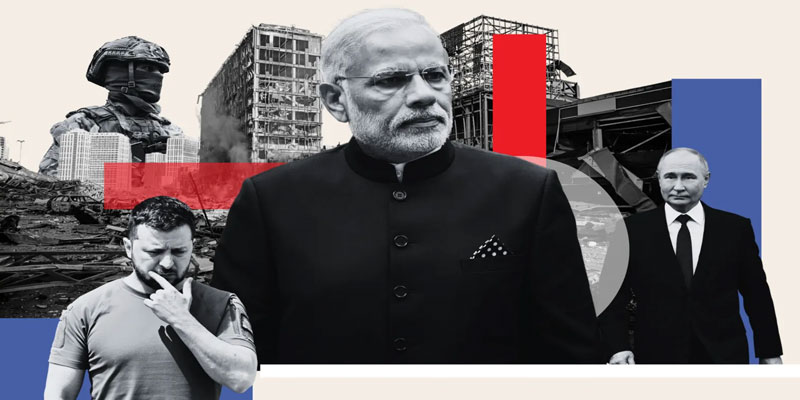
A Message of Restraint Amid a Turbulent Global Landscape
As wars and geopolitical tensions intensify across regions, India has reiterated its preference for diplomacy over confrontation. Prime Minister Narendra Modi on March 5, 2026, declared that “military conflict can’t fix any issue,” calling for dialogue, adherence to international law, and diplomatic engagement to resolve global disputes.
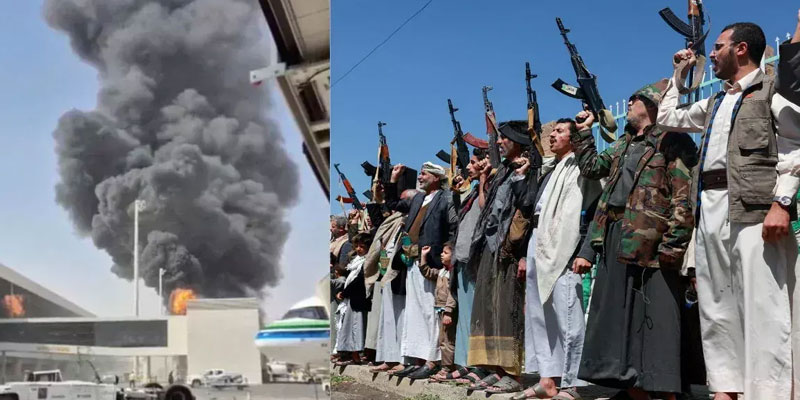
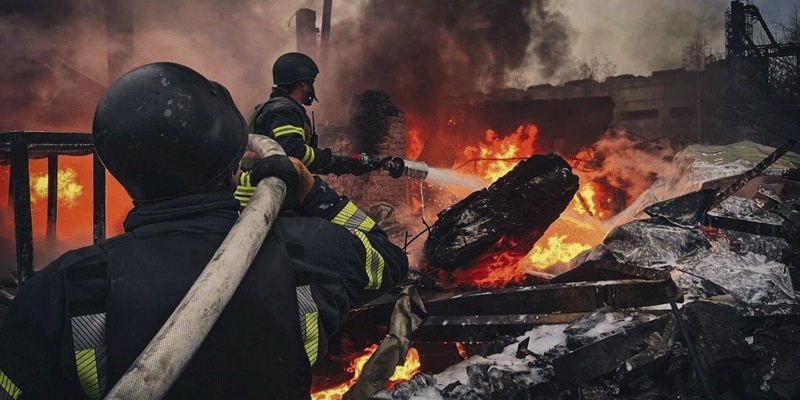
The remark came during a joint press conference with Finland’s President Alexander Stubb, as both countries announced the elevation of their bilateral relationship to a Strategic Partnership in Digitalisation and Sustainability. Modi’s statement arrives at a time when the war between the United States and Iran is intensifying across West Asia, adding to ongoing hostilities in Ukraine and further straining global stability.
Modi’s Call for Dialogue Over War
During the press interaction, Modi stressed that conflicts—whether in Ukraine or West Asia—cannot be resolved solely through military action. He emphasized that nations must rely on the rule of law, diplomatic negotiations, and multilateral cooperation.
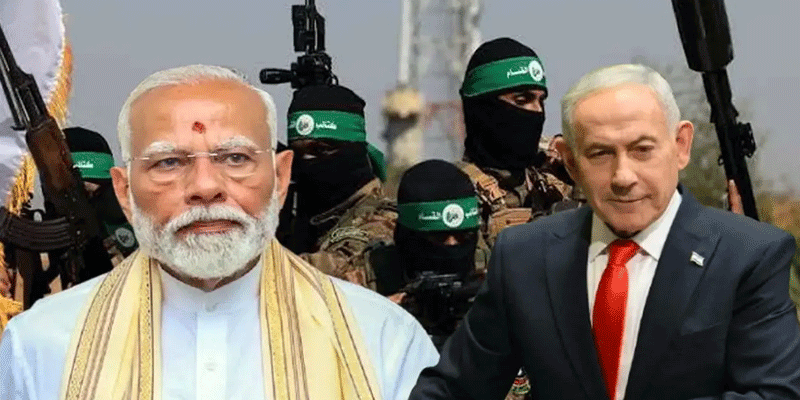
The statement carries significance as tensions in West Asia continue to escalate following US–Israel strikes that reportedly killed Iran’s supreme leader Ali Khamenei and resulted in more than a thousand Iranian casualties. Tehran has retaliated with missile strikes and naval confrontations in the Indian Ocean, raising fears of a wider regional conflict.
India’s stance has consistently centered on civilian protection, restraint, and dialogue. By avoiding direct alignment with any side in the conflict, New Delhi is attempting to maintain strategic balance while advocating de-escalation.
India–Finland Strategic Partnership: A New Chapter
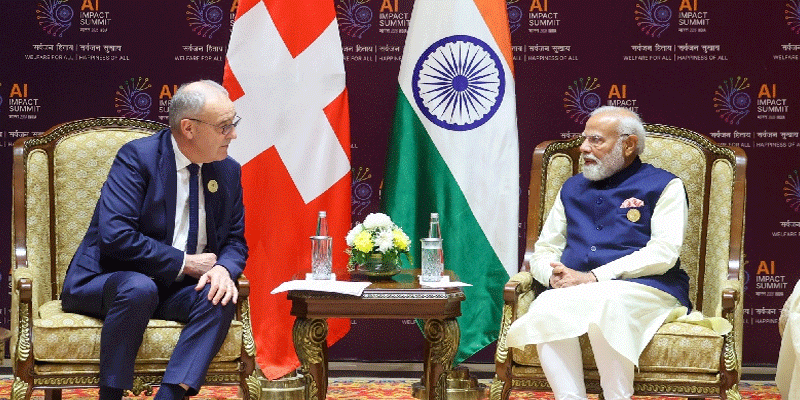
While emphasizing peace in global affairs, India and Finland simultaneously strengthened bilateral cooperation by upgrading ties to a Strategic Partnership in Digitalisation and Sustainability. The agreement expands collaboration in emerging technologies and sustainable development.
Key areas of cooperation include artificial intelligence, quantum computing, 6G telecommunications, cybersecurity, and clean energy. The partnership will also extend into sectors such as defence, space technology, semiconductors, and critical minerals—areas seen as crucial for technological self-reliance and future economic growth.
Both countries signed multiple memorandums of understanding to facilitate research collaboration, industry partnerships, and academic exchanges. With bilateral trade already exceeding $4 billion, leaders expressed optimism that deeper technology cooperation could push trade to $10 billion by 2030.
Strategic Context Behind the Partnership
The India–Finland partnership reflects a broader geopolitical recalibration. Europe is increasingly looking to diversify its technology and economic partnerships beyond traditional alliances, while India seeks to strengthen ties with democratic and innovation-driven economies.
For New Delhi, deeper engagement with Nordic countries helps counterbalance China’s influence in high-tech sectors and reinforces India’s ambitions to become a global technology hub. Cooperation in clean energy and sustainability also supports India’s long-term climate commitments and net-zero goals.
The timing is equally important. With global energy markets under pressure due to the West Asia conflict and shipping disruptions around the Strait of Hormuz, partnerships focused on innovation and green energy gain strategic significance.
India’s Multi-Alignment Strategy
Modi’s remarks and the Finland partnership highlight India’s broader diplomatic approach—often described as multi-alignment. New Delhi maintains strategic cooperation with diverse partners, including the United States in defence and technology, Russia in security and energy, and Iran in connectivity projects such as the Chabahar Port.
At the same time, India coordinates with Quad partners in the Indo-Pacific while maintaining strong ties with European economies. This approach allows India to navigate complex geopolitical rivalries without being locked into rigid alliances.
Diplomacy as India’s Strategic Compass
In a world marked by escalating conflicts and economic uncertainty, India’s emphasis on dialogue and diplomacy underscores its aspiration to play a stabilizing role in global affairs. Modi’s assertion that military force cannot resolve complex disputes reflects a broader call for reforming international institutions and strengthening multilateral engagement.
At the same time, the India–Finland strategic partnership demonstrates how countries can advance cooperation in technology, sustainability, and innovation even amid geopolitical turmoil. Together, these moves signal New Delhi’s attempt to balance peace advocacy with pragmatic partnerships—positioning India as both a diplomatic voice for restraint and a key player in shaping the future global order.
(With agency inputs)