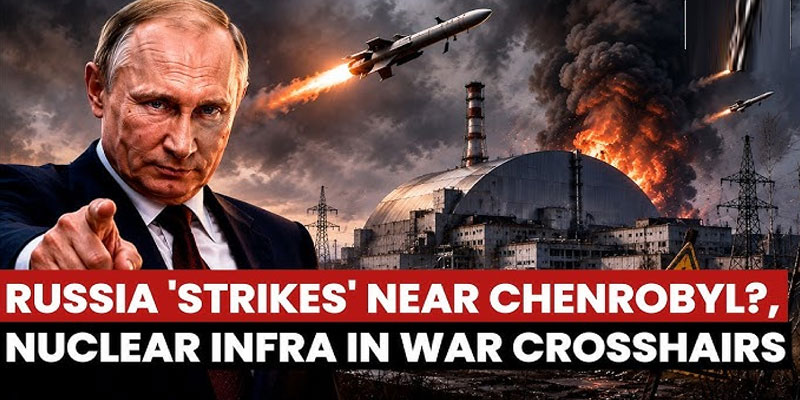
A Russian drone strike on a nuclear-fuel storage facility near Chornobyl has once again heightened fears over nuclear safety in wartime Ukraine. Ukrainian authorities said the attack occurred early on June 7, targeting infrastructure linked to the Centralized Spent Nuclear Fuel Storage Facility inside the Chornobyl Exclusion Zone. While no radiation leak was reported and no injuries occurred, the incident has renewed international concern over repeated attacks near sensitive nuclear sites during the ongoing conflict.
Attack Near Chornobyl Raises Global Concern
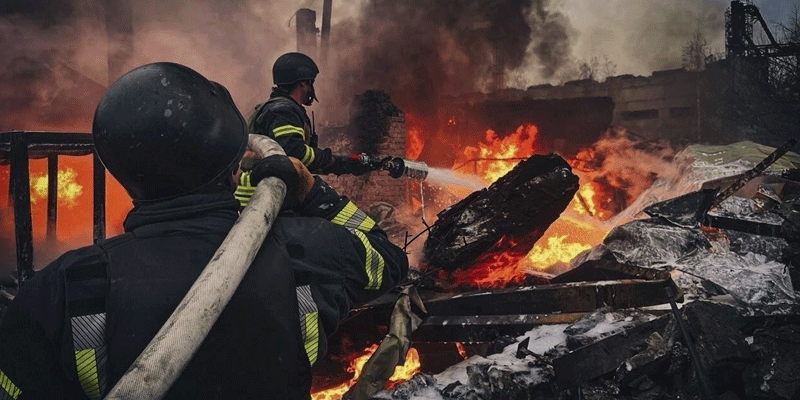
According to Ukraine’s state atomic agency Energoatom, the drone struck a fuel-reception building located roughly 15 kilometers from the Chornobyl nuclear power plant. The building suffered major structural damage, and a fire covering around 40 square meters broke out before emergency crews extinguished it.
Crucially, officials confirmed that no spent nuclear fuel was stored inside the facility at the time of the attack, preventing what could have become a serious radiological disaster. Radiation monitoring systems recorded no increase beyond normal safety limits.
The International Atomic Energy Agency (IAEA), which was briefed by Ukrainian authorities, also confirmed that radiation levels remained stable following the strike. Greenpeace Ukraine similarly stated that no dangerous radiation spike had been detected.
Chornobyl’s Sensitive Legacy
The strike carries enormous symbolic and geopolitical significance because it occurred near the site of the world’s worst nuclear disaster. In April 1986, Reactor 4 at the Chornobyl Nuclear Power Plant exploded during a safety test, releasing radioactive material across large parts of Europe and forcing mass evacuations.
Since Russia’s invasion of Ukraine in 2022, concerns over nuclear safety have repeatedly intensified. The Chornobyl Exclusion Zone and the Zaporizhzhia Nuclear Power Plant — Europe’s largest nuclear facility — have become dangerous flashpoints amid military operations.
This is not the first reported attack near Chornobyl. In February 2025, a Russian Shahed drone reportedly damaged the New Safe Confinement structure built over Reactor 4 to contain radioactive material from the 1986 disaster. The IAEA later confirmed that the protective barrier had been compromised. Russia denied involvement in that incident as well.
Ukraine Accuses Russia of Escalation
Ukrainian President Volodymyr Zelenskyy strongly condemned the latest strike, calling it “extremely vile” and “exceptionally cowardly.” He accused Moscow of deliberately targeting critical nuclear infrastructure and warned that Russia had crossed a “dangerous line.”
Ukraine argues that repeated attacks near nuclear facilities increase the risk of a catastrophe, even if immediate radiation leaks are avoided. Kyiv also claims Russia has obstructed independent monitoring efforts around occupied nuclear sites, particularly at Zaporizhzhia.
Russia Rejects Responsibility
Moscow has denied responsibility for the Chornobyl strike, repeating earlier claims that Ukraine fabricates such incidents to influence international opinion and disrupt peace negotiations. Russian officials have consistently rejected accusations of targeting nuclear infrastructure.
Meanwhile, tensions around the Zaporizhzhia plant continue to escalate, with both sides accusing each other of shelling the area. The facility has reportedly suffered repeated disruptions to external power supply in recent days, adding to fears of a wider nuclear safety crisis.
Growing Risks Around Nuclear Sites in Wartime Ukraine
Although the latest drone strike did not trigger a radiological emergency, it highlights the growing danger surrounding nuclear infrastructure in wartime Ukraine. The repeated targeting of sites linked to Chornobyl and ongoing tensions at Zaporizhzhia underscore how fragile nuclear safety has become amid the conflict. Even without immediate contamination, every strike near such facilities raises the risk of a disaster with consequences far beyond Ukraine’s borders.
(With agency inputs)