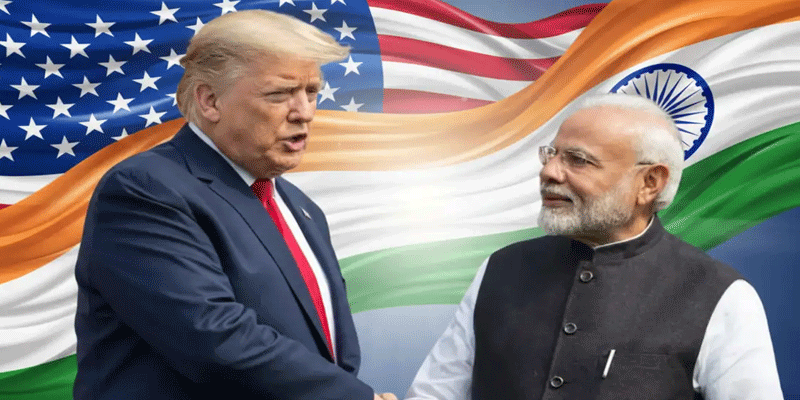
The Trump administration has proposed imposing additional tariffs of up to 12.5 per cent on imports from 60 economies, including India, alleging that these countries have not done enough to prevent the import and trade of goods produced through forced labour. The move, announced by the Office of the United States Trade Representative (USTR), marks a revival of Section 301 trade enforcement measures and introduces a new layer of uncertainty into ongoing negotiations for a broader India–US trade agreement.
Coming at a time when both countries are attempting to deepen economic engagement, the proposal has triggered concerns about its potential impact on bilateral trade and global supply chains.
Understanding the Proposal
The proposed duties have been initiated under Section 301 of the US Trade Act of 1974, a provision that allows Washington to investigate and respond to trade practices it considers unfair or harmful to American interests.
Under the latest proposal, countries have been divided into two categories. India is among a group of 54 economies that could face an additional tariff of 12.5 per cent on exports to the United States. Other countries in this category include China, Japan, South Korea, Brazil and Switzerland.
According to the USTR, the higher tariff category applies to countries that have neither implemented nor effectively enforced restrictions on imports linked to forced labour practices.
Why Is India on the List?
The central issue raised by the USTR is the absence of what it considers adequate mechanisms to prohibit and enforce restrictions on goods associated with forced labour.
Washington argues that stronger measures are needed to ensure that products entering international supply chains are not linked to exploitative labour practices. The proposal is part of a broader US effort to tighten scrutiny of supply chains and strengthen labour-related trade standards.
India, however, has emphasized that the proposal is not final and remains subject to a public consultation process. The Commerce Ministry has stated that New Delhi continues to engage with US authorities and remains committed to ongoing discussions regarding the broader trade framework.
A Sensitive Moment in India–US Relations
The timing of the proposal is particularly significant.
Over the past several months, India and the United States have been engaged in intensive negotiations aimed at resolving longstanding trade disputes and building a more comprehensive economic partnership. Recent discussions had fuelled optimism about progress toward a wider trade pact that could reduce barriers and expand market access for businesses on both sides.
The new tariff proposal risks complicating those efforts. While the consultation process leaves room for revisions, it introduces uncertainty for exporters and investors at a crucial stage of negotiations.
The development also reflects a broader trend in US trade policy, where labour standards, supply-chain transparency and strategic economic considerations are increasingly influencing tariff decisions.
Potential Impact on Indian Exports
If implemented in its current form, the proposed 12.5 per cent tariff could affect a wide range of Indian exports to the United States, India’s largest export destination.
Higher tariffs would increase costs for American importers and could reduce the competitiveness of Indian goods in sectors ranging from manufacturing and engineering products to consumer goods and textiles.
However, the consultation process provides an opportunity for affected countries, including India, to present their views. Written submissions can be made until July 6, while public hearings are scheduled for July 7 in Washington.
Negotiation or New Trade Friction?
The proposed tariffs underscore the increasingly complex intersection of trade policy, labour standards and geopolitical strategy. While the Trump administration frames the measures as an effort to combat forced labour and strengthen ethical supply chains, affected countries view them through the lens of market access and economic competitiveness.
For India, the coming weeks will be critical. The challenge will be to safeguard its export interests while advancing negotiations on a broader trade agreement with the United States. Whether the proposal evolves into a new source of trade friction or becomes a bargaining point in a larger economic settlement will depend on the outcome of consultations and the willingness of both sides to find common ground.
(With agency inputs)