A Bigger House, A New Mandate
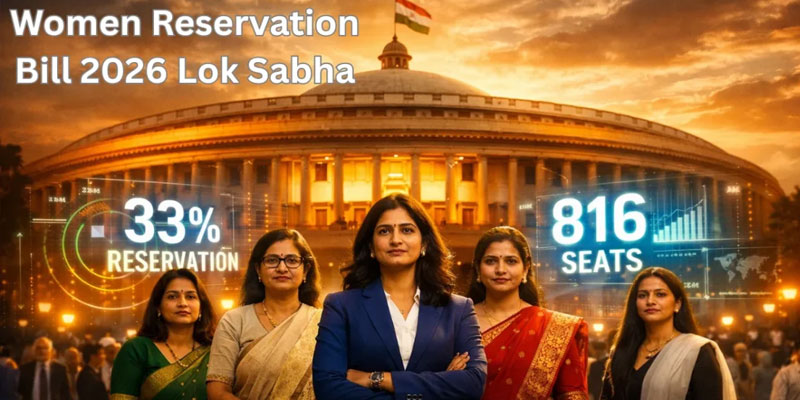
India’s lower house, the Lok Sabha, may soon expand dramatically from 543 to 816 seats, alongside the implementation of a 33% reservation for women. The proposal, linked to the Nari Shakti Vandan Adhiniyam, would reserve around 273 seats for women, marking a major shift in parliamentary representation. The move is being positioned as a way to fast-track women’s participation in politics while simultaneously recalibrating representation across states.
The Logic Behind Expansion
The proposed expansion is not just about numbers—it reflects an attempt to address both representation gaps and political bottlenecks. By increasing seats proportionally for all states, the government aims to avoid skewing the federal balance while accommodating population growth.
Large states such as Uttar Pradesh, Bihar, Maharashtra, and West Bengal are expected to see significant increases in their seat counts, while southern states like Tamil Nadu, Karnataka, Kerala, and Andhra Pradesh would also gain seats in proportion to their current share. This proportional approach is intended to counter earlier fears that delimitation would disproportionately favour northern states.
At the same time, the expansion provides a practical pathway to implement the long-pending women’s quota without displacing existing political actors. By enlarging the House, the system can accommodate new entrants while maintaining continuity in representation.
Political Reactions: Support, Caution, and Contestation
The proposal has triggered a mix of support and skepticism across the political spectrum. The ruling Bharatiya Janata Party and its NDA allies have broadly welcomed the move, framing it as a historic reform that combines gender justice with enhanced representation. They argue that a larger House will amplify regional voices while ensuring that women achieve a critical mass in Parliament.
Regional parties, particularly from southern states, have expressed unease. Despite assurances of proportional increases, leaders in Tamil Nadu and parts of Andhra Pradesh remain wary of a potential long-term shift in political weight toward the north. Their concerns are rooted in earlier debates over delimitation, where population-based redistribution was seen as disadvantaging states that had successfully controlled population growth.
Federal Balance and Representation Debate
At its core, the proposal revives a long-standing tension between demographic representation and federal equity. While expanding the Lok Sabha could make representation more reflective of current population realities, it also risks altering the political balance between regions.
The inclusion of a 33% women’s quota, however, enjoys near-universal support, cutting across party lines. The real contest lies in how the expansion is implemented—particularly the timing of delimitation, the census base used, and safeguards for smaller or slower-growing states.
Reform with Far-Reaching Implications
The proposed 816-seat Lok Sabha represents a bold attempt to modernize India’s parliamentary structure while advancing gender inclusion. Yet, its success will depend on careful calibration of political and federal sensitivities. If managed well, it could redefine representation for a new era; if not, it risks deepening regional divides. The challenge lies in ensuring that expansion strengthens democracy without unsettling its delicate balance.
(With agency inputs)