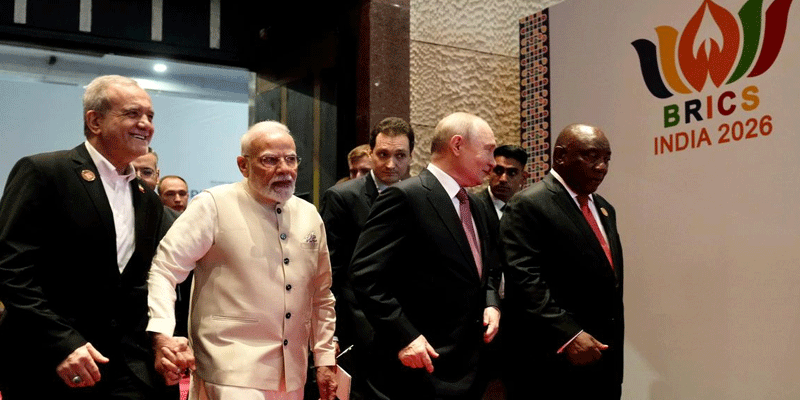
BRICS Summit Delhi Declaration adopted as Modi seeks tangible outcomes marks an important diplomatic achievement for India as chair of the expanded grouping. Prime Minister Narendra Modi has urged members to move beyond declarations and translate their collective decisions into “tangible results”, highlighting the need for BRICS to demonstrate practical relevance in a rapidly changing global order.
Delhi Declaration Signals Consensus Amid Differences
The adoption of the Delhi Declaration at the 18th BRICS Summit provides India with an immediate outcome from its presidency. Negotiations were particularly significant because members hold divergent positions on global conflicts, sanctions, multilateralism and the evolving international system. The effort to reach common language without deepening internal divisions underlines the bloc’s continuing emphasis on consensus.
The declaration is therefore more than a diplomatic document. Its significance will ultimately depend on whether its commitments can be converted into measurable cooperation among members.
India’s Presidency Sets a Practical Agenda
India is chairing BRICS in 2026 under the theme “Building for Resilience, Innovation, Cooperation and Sustainability.” This reflects New Delhi’s attempt to give the grouping a more practical orientation, with emphasis on trade, development finance, digital technology, resilient supply chains, healthcare, food and energy security.
Founded in 2006 by Brazil, Russia, India and China, BRICS has expanded to 11 members: Brazil, Russia, India, China, South Africa, Egypt, Ethiopia, Iran, Indonesia, Saudi Arabia and the United Arab Emirates. The enlarged grouping now represents nearly half of the world’s population and around 40% of global GDP, giving it substantial economic and geopolitical weight.
However, greater membership also means greater complexity. Differences over relations with Western powers, sanctions, Ukraine, West Asian conflicts and reforms to global financial institutions can make consensus more difficult.
A Summit Carrying Considerable Diplomatic Weight
The New Delhi gathering has brought together prominent leaders from across Asia, Africa, the Middle East and beyond. Iranian President Masoud Pezeshkian, South African President Cyril Ramaphosa, Malaysian Prime Minister Anwar Ibrahim, Indonesian President Prabowo Subianto, Ethiopian Prime Minister Abiy Ahmed Ali and Egyptian President Abdel Fattah el-Sisi are among the participating leaders.
Chinese President Xi Jinping and Russian President Vladimir Putin add particular strategic significance. Xi’s presence provides an opportunity for India-China engagement, while Putin’s participation reinforces discussions around energy, security and geopolitics.
The presence of UN Secretary-General Antonio Guterres and senior leaders from the WTO, WHO, New Development Bank and Asian Infrastructure Investment Bank further broadens the summit’s institutional significance.
From Political Consensus to Practical Cooperation
Modi’s emphasis on tangible outcomes addresses BRICS’ biggest credibility challenge: ensuring that repeated declarations produce visible results. India has promoted cooperation on cross-border payment interoperability, resilient logistics, start-ups, artificial intelligence, development finance and supply-chain security.
Alternative payment mechanisms could become particularly important. Rather than immediately pursuing a common BRICS currency, members can focus on local-currency settlements and interoperable digital-payment systems to facilitate trade and reduce vulnerability to financial restrictions.
The New Development Bank can potentially provide financing for infrastructure and climate-resilience projects, although regulatory differences, currency issues and divergent national priorities could constrain implementation.
The Real Test Begins After Delhi
The Delhi Declaration gives India a valuable diplomatic accomplishment, but its lasting importance will depend on delivery. For BRICS, credibility will increasingly be measured not by the number of declarations it adopts, but by the projects it completes. India’s presidency has the opportunity to turn the bloc’s expanding political weight into practical mechanisms for trade, technology, development and global governance.
(With agency inputs)