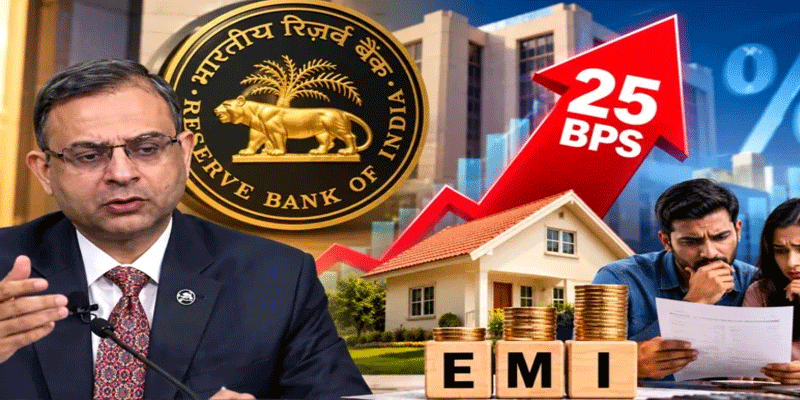
India’s ambitious Goods and Services Tax (GST) reform has begun to reshape the economy’s inflation trajectory, with consumer prices projected to touch multi-year lows. Against this backdrop, the Reserve Bank of India (RBI) faces a pivotal decision. With inflation sliding and trade relations with the United States improving, market watchers suggest the central bank may seize the moment to cut interest rates in September, reinforcing its position as a forward-looking monetary authority.
Inflation Trends at Historic Lows
According to an SBI research note led by Group Chief Economic Advisor Dr. Soumya Kanti Ghosh, consumer price index (CPI) inflation could dip another 65–75 basis points, largely due to GST rationalization. This would bring October’s CPI figure closer to 1.1%—the lowest level since 2004.
Ghosh further observed that inflation is likely to remain subdued well into FY27, staying below 2% during September and October even without additional GST rate cuts. With the introduction of a new CPI series, analysts anticipate another 20–30 basis point drop, suggesting prices may linger at the bottom end of the RBI’s mandated inflation band of 4% ± 2%.
Recent Monetary Policy Context
The Monetary Policy Committee (MPC), which convenes from September 29 to October 1, has been balancing growth needs with price stability. Following a sharp rate cut earlier this year, the RBI chose to maintain the repo rate at 5.50% during its August review.
The current economic landscape, however, offers fresh impetus for further easing. SBI’s report argues that the risks of delaying action outweigh the dangers of moving early. Drawing from the 2019 experience, when a rate cut contributed to a 35-basis point decline in inflation within months, the case for decisive policy intervention appears strong.
For policymakers, timing is everything. Ghosh argues that the RBI risks committing a “Type 2 mistake” if it refrains from cutting rates in September—essentially missing an opportunity to act when conditions are clearly favourable. With inflation entrenched at the lower bound and demand still seeking momentum, a rate cut could reinforce economic confidence and lend stability to investment planning.
Yet, the move is not without challenges. Since the RBI already frontloaded an aggressive cut earlier this year, expectations for back-to-back easing are naturally high. This means the central bank must weigh credibility and caution against the urgency of capitalizing on the current disinflationary window.
The potential September cut would resonate beyond inflation management. It could signal the RBI’s confidence in structural reforms like GST and its willingness to adapt proactively. Lower borrowing costs could stimulate consumption and business investment at a time when India is working to consolidate trade ties with the U.S. and sustain its growth momentum.
At the same time, persistently low inflation could raise questions about demand strength in the economy. Policymakers will therefore need to calibrate carefully, ensuring that monetary easing complements broader fiscal and structural measures rather than substituting for them.
Balancing Prudence with Vision
The convergence of record-low inflation, GST-driven reforms, and stable global trade dynamics provides a rare opening for the RBI. A timely September rate cut could not only reduce financing costs but also establish the central bank as an agile, visionary institution attuned to the economy’s evolving needs.
While caution is warranted, inaction risks letting a historic opportunity slip by. If managed well, a rate cut now could serve as the foundation for sustained growth, stable prices, and renewed investor confidence in the years ahead.
(With agency inputs)