The reported Houthi seizure of Yemen’s strategic port city of Mocha and subsequent advance towards the Hanish Islands marks a major escalation in the struggle for control of the Red Sea. The development brings the Iran-aligned movement closer to the Bab el-Mandeb Strait, a crucial maritime gateway between the Red Sea and Gulf of Aden, raising fresh concerns over Saudi oil exports, global shipping and already strained energy markets.
From Yemen Conflict to Maritime Confrontation
Yemen’s conflict began as a domestic power struggle but has increasingly become intertwined with the wider rivalry between Iran, Saudi Arabia and the United States. The Houthis control much of northern Yemen, while internationally recognised government forces have been backed by Saudi Arabia and other regional partners.
The latest offensive represents a significant shift because it pushes the Houthis deeper into Yemen’s western coastline. The group seized Mocha after intense fighting and government-aligned forces withdrew southwards to regroup. Houthi forces have also moved towards the strategic Hanish Islands, while fighting has spread across several Yemeni fronts.
Mocha Opens a Path Towards Bab el-Mandeb
Mocha’s importance extends far beyond Yemen. Located roughly 75 kilometres north of Bab el-Mandeb, the port sits close to one of the world’s most consequential shipping chokepoints. Bab el-Mandeb connects the Red Sea with the Gulf of Aden and provides a critical route for vessels travelling between the energy-producing Gulf region, the Suez Canal and European markets.
Control over Mocha and nearby islands could therefore give the Houthis greater military leverage over maritime traffic. The Hanish Islands, together with positions around Dhubab and Perim, could strengthen their ability to monitor or threaten vessels approaching the strait.
The Houthis have said navigation remains safe for shipping companies except Saudi vessels, portraying their operations as directed against Saudi Arabia rather than international commerce. That distinction, however, offers little comfort to energy markets because uncertainty alone can increase insurance, freight and security costs.
Saudi Oil Faces a Second Maritime Vulnerability
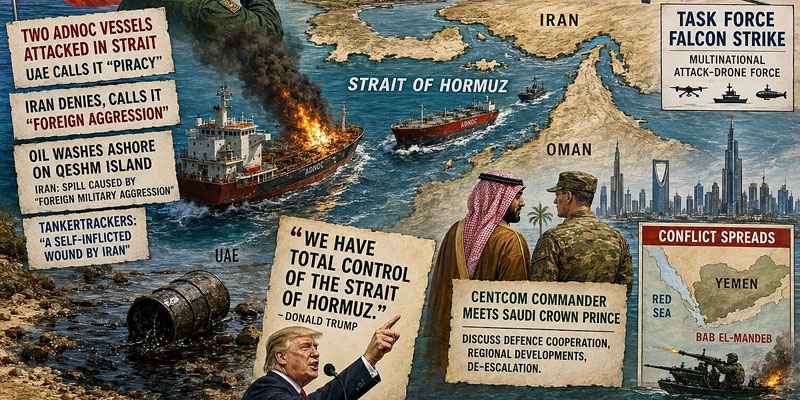
The timing is particularly significant. Disruption around the Strait of Hormuz has already placed enormous pressure on global energy supplies. Saudi Arabia has consequently depended more heavily on Red Sea routes to move oil towards international markets.
A sustained Houthi campaign against Saudi-linked shipping could therefore create a dangerous second bottleneck. Reuters reported that Brent crude moved above $105 a barrel amid concerns over the escalating threat, demonstrating how quickly geopolitical risk is being incorporated into energy prices.
For India, prolonged disruption would be particularly consequential. As a major crude importer and an important user of the Red Sea-Suez corridor, India could face higher freight and insurance costs, costlier energy imports and renewed inflationary pressure.
Iran-Saudi Rivalry Deepens
The escalation also carries a broader geopolitical dimension. Saudi Arabia has accused Iran of supporting the Houthis, while Tehran denies directly controlling the movement. Reuters reported that sources alleged Iranian Revolutionary Guard assistance and guidance during the coastal advance.
The United Nations has warned that the development represents a more dangerous phase of Yemen’s conflict. The concern is that the country could once again become a major regional battlefield rather than remaining primarily a civil conflict.
A Chokepoint Battle with Global Consequences
The capture of Mocha does not automatically mean that Bab el-Mandeb will be closed. But it gives the Houthis a stronger geographical position from which to threaten or disrupt maritime traffic.
The central danger is therefore not merely the loss of another Yemeni city. If Mocha becomes the launchpad for sustained pressure on Bab el-Mandeb, the world could face simultaneous vulnerabilities at two critical energy gateways—Hormuz and the Red Sea. That would transform Yemen’s latest battlefield advance into a direct challenge to global energy security, trade and economic stability.
(With agency inputs)